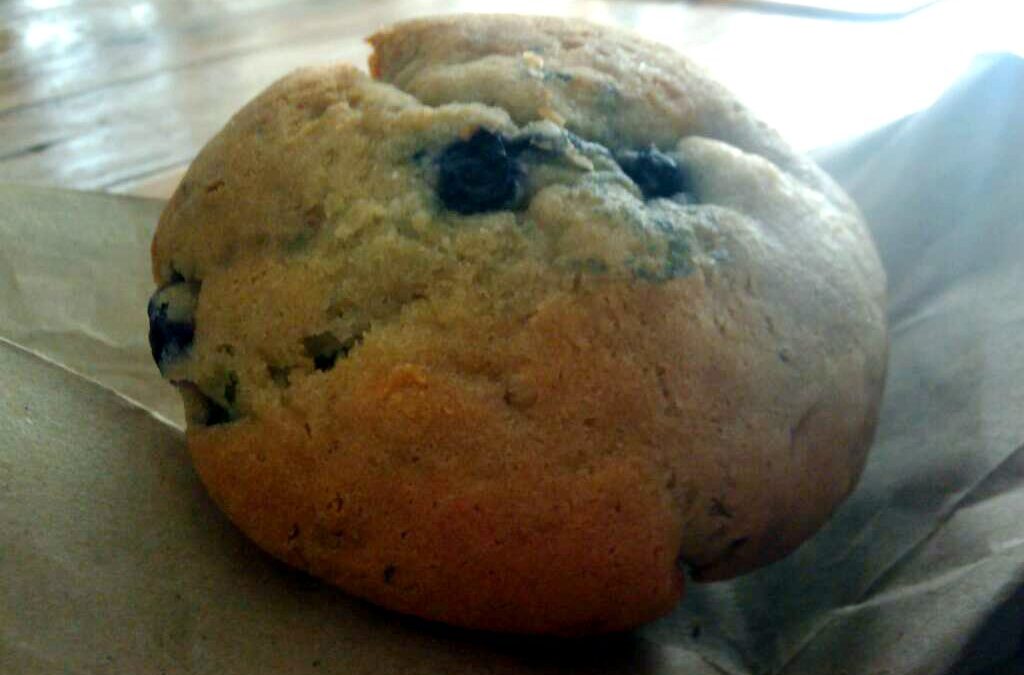
Blueberry muffins fail in about five specific ways, and every one of them is fixable at a step you can name. I know this because I’ve hit all five, usually on a Saturday morning with people waiting.
Here they are in the order they tend to happen, with what’s actually causing each one. The recipe is below all of it, and it already has the fixes built in.
Problem One: Every Berry Sinks to the Bottom
You cut one open and there’s a purple stripe along the base and a plain sponge cap above it.
The cause is batter viscosity, not the berries. Blueberries are denser than a thin batter, so they descend while the crumb is still liquid, which lasts a good 6 to 8 minutes into the bake. A batter loose enough to pour smoothly from the bowl will let them fall.
Two fixes, and you want both. Toss the berries in a teaspoon of flour, which gives their wet skins something to grip. And keep the batter thick, which is what the half cup of sour cream is doing in the ingredient list. It should drop off the spatula in heavy lumps, not ribbon off it.
The trick I actually rely on: hold back about 15 berries and press them into the tops after filling the cups. Whatever happens underneath, the top three are staying visible.
Problem Two: Grey-Purple Streaks Through the Crumb
This one is almost always frozen berries, and almost always the fold.
Frozen blueberries carry a coating of ice crystals with pigment dissolved in them, and the moment that meets batter it bleeds. Rinse them under cold running water in a sieve until the water coming off runs pale rather than deep purple, then pat them dry on kitchen paper. Takes 40 seconds. Do not thaw them past that.
Then fold three or four strokes. Not ten. Every extra stroke bursts more skins, and burst skin plus alkaline baking soda turns that blue-purple into a dull green-grey. If you’ve ever pulled out a muffin with genuinely khaki patches, that reaction is what you saw.
Problem Three: The Streusel Vanishes Into a Slick
You piled it on and it came out as a shiny sugar glaze welded to the top.
Streusel needs cold butter, a flour-heavy ratio, and pieces big enough to survive. The topping here runs 1/3 cup flour to 1/4 cup brown sugar with 3 tablespoons of butter. Push the sugar above the flour and it melts and runs before it can set.
Rub the butter in with fingertips only until you have pea-sized crumbs, then stop. Sandy, uniform streusel dissolves; lumpy streusel holds. Chill it 15 minutes minimum so the butter enters the oven cold and the flour sets around it. It’s the same crumb topping I use on cinnamon coffee cake, where the deeper layer makes the cold-butter rule even less negotiable. My kitchen in May is warm enough that I now use the freezer rather than the fridge, and that alone fixed it.
Problem Four: Flat, Sad Tops
Domes come from a burst of heat at the start. The outside sets into a wall while the inside is still expanding, so the only escape route is up. That means 425°F (220°C) for the first 5 minutes, then down to 350°F (175°C) without opening the door. Opening it drops the oven 25 to 50°F and undoes exactly the thing you were doing.
Two other causes. Underfilled cups can’t dome, so fill nearly to the rim, not two-thirds. And baking powder loses strength after about six months open: drop half a teaspoon into hot water, and if it doesn’t fizz hard immediately, that’s your answer.
Problem Five: A Crumb Like a Rubber Band
Tough muffins with long vertical tunnels inside are overmixed muffins, full stop. Flour plus liquid plus agitation builds gluten, and gluten is what you want in a bread dough and what ruins a muffin.
Fold until the dry flour disappears and not one stroke past it. Visible lumps are correct; they hydrate in the oven. Melted butter helps here in a way creamed butter doesn’t, because you’re not beating air and gluten into the batter for three minutes at the start.
Ingredients
- 2 cups all-purpose flour, spooned and leveled
- 2 teaspoons baking powder
- 1/2 teaspoon baking soda
- 1/2 teaspoon fine salt
- 1/2 cup unsalted butter, melted and slightly cooled
- 3/4 cup granulated sugar
- 2 large eggs, at room temperature
- 1/2 cup sour cream or plain Greek yogurt
- 1/2 cup whole milk
- 2 teaspoons vanilla extract
- 1 1/2 cups fresh or frozen blueberries (do not thaw if frozen)
- Streusel: 1/3 cup flour, 1/4 cup brown sugar, 1/2 teaspoon cinnamon, 3 tablespoons cold butter
Instructions
- Heat your oven to 425°F (220°C) and line a 12-cup muffin tin with paper liners. The high starting temperature is the secret to domed tops.
- Make the streusel first: rub the cold butter into the flour, brown sugar, and cinnamon with your fingertips until you have a bowl of coarse, pea-sized crumbs. Chill it while you mix the batter.
- In a large bowl, whisk together the flour, baking powder, baking soda, and salt so the leaveners are evenly distributed.
- In a second bowl, whisk the melted butter and sugar, then add the eggs, sour cream, milk, and vanilla. Whisk until smooth and glossy, about 30 seconds.
- Pour the wet mixture into the dry and fold gently with a spatula. Stop the moment you no longer see dry flour; a few lumps are perfect. Overmixing makes tough, tunnel-riddled muffins.
- Toss the blueberries with a teaspoon of flour, then fold them in with just three or four strokes. The flour coating keeps them suspended instead of sinking.
- Divide the batter among the cups, filling them nearly to the top. Mound the chilled streusel generously over each one, pressing lightly so it sticks.
- Bake at 425°F for 5 minutes, then, without opening the door, lower the heat to 350°F (175°C) and bake 16 to 18 minutes more, until the tops spring back and a toothpick comes out with only a few moist crumbs.
- Cool in the tin for 5 minutes, then lift the muffins onto a rack. They finish setting as they cool, so resist the urge to dig in immediately.
Testing for Done When There’s Fruit in the Way
A toothpick that hits a blueberry comes out wet every time, and I’ve overbaked a whole tray chasing a clean skewer that was never going to happen. Press the top instead: it should spring back and leave no dent. If you want the skewer, aim it at the edge rather than dead centre, where the berries cluster least.
Frozen Berries, Handled Properly
Frozen work genuinely well here and I use them nine months of the year. Small wild blueberries beat the big cultivated ones because there’s less liquid per berry to leak.
Rinse, dry, flour, fold cold, and add 2 minutes to the bake since you’ve put ice into the batter. That’s the whole adjustment.
Baking These the Night Before
Streusel goes soft overnight in a sealed box, because the sugar pulls moisture out of the crumb. Store them loosely covered at room temperature with kitchen paper underneath and they hold their crunch for about a day and a half. Five minutes at 300°F (150°C) brings most of it back; a microwave brings back none of it.
You can make the streusel and whisk the dry ingredients the night before. Don’t combine wet and dry until you’re ready to bake. Baking powder starts reacting on contact with liquid, and a batter left overnight bakes flat, which I found out trying to get ahead of a school morning.
The One Swap I’d Argue Against
People substitute oil for the melted butter to get a moister muffin. It works, and it’s the wrong call here.
Oil gives you a crumb that stays soft for three days, but blueberry muffins live or die on the smell of butter and cinnamon coming out of the oven, and oil contributes nothing to that. Baking Tuesday to eat Friday, use oil. Eating them warm, use butter and accept the shorter shelf life.
Frozen berries in a scone dough behave completely differently, incidentally, since there’s barely any liquid to bleed into. That’s covered properly in my blueberry scones, and the sinking problem above doesn’t apply there at all. If it’s the muffin method itself you want to practise, chocolate chip muffins are more forgiving because nothing bleeds, and banana nut muffins run on a heavier batter that hides most mixing sins.