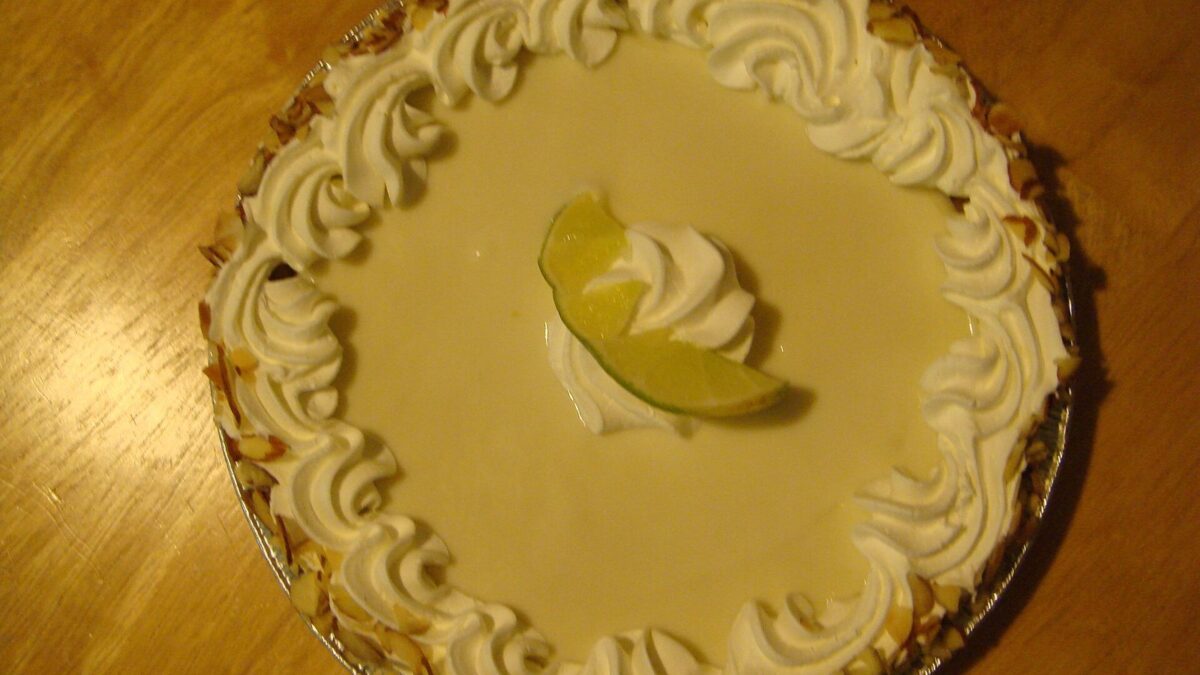
The filling of a key lime pie is set before it ever sees the oven. That’s the part most recipes skip past, and it explains almost every question people have about this pie.
Sweetened condensed milk is roughly 8 percent protein by weight, in a syrup so concentrated there’s barely any free water. Add acid, and those casein proteins lose the charge that keeps them apart, clump together and build a mesh. Lime juice sits around pH 2.0 to 2.2. Casein starts dropping out near pH 4.6. You are, in effect, curdling the milk on purpose, in slow motion, into something smooth.
Whisk the juice into the milk and watch: within 30 seconds it goes from pourable to the thickness of soft-set yoghurt. That’s the set happening in the bowl.
Prep: 20 mins Bake: 15 mins Chill: 3 hrs minimum Serves: 8
The Acid Does the Setting, Not the Oven
Because of that chemical set, a pie made only from condensed milk and lime juice will firm up in the fridge with no heat at all. Plenty of Key West recipes are exactly that, and they work.
What you get is a slightly grainier, chalkier set. The acid-coagulated curd is fine but not silky, and it can taste a touch raw and sharp on the finish. It also stays soft in a warm room. I served a no-bake one at a July lunch and by the second slice it was sliding.
The thickening is fast but not instant. Give it a full minute of whisking after the last of the juice goes in, then leave it two minutes before you pour. If you pour immediately, the filling levels itself beautifully and then continues to thicken unevenly in the shell.
So Why Bake It at All?
Two reasons, and they’re both about the yolks.
Egg yolks contain lecithin and proteins that set at a different temperature and in a different structure than acid-coagulated casein. Heat them to around 165°F and they build a second, finer network through the filling. The result is a custard rather than a curd: denser, glossier, and it cuts with a clean edge instead of a crumbly one. That’s the texture people remember from a good diner slice.
The second reason is plainer. Raw yolks in a chilled pie are raw yolks. A 15-minute bake takes the filling past the temperature at which salmonella is destroyed, which matters more if you’re feeding older relatives or small children.
You are not baking it to set it. You are baking it to change what kind of set you have. That distinction is why the pie only needs 12 to 15 minutes, and why an overbaked one cracks and weeps rather than firming up further.
Bottled Key Lime Juice, Honestly
I use it, and I’ll defend it.
A pound of key limes yields maybe a third of a cup of juice, they’re the size of walnuts, and juicing enough for one pie took me nineteen minutes and left my thumbs aching. Bottled key lime juice from a dedicated brand is pasteurised, which flattens the top aromatic notes, but the acid is intact and the acid is what sets the pie.
Where bottled falls down is aroma, not structure. Fix that with zest. One tablespoon of fresh lime zest whisked into the yolks does more for the finished flavour than the gap between fresh and bottled juice does. Zest holds the oils; juice holds the acid. Use bottled juice plus fresh zest and almost nobody can pick it out.
What I won’t use is generic bottled lime juice with a long preservative list on the label. Those carry a faint metallic bitterness that survives baking.
Key Limes Versus Persian Limes in the Actual Pie
Key limes are more acidic, around pH 2.0 against roughly 2.2 to 2.4 for the common Persian lime, and more floral. In a side-by-side I did with two half-pies, the key lime version set marginally firmer and tasted more perfumed. The Persian version tasted straightforwardly of lime and three of five people preferred it.
If you use Persian limes, don’t add more juice to compensate for the lower acid. The ratio below is already at the limit of what the crust holds without weeping. Add the zest of an extra lime instead.
Ingredients
- 1 1/2 cups graham cracker crumbs, about 12 full crackers crushed fine.
- 1/3 cup granulated sugar, for the crust.
- 6 tablespoons melted butter.
- One 14-ounce can sweetened condensed milk.
- 4 large egg yolks.
- 1/2 cup key lime juice, bottled or fresh.
- 1 tablespoon lime zest, fresh, always.
- 1 cup heavy cream, very cold.
- 2 tablespoons powdered sugar.
- 1/2 teaspoon vanilla extract.
Instructions
- Heat the oven to 350°F. Mix the crumbs, sugar and melted butter until the mixture clumps when you squeeze it in your fist.
- Press into a 9-inch pie dish, base and sides, packing hard with the flat bottom of a measuring cup. Work the corner where base meets side first; that’s where crusts crack.
- Bake the crust 8 to 10 minutes, until it smells toasty and the edge is a shade darker. Leave the oven on.
- Whisk the yolks with the lime zest for a full minute, until they lighten and thicken slightly. Whisk in the condensed milk until completely smooth.
- Add the lime juice in a thin stream, whisking. The mixture will thicken visibly as you go. Whisk one more minute, then let it stand 2 minutes.
- Pour into the warm crust and bake 12 to 15 minutes. Done is when the outer two inches are set and a 2-inch circle in the centre still shivers when you nudge the dish. An instant-read thermometer in the middle should show 165 to 170°F.
- Cool on the counter 30 minutes, then refrigerate at least 3 hours, ideally overnight. Don’t cover it until it’s fully cold or condensation will pit the surface.
- Whip the cold cream with the powdered sugar and vanilla to soft peaks only, and spread it over the pie within an hour of serving. Finish with zest.
How Long the Thickening Takes, and What It Should Look Like
People ask whether they’ve under-mixed. Here’s the visual sequence, timed from my own bowl: at 10 seconds after the juice goes in the mixture still runs off the whisk in a stream; at 30 seconds it falls in ribbons that sit on the surface for a beat; at 60 seconds a whisk drawn through leaves a track that closes slowly.
Stop there. Beyond that you’re just working air in, and air bubbles trapped in the filling bake into a pocked top that whipped cream can hide but a fork will find.
If it never thickens at all, the usual cause is a can of evaporated milk rather than sweetened condensed. They sit next to each other on the shelf and the tins look alike. Evaporated milk has no added sugar and will not set this way.
Crust Failures: Crumbly, Greasy, or Welded to the Dish
Crumbly means not enough butter or not enough pressure. The squeeze test in step 1 is the check: a fistful should hold its shape. If it falls apart, add butter a tablespoon at a time.
Greasy, with butter pooling at the edge during the blind bake, means too much butter for the crumb quantity, or crumbs that were coarse rather than fine. Coarse crumbs have less surface area to absorb it.
Welded to the dish is the common one, and it isn’t a crust problem, it’s a temperature problem. Sugar in the crust caramelises against a hot dish and glues itself down. Let the finished pie sit at room temperature for 10 minutes before the first slice, and dip the knife in hot water between cuts. If you’re going to freeze slices, line the dish with a parchment sling first.
The same pressing technique carries over to a New York cheesecake base, where the crust climbs the sides of a springform and gets a longer bake.
Chilling Times and When You Can Actually Slice
Three hours is the minimum, and at three hours the slices will lean. Overnight, six hours or more, gives you a slice that stands up with a square shoulder. That’s not fussiness, it’s the casein network continuing to tighten as it cools through the fridge range.
The crust starts softening from the second day as moisture migrates out of the filling. Day one is best, day two is good, day three is a pie you eat with a spoon. Freezing it uncovered for 30 minutes and then wrapping tightly holds it for a month, but add the cream after thawing.
If you want the same tart-citrus finish with a different technique, lemon meringue pie sets with cornstarch instead of acid and behaves nothing like this one. For a custard that sets purely on egg and heat, with no acid involved at all, compare it to pumpkin pie, or to the pastry-cream approach in a fresh fruit tart.
One habit worth stealing: zest all your limes before you juice a single one, and freeze the extra zest flat in a small bag. Zesting a spent half-lime is miserable, and you will always want more zest than you planned.