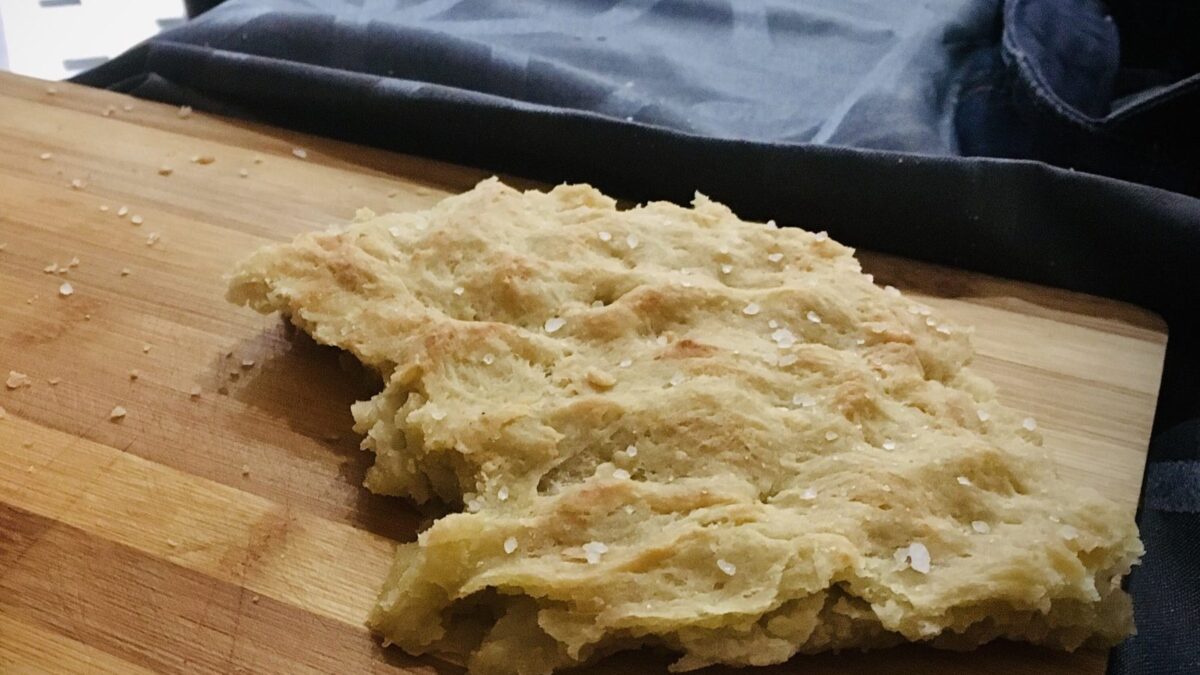
Focaccia is decided by one number before you touch anything else, and that number is the water. This dough runs at 94% hydration: 470ml of water to 500g of flour. That single ratio is why it needs no kneading, why the crumb comes out full of irregular holes, and why the dough will feel wrong in your hands the first time.
Everything else in the recipe is downstream of it.
Why 94% Water Behaves Nothing Like 70%
A standard sandwich loaf sits somewhere around 65 to 70% hydration. You can pick that dough up, it holds a ball, and you knead it to build the gluten network. At 94% you cannot pick it up at all. It pours.
What replaces kneading is time. Gluten strands form on their own in a wet dough because the proteins are mobile enough to find each other, given hours instead of minutes. The wetter it is, the faster that happens without help. So the same property that makes the dough impossible to handle is the property that means you never have to handle it.
The water does a second job in the oven. At 230°C, water in the dough flashes to steam and inflates the gas pockets the yeast already made. More water, bigger and more uneven bubbles. That’s the open, holey crumb you’re after, and it’s also why focaccia goes stale faster than my honey oat loaf does, since there’s more moisture to lose.
The first time I made this I assumed I’d mismeasured and added another half cup of flour to “fix” the texture. What I got was a decent flatbread with a tight crumb, and it took me three more bakes to understand I’d cured the symptom I actually wanted.
The Cold Ferment Does Two Separate Jobs
You can make this dough on the same day. Two hours at room temperature until doubled and bubbly, and it works. It’s just a different, plainer bread.
Eight to 24 hours in the fridge changes two things at once, and it’s worth separating them.
The first is flavour. Cold slows the yeast down badly, but the enzymes already in the flour keep working at close to their normal pace, breaking starch into simpler sugars and protein into amino acids. Those are what brown and taste like something. A same-day focaccia tastes of olive oil and salt. A 24-hour one tastes faintly of beer and toasted nuts underneath the oil.
The second is handling, and this is the part that gets undersold. Cold dough at 94% hydration is dramatically easier to tip into a pan than warm dough at the same hydration, because the fat and the gluten have firmed up. It still isn’t tidy. It’s just possible.
I run mine at about 16 hours, which for me means mixing after dinner and baking around lunch the next day. Past 24 hours the dough starts to go slack and sour and loses its lift, so that’s a real ceiling, not a cautious one.
Dimpling Is Structural, Not Decorative
This is the step people do timidly, and timid dimpling is why home focaccia often bakes into a dome.
Press your oiled fingers all the way down to the metal, not halfway. Where your finger reaches the pan, the dough is pinned to the base and cannot rise there. Between the pins, the trapped gas has nowhere to go but up. That’s what produces the ridge-and-valley surface instead of one smooth swollen slab, and it’s also what keeps the big bubbles distributed across the whole tray rather than migrating to the centre.
The dimples then fill with oil, which sits in direct contact with the dough at 230°C and fries those pockets rather than baking them. Crisp edges around soft ridges, in the same bite.
Ten fingers, straight down, all over the surface, and you should hear the dough sigh a little. If the dimples spring back and vanish within a minute, the dough hasn’t proofed long enough in the pan yet.
Ingredients
- 4 cups (500g) all-purpose or bread flour
- 2 teaspoons (7g) instant yeast
- 2 teaspoons fine sea salt
- 2 cups (470ml) lukewarm water
- 6 tablespoons extra-virgin olive oil, divided, plus more for drizzling
- 2 tablespoons fresh rosemary leaves, roughly chopped
- Flaky sea salt, for finishing
- 1 teaspoon honey or sugar, to feed the yeast
- Optional: 1 clove garlic, thinly sliced
Instructions
- In a large bowl, whisk together the flour, yeast, and fine salt. Add the honey and lukewarm water, then stir with a spatula until you have a wet, shaggy dough with no dry flour left. It will look messy and sticky, which is exactly right.
- Drizzle 2 tablespoons of olive oil over the dough and turn it to coat. Cover the bowl tightly and let it rise. For the best flavor, refrigerate overnight, 8 to 24 hours; for same-day bread, leave it at room temperature for about 2 hours until doubled and bubbly.
- Pour 3 tablespoons of olive oil into a 9×13-inch metal pan, spreading it up the sides. Tip the dough into the pan and gently fold it over on itself a few times, then flip it so it is coated in oil.
- Cover and let the dough relax and puff in the pan for 1 to 2 hours at room temperature (longer if it came from the fridge), until it has spread toward the edges and looks jiggly and full of air.
- Heat the oven to 450°F (230°C). Drizzle the remaining tablespoon of oil over the top. Now press all ten oiled fingers straight down to the bottom of the pan, all over the dough, creating the signature deep dimples.
- Scatter the rosemary (and garlic, if using) over the surface and finish with a generous pinch of flaky salt.
- Bake for 22 to 27 minutes, until the top is deeply golden and the edges are crisp and lacquered. For extra crunch, run it under the broiler for the last minute, watching closely.
- Let it cool in the pan for 5 minutes, then lift the focaccia onto a rack so the bottom stays crisp. Slice and serve warm.
The Pan Is Doing Half the Cooking
Three tablespoons of olive oil in a 9×13 pan is not seasoning. It’s a shallow fry. The bottom of this bread cooks in hot oil against hot metal, which is where the crackly base comes from.
Use metal, not glass or ceramic. Glass conducts heat slowly and unevenly, and my one attempt in a Pyrex dish gave me a pale, slightly damp underside even after 30 minutes. A dark metal pan browns fastest; a light aluminium one needs the full 27 minutes.
Rosemary Burns Before the Bread Is Done
Scatter chopped rosemary loose across a flat surface and the exposed leaves are black by minute 18, which tastes exactly like it sounds.
Push the leaves down into the oil sitting in the dimples instead. Submerged in fat they steep rather than scorch, and the oil carries that flavour through the whole top crust rather than leaving it stranded on a few leaves. Garlic is less forgiving still and turns properly bitter, so I press those slices right under the surface or leave them out.
Should you use bread flour?
Bread flour, at roughly 12 to 13% protein against all-purpose at 10 to 11.5%, gives a chewier crumb and holds the high hydration slightly better. I use all-purpose most weeks and don’t feel robbed. If your dough consistently collapses into a puddle rather than holding any shape in the pan, switching flour is the first thing to try.
Read the Dough, Not the Clock
Every rise time in this recipe is an estimate that assumes a 20 to 22°C kitchen. Mine hits 30°C in summer and the second proof is done in 50 minutes, not two hours.
Three cues that actually tell you something. The dough should have spread to touch or nearly touch the corners of the pan on its own. It should jiggle as one loose mass when you shake the pan, like a set custard. And it should show visible bubbles under the surface, not a smooth skin.
Underproofed dough fights the dimples. Overproofed dough smells sharply of alcohol and deflates when you press it, and no oven heat will bring that back.
If 94% Frightens You, Cut It to 85%
Drop the water to 425ml against the same 500g of flour and the dough becomes genuinely manageable. You lose some of the open crumb and gain the ability to move the dough without a spatula in each hand. That’s a fair trade for a first attempt, and it’s roughly where I’d start someone who has only made soft dinner rolls before.
What I wouldn’t do is go the other way. I’ve pushed to 100% out of curiosity and the dough had no ability to hold gas at all; it baked flat and dense, which is the opposite of what more water is supposed to do. There’s a ceiling, and 94% sits just under it for this flour.
Cold leftovers are a lost cause eaten as-is. Split a square horizontally, toast the cut faces in a dry pan for 90 seconds, and it comes back almost entirely. It’s also the best thing I know to put under a wet tomato topping, better than a pizza base, because the oil-soaked crumb doesn’t turn to paste. If you want the flavour lesson rather than the texture one, the same cold-ferment logic drives my sourdough, just over days instead of hours.