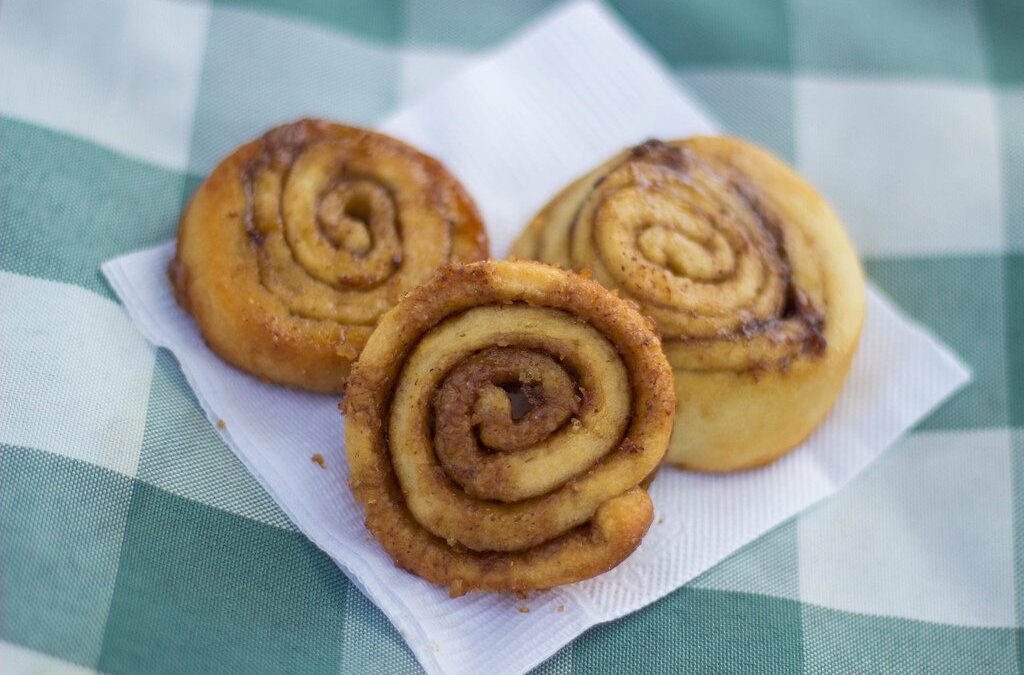
Dough tonight, rolls at 8am, no alarm set for 5. That’s the whole point of this one.
If you want the full lesson on cinnamon rolls — the yeast questions, the frosting ratios, why the middle ones are always softest — that’s over in my cinnamon rolls with cream cheese icing. This post is about one thing only: what a night in the fridge does to the dough, and how to time it so breakfast lands when you want it.
What the Cold Night Actually Does
Yeast doesn’t stop below 4C, it just slows to a crawl. The rolls still rise overnight, only over eight hours instead of one.
That slowness buys two things. Enzymes in the flour keep breaking starch into sugar the whole time, so the crumb tastes deeper and less plainly sweet than a same-day batch. And cold dough is firm dough — the butter and cinnamon sugar stay in their spiral instead of leaking into a puddle at the bottom of the pan, which is what a warm log does. The same slow, cold patience is what gives a tall Italian holiday bread studded with candied fruit its crumb, over three rises rather than one.
The trade is texture. Overnight rolls come out a touch denser and chewier than rolls proofed and baked inside three hours. I prefer them. My husband says the same-day ones are fluffier and he’s not wrong.
Ingredients
- 4 cups all-purpose flour, plus more for rolling
- 1 cup warm milk, around 110F
- 2 1/4 tsp active dry yeast (one packet)
- 1/3 cup granulated sugar
- 1 large egg plus 1 egg yolk, at room temperature
- 6 tbsp unsalted butter, softened, for the dough
- 1 tsp fine salt
- 3/4 cup packed light brown sugar, for the filling
- 2 tbsp ground cinnamon
- 1/4 cup unsalted butter, very soft, for spreading
- 4 oz cream cheese, softened
- 1 cup powdered sugar and 1/2 tsp vanilla, for the frosting
Instructions
- Stir the yeast and a pinch of the sugar into the warm milk. Wait 5 to 10 minutes for foam. No foam means dead yeast or milk that was too hot, and there’s no rescuing it — start again.
- Whisk the foamy milk with the rest of the granulated sugar, the egg, the yolk, and the softened butter. Add the salt and about half the flour, and mix to a shaggy mass.
- Work in the remaining flour a little at a time, kneading 6 to 8 minutes by hand or with a dough hook, until smooth and elastic and still slightly tacky. Cover and rise somewhere warm until doubled, 60 to 90 minutes.
- Punch down and roll into a rectangle about 16 by 12 inches. Spread the very soft butter edge to edge, then scatter the brown sugar and cinnamon and press it in gently.
- Roll up tightly from a long edge, pinch the seam, and cut 12 even pieces with unflavoured dental floss or a serrated knife.
- Set them cut-side up in a buttered 9 by 13-inch pan, cover tightly, and refrigerate overnight.
- In the morning, leave the pan on the counter 45 minutes to an hour while the oven heats to 350F. They should look puffy and be touching.
- Bake 22 to 28 minutes until golden and set in the centre. Beat the cream cheese, powdered sugar, and vanilla smooth, and spread it over the rolls while they’re warm.
Timing It Backwards from Breakfast
Work back from when you want to eat, not forward from when you start.
For rolls on the table at 9am: out of the fridge at 7:15, oven on at 7:45, in at 8:15, out at about 8:40, frosted and served by 8:50. The 45-minute counter rest isn’t optional padding — a fridge-cold pan straight into the oven gives rolls browned outside and doughy in the middle, because the centre never warmed enough to finish rising before the crust set.
The dough is happy in the fridge from about 8 hours up to 16. Past that the yeast runs short of food and they rise less. At hour 20, bake them anyway and expect something closer to a sweet dinner roll.
Kitchen under 18C? Give the counter rest 75 minutes instead of 45. Poke a roll; the dent should spring back slowly, not instantly.
Two Things I’d Fix If Yours Came Out Dense
Dense overnight rolls almost always trace back to the first rise, before the fridge got involved. If the dough hadn’t properly doubled at room temperature, the cold night won’t make up the difference. Give it the full 90 minutes in a cool kitchen, and judge by size, not the clock.
The other is flour. Scooping the cup straight from the bag packs in an extra 20 grams or so, and across 4 cups that’s a stiffer dough. Spoon it in and level it off. Mine come out best when the finished dough still sticks faintly to my palm — dough that leaves your hands completely clean has too much flour in it.
The pan also freezes well at step 6: slice, arrange, wrap tight, up to a month, then into the fridge the night before and carry on as written. For a make-ahead breakfast with no oven at all, maple cinnamon overnight oats cover the same lazy morning in four minutes of work.