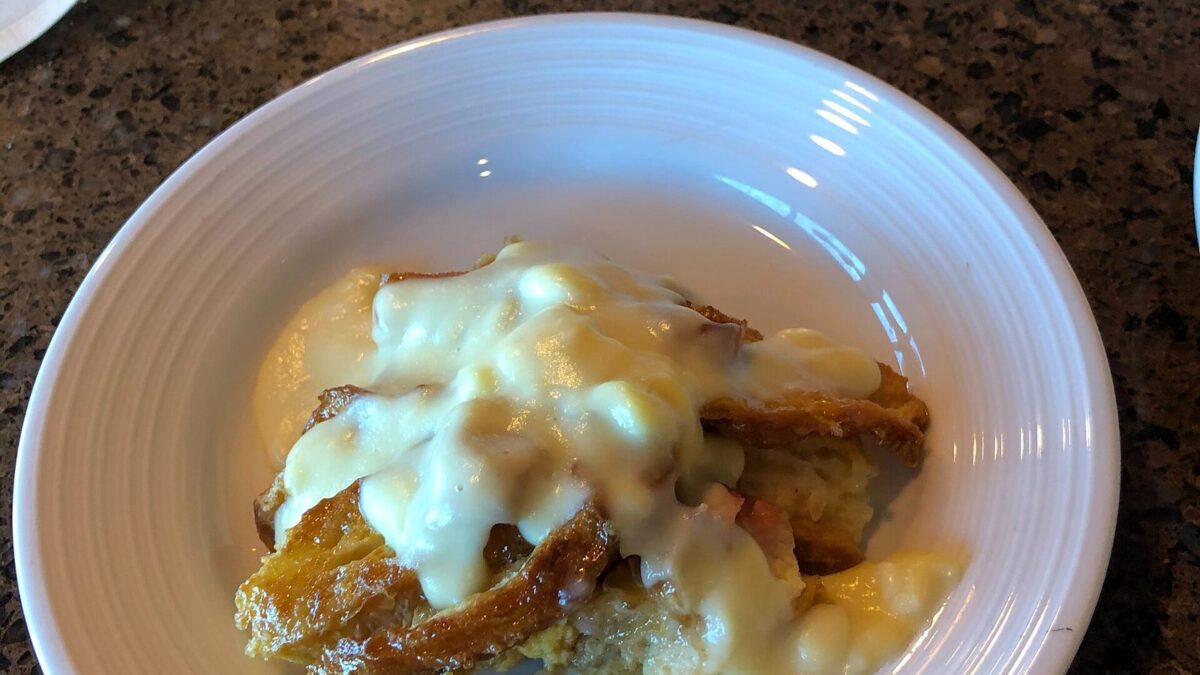
Twenty minutes before people were due, I lifted the foil and found the middle of the dish still sloshing. Not wobbling. Sloshing. I had cubed the bread that morning from a loaf bought that morning, and fresh bread doesn’t drink custard, it floats in it.
The tray went back in for another eighteen minutes and came out passable: browned on top, faintly wet underneath. Everyone ate it and said nice things. I knew.
One attempt later I had the fix, and it costs ten minutes. Spread the cubes on a sheet pan, 300°F, ten minutes, then let them cool on the counter. Dry bread is thirsty bread. I’ve made this roughly every second Sunday from October to February since, and the middle has behaved every time.
Prep: 20 mins, plus a 20-minute soak Bake: 40–50 mins Serves: 8
Cubes, Not Slices, and Why That Changes the Bake
Two different desserts share this name, and they don’t behave alike.
The British version shingles buttered slices flat in a shallow dish, pours a thin custard around them and bakes until the exposed corners go crisp. If that’s what you’re after, I’ve written it up separately as bread and butter pudding, including the soak timings and the scorched-custard mistake that taught me to keep the oven low.
This one is the American style: one-inch cubes piled loose, a heavier custard poured over the lot, and a warm sauce spooned on at the table rather than baked in. Cubes give you far more surface for the custard to grip, so the finished pudding slices into squares instead of scooping out in soft sheets. The interior is denser, closer to a savoury bread stuffing in structure, and the top layer of cubes toasts into little peaks that stay crunchy for about an hour.
Because the custard has to hold all those cubes together, the ratio runs richer: four eggs and three cups of dairy to eight cups of bread. Go lighter than that and the cubes stay separate, like croutons in a puddle.
Ingredients
- 8 cups day-old bread, cut into 1-inch cubes. Brioche and challah give the softest result; a plain French loaf holds its edges better.
- 4 large eggs, at room temperature.
- 2 cups whole milk.
- 1 cup heavy cream, or swap in more milk for a leaner pudding.
- 3/4 cup granulated sugar.
- 2 teaspoons vanilla extract.
- 1 1/2 teaspoons ground cinnamon, plus a good scrape of nutmeg.
- 1/4 teaspoon salt.
- 1/2 cup raisins, optional.
- 3 tablespoons melted butter, for the top.
- For the vanilla sauce: 1/2 cup butter, 1/2 cup sugar, 1/4 cup cream, 1 teaspoon vanilla.
Instructions
- If the bread isn’t properly stale, spread the cubes on a sheet pan and dry them at 300°F for 10 minutes. Let them cool before they meet any liquid, or the outsides go slimy.
- Butter a 9-by-13-inch dish and tip in the cubes. Scatter the raisins over, pushing a few down between the pieces so they don’t all scorch on the surface.
- Whisk the eggs, milk, cream, sugar, vanilla, cinnamon, nutmeg and salt until you can’t see any streaks of yolk.
- Pour the custard over the bread and press the cubes down with a spatula until every one has been wet. Drizzle the melted butter across the top.
- Rest for at least 20 minutes at room temperature, or up to an hour covered in the fridge. Press again halfway through. The cubes on top will keep bobbing up.
- Heat the oven to 350°F (175°C). Bake 40 to 50 minutes, until the top is puffed and deep gold and the centre reads about 170°F on an instant-read thermometer.
- While it bakes, melt the butter for the sauce in a small pan, stir in the sugar and cream, and simmer 3 to 4 minutes until it coats the back of a spoon. Off the heat, stir in the vanilla.
- Rest the pudding 10 minutes before serving. Spoon the warm sauce over each portion at the table rather than over the whole dish, or the crisp top softens within minutes.
The Sauce Is the Point, and I Under-Made It for Years
For a long time I treated the sauce as decoration and made half a cup for eight people. That’s about a tablespoon each, which does nothing. The whole reason this style exists is that the pudding is deliberately drier than a soft-set custard dessert, and the sauce arrives hot to fix that on the plate.
Make the full quantity. Half a cup of butter and half a cup of sugar sounds absurd next to an already-rich pudding, and it is, and it’s correct.
Two things I’ve learned about it. First, it will look split for the first minute of simmering, before the sugar dissolves fully; keep stirring and it comes together around the two-minute mark. Second, it thickens noticeably as it cools, so pull it while it still looks slightly thin. If it sets too firm on the counter, thirty seconds over low heat with a splash of cream brings it back.
A tablespoon of bourbon stirred in off the heat is the version I make for adults. Not enough to taste boozy, just enough to stop the sweetness landing flat.
Three Things I’ve Changed Since That First Tray
I stopped using sandwich bread. It has too fine a crumb and turns to paste under a heavy custard. Anything with visible open holes works better, which is also why leftover French toast bread, thick-cut and slightly dried, is my usual choice.
I started weighing the soak rather than eyeballing it. Twenty minutes is the floor, and an overnight fridge soak genuinely does taste different, more evenly seasoned throughout rather than sweet on top and bland in the centre. If you soak overnight, add 5 to 8 minutes to the bake because the dish goes in cold.
And I gave up on covering it with foil. I used to, out of a vague fear of burning, and it steamed the top into softness. Uncovered the whole way at 350°F is right. If the surface is browning too fast at the 30-minute mark, drop the oven to 325°F rather than reaching for foil.
Leftovers keep four days covered in the fridge. Reheat portions 30 seconds in the microwave, or the whole dish at 325°F for 15 to 20 minutes. The sauce keeps a week separately.
If you want the same comfort without the oven, stovetop rice pudding gets you there in a saucepan, and for something with a proper self-saucing sponge, sticky toffee pudding is the one I make when I want the sauce baked in rather than poured over.
One last practical thing: bake it in a glass or ceramic dish if you can, not metal. I’ve done both, and the metal pan browned the base hard before the centre reached 170°F, which is exactly the problem I started with.