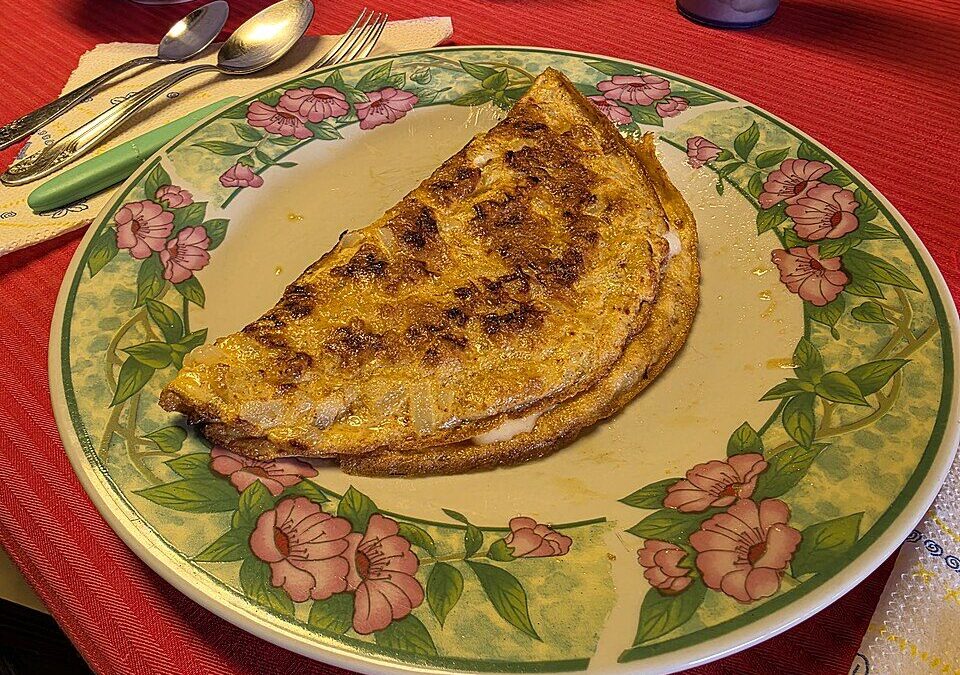
Two dishes share the name omelette and they have almost nothing in common beyond eggs and a pan.
The French one is pale, rolled into a cigar shape, cooked in about ninety seconds, and still slightly loose in the middle. The American one is flat, folded in half, faintly golden, and set through. They need different heat, different timing, different amounts of cheese, and they reward completely different temperaments at the stove.
I’ve made both for years and I have a firm view about which one you should make when cheese is involved. It’s probably not the one that gets called superior.
French Rolled: What It Demands
The French method keeps the pan at a low medium, around 130 to 140°C, and never lets the egg colour. You beat 3 eggs until completely homogeneous — no streaks of white at all, which takes about 40 seconds of proper fork work — melt 15g of butter in a 20cm non-stick pan until it foams without browning, and pour.
Then you stir. Constantly, with the flat of a fork or a spatula, small circles, shaking the pan at the same time, for roughly 45 seconds. What you’re making is a mass of very fine curds suspended in still-liquid egg. When it looks like loose scrambled egg, you stop stirring, spread it flat, count ten seconds for the base to set into a skin, then tilt the pan and roll it out onto the plate.
Total time from pour to plate: about 90 seconds. The interior is deliberately underset — the French call that texture baveuse, and it’s the whole point.
It’s a genuinely lovely thing to eat. It’s also unforgiving. Fifteen seconds too long and it’s rubber. A pan 20 degrees too hot and you get brown freckles, which in this style counts as a mistake. My first dozen attempts were somewhere between scrambled eggs and an accident, and the pan matters enormously: a scratched non-stick will not let it roll.
American Folded: What It Forgives
The folded version runs a bit hotter, medium-low to medium, and takes about three minutes. You pour the beaten eggs in and let them sit. As the edges set you push them towards the centre with a spatula and tilt so the raw egg runs into the gap, working round the pan for a minute or so.
When the top is mostly set but still glossy, the filling goes on one half, then you fold the other half over and let residual heat finish it.
Nothing about this is precarious. If you’re twenty seconds late, the omelette is slightly firmer and still good. A hint of gold on the base is normal here rather than a failure. You can hold a conversation while you make it, which is not true of the French one.
Side by Side
| French rolled | American folded | |
|---|---|---|
| Pan heat | Low-medium, ~130-140°C | Medium-low to medium |
| Time in pan | About 90 seconds | About 3 minutes |
| Colour | Pale yellow, no browning at all | Light gold base is fine |
| Interior | Loose and creamy (baveuse) | Set through |
| Cheese it handles | 25-30g, finely grated, mild melters | 50g, coarsely grated, including cheddar |
| Margin for error | Roughly 10 seconds | Roughly a minute |
| Pan needed | Flawless 20cm non-stick | Any decent 20-24cm pan |
Which One I Actually Make on a Tuesday
For a cheese omelette, the folded one wins, and it isn’t close.
The reason is temperature. Cheddar needs real heat to melt properly — it starts flowing somewhere around 65°C and wants a bit above that to go fully molten. The French omelette’s whole discipline is keeping the pan and the egg below the point where anything browns, and the interior stays deliberately cool and loose. Put 50g of mature cheddar into that and it doesn’t melt, it sits there in warm shreds. I’ve done it. It tastes like cold cheese in warm egg.
The folded omelette gives you thirty to forty seconds of contact with a hotter base plus a fold that traps the heat, and the cheddar goes properly molten and stretches when you cut it.
Where the French version does win: a plain omelette, or one with herbs, or with a soft cheese that flows at low temperature — a spoon of goat’s cheese or a little boursin will loosen at French-omelette temperatures. For those, roll it. For sharp hard cheese, fold it.
Cheese Choice Changes the Answer
Grate it yourself. Pre-grated cheese is dusted with potato starch or cellulose to stop it clumping in the bag, and that coating shows up as a slightly grainy, sometimes gritty melt. It’s the single most common reason a cheese omelette turns out disappointing despite everything else being right.
Mature cheddar has the strongest flavour and, being higher in fat and lower in moisture, it’s also the one most likely to split into an oily puddle if you leave the pan on too long past melting. Gruyère melts more smoothly and stays cohesive. A mix — 35g cheddar for flavour, 15g gruyère for texture — is what I’ve settled on, and it’s the one small refinement in this piece I’d argue hardest for.
Coarse holes on the grater, not fine. Fine shreds pack together and melt into a single dense layer instead of pooling.
Ingredients
- 3 large eggs, as fresh as you can get
- 50g mature cheddar, grated on the coarse holes (or 35g cheddar plus 15g gruyère)
- 15g unsalted butter — don’t reduce this
- 1 tbsp milk, optional, for a slightly softer set
- 1 pinch salt
- 1 pinch black pepper, freshly ground
- 1 small handful chives, finely snipped, optional
Instructions
- Crack the eggs into a bowl, add the milk if using, and season with the salt and pepper. Beat with a fork for a good 30 seconds until there’s no visible white and the surface has a light froth.
- Put a 20cm non-stick pan over medium-low heat. Add the butter and let it melt and foam, swirling to coat the base and about 2cm up the sides. Don’t let it turn brown.
- Pour in the eggs. They should sizzle faintly, not aggressively. If the pan spits or the edges set instantly, take it off the heat for 15 seconds and start again lower.
- As the outside edge sets, push it gently towards the centre with a spatula and tilt the pan so the liquid egg runs into the gap. Work your way round, roughly a minute in total.
- When the surface is mostly set but still looks wet and glossy, scatter the cheese over one half. Add the chives now if you’re using them.
- Cook another 30 to 40 seconds, until the cheese has gone visibly soft at the edges and the base is just set. Lift a corner: pale gold is right, brown is 20 seconds too far.
- Tilt the pan and fold the bare half over the cheese. Leave it 15 seconds off the heat so the trapped steam finishes the melt.
- Slide onto a warm plate, folded edge down. Eat immediately — an omelette left standing goes weepy within a couple of minutes as the egg contracts and releases water.
Rolling It Instead, If You Want the French Version
Same ingredients, drop the cheese to 30g and switch to gruyère or comté grated fine.
Melt the butter over a lower heat, pour the eggs, and immediately start stirring with the back of a fork in small circles while shaking the pan gently. Keep going for about 45 seconds until you have fine curds sitting in loose egg. Stop, spread it level, scatter the cheese down the middle third, and count ten.
Tilt the pan away from you to about 45 degrees. Use the fork to fold the near third over the middle, then let the far edge roll over as you tip the whole thing onto the plate, seam underneath. It looks like a plump pale cigar. If it tears, the base wasn’t set — count fifteen next time instead of ten.
The Pan Question
Nothing else on this page matters as much as this: use a small pan.
Three eggs in a 20cm pan gives you a layer thick enough to stay tender through the cooking. The same three eggs in a 28cm pan spread into a thin sheet that overcooks before the middle has a chance to set — it turns leathery and it tears when you fold it. I spent an embarrassing stretch of time blaming my eggs, my butter and my hob for something that was purely a diameter problem.
If you’re cooking two omelettes, cook them one after the other in the small pan rather than both in a big one. It takes six minutes instead of four and the difference in what lands on the plate is not subtle.