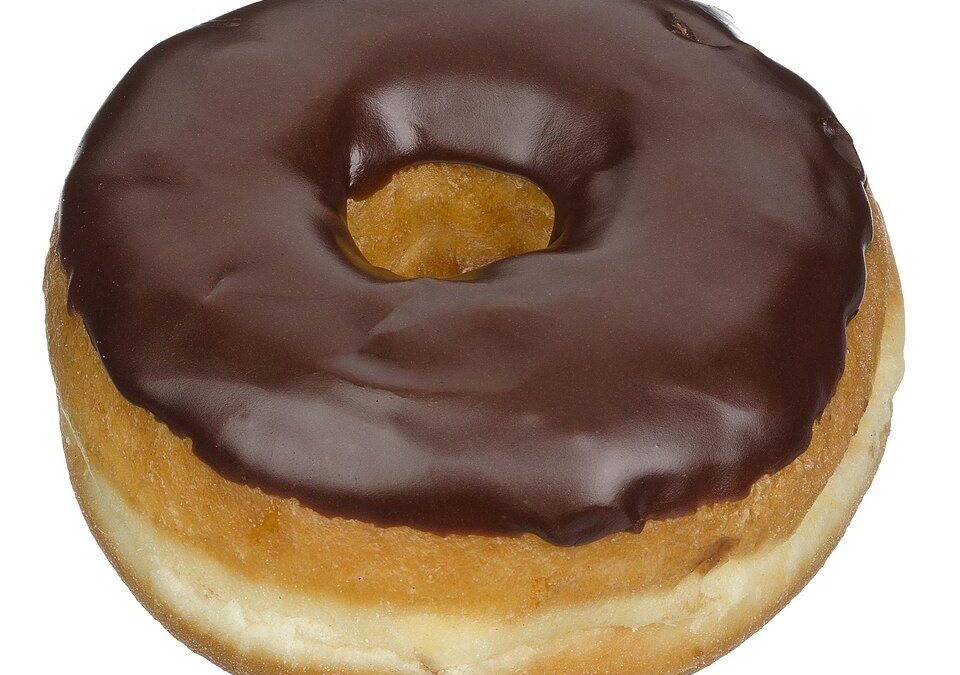
A yeast doughnut is decided in about 90 seconds, and almost all of it is oil temperature. Get the oil to 350F and hold it there, and even a mediocre dough gives you something light with a pale ring around its middle. Let the oil drift to 320F and the same dough drinks fat and comes out heavy. Let it climb to 380F and you get a dark shell around a raw seam.
That’s the whole game. The dough matters, the proof matters, but oil temperature is the variable that decides whether you’ve made doughnuts or made grease sponges. Everything below is built around holding that number.
What 350F is actually doing
When dough hits oil at 350F, the water at its surface flashes to steam almost immediately. That outward rush of steam is what keeps oil from soaking inward. You get a thin sealed crust in the first few seconds, and the inside then cooks in trapped steam rather than in fat.
Drop the temperature and the seal forms slowly. Oil moves in during that gap, and it does not come back out. A doughnut fried at 320F can carry noticeably more fat than the same doughnut fried at 350F, and you can feel it before you taste it: it’s heavier in the hand and leaves a slick on your fingers.
Push above 370F and the opposite happens. The crust darkens before the centre has cooked through, so you get something that looks fully browned at 60 seconds a side and is still doughy at the seam. I’ve cut one open and found a wet grey band right through the middle.
The other half of it is recovery. Every doughnut you drop in pulls heat out of the oil. Three doughnuts in a 4-quart pot can drag 350F down to about 325F within ten seconds. That’s why the recipe says a few at a time, and why the thermometer matters more than the timer.
The proof window, and how to see it
The second proof, after cutting, is short and unforgiving. Underproofed doughnuts come out dense and often burst at the seam. Overproofed ones collapse the moment they hit the oil and fry into flat, greasy discs, because the gluten has stretched past the point where it can hold the gas.
Thirty to 45 minutes is the range in a normal 70F kitchen. In an Indian summer kitchen at 32C, mine have been ready in 22 minutes, so treat the clock as a rough guide and use the test instead.
The test: press the side of a proofed doughnut very lightly with a floured fingertip. If the dent springs back fully, it needs more time. If it springs back most of the way and leaves a shallow mark, fry now. If the dent stays put and the dough sighs, you’re past the window and should fry immediately rather than waiting for anything to improve.
Visually, a ready doughnut looks puffed and slightly translucent at the edges, and it will have gone from about 1/2 inch thick to just under 3/4 inch. It should not have doubled. A doubled doughnut is an overproofed doughnut.
The pot, the oil, and why both matter
Use the heaviest pot you own. A thin pan swings 30 degrees between doughnuts; a heavy cast iron or thick-based stainless pot holds within about 10. That alone will improve your results more than any change to the dough. Depth matters too: at least 2 inches of oil so the doughnut floats clear of the bottom, and no higher than a third of the way up the pot, which is your buffer against bubbling over.
For the oil itself, canola or plain vegetable oil is right. Both sit comfortably above the frying range and taste of nothing. Ghee works and smells wonderful, but it browns the sugar in the dough faster, so drop your target to about 340F if you use it.
A clip-on candy thermometer beats an instant-read here, because you want to watch the number continuously rather than check it. If you only have an instant-read, check between every batch, not just at the start.
Frying safely, briefly and seriously
Hot oil deserves a paragraph of respect. Keep the pot on a back burner with the handle turned inward and a lid within arm’s reach. If the oil starts smoking, turn the heat off and let it come down on its own rather than moving the pot.
Never add water to hot oil, and never try to put out an oil fire with water. Smother it with the lid and turn off the heat. Dry your cutter and your spider before they go near the pot, because a few drops on the surface will spit.
Lower each doughnut in gently, away from you. Keep children and pets out of the kitchen for the 20 minutes this takes, and let the oil cool completely in the pot before you deal with it. Frying is the one step in home baking where carelessness has real consequences.
Ingredients
- 1 cup warm whole milk (about 110F, warm to the touch but not hot)
- 2 1/4 teaspoons active dry yeast (one standard packet)
- 1/4 cup granulated sugar, divided, to feed the yeast and sweeten the dough
- 3 1/2 to 4 cups all-purpose flour, plus more for dusting
- 2 large eggs, at room temperature
- 4 tablespoons unsalted butter, softened
- 1 teaspoon fine salt to balance the sweetness
- 1 teaspoon vanilla extract for warmth in the dough
- Neutral oil for frying, such as canola or vegetable, about 2 quarts
- 2 cups powdered sugar for the glaze
- 1/4 cup milk or water for the glaze, adjusted to consistency
- 1 teaspoon vanilla extract for the glaze
Instructions
- In a large bowl, stir together the warm milk, yeast, and one tablespoon of the sugar. Let it sit for 5 to 10 minutes until foamy and fragrant. If nothing happens, your yeast is dead and you should start again with a fresh packet.
- Add the remaining sugar, eggs, softened butter, salt, vanilla, and 3 cups of the flour. Mix until a shaggy dough forms, then add more flour a few tablespoons at a time until the dough pulls away from the sides but stays slightly tacky.
- Knead on a lightly floured surface for 6 to 8 minutes, or use a stand mixer with the dough hook, until smooth and elastic. The dough should spring back gently when poked.
- Place the dough in a greased bowl, cover, and let it rise in a warm spot for about 1 to 1 1/2 hours, until doubled in size.
- Roll the dough out to 1/2 inch thick on a floured surface. Cut rings with a doughnut cutter or a large and small round cutter. Re-roll scraps once. Place the doughnuts and holes on floured parchment, cover loosely, and let rise 30 to 45 minutes until puffy.
- Heat the oil in a heavy pot to 350F. Fry the doughnuts a few at a time, about 60 to 90 seconds per side, until deep golden. Do not crowd the pot or the temperature will drop.
- Lift the doughnuts out with a slotted spoon or spider and drain on a wire rack set over paper towels. Let them cool for a few minutes so the glaze will cling.
- Whisk the powdered sugar, milk, and vanilla into a smooth glaze. Dip each doughnut top-down, let the excess drip off, and set back on the rack. For a thicker shell, dip a second time once the first coat sets.
Reading a doughnut while it fries
A doughnut at the right temperature bobs up within about five seconds and sits high, with maybe a third of its depth under the oil. If it sinks and stays down, your oil is too cool. If it browns visibly in the first 20 seconds, it’s too hot.
The bubbling tells you as much as the colour. You want a steady, medium fizz all around the edge. Furious spitting means the oil is too hot or the dough was too wet. A lazy trickle means the temperature has dropped and the doughnut is absorbing fat right now.
Flip once, at 60 to 90 seconds, when the underside is the colour of a digestive biscuit. Flipping repeatedly is a habit worth breaking; each flip breaks the crust seal slightly and lets oil in.
The white ring around the middle
Look at any good yeast doughnut and you’ll see a pale band running around its equator. That’s the part that floated at the oil line, never submerged, so it never browned.
It’s worth wanting. A clear ring means your doughnut was buoyant, which means it was properly proofed and the oil was hot enough for it to rise fast. No ring at all means it was either too heavy to float or got rolled around too much in the pot. A very wide ring, more than about half an inch, usually means overproofing: so much gas that barely any of the doughnut sat in the oil, and the middle stayed pale.
Glaze that sets instead of sliding off
Dip a doughnut straight out of the oil and the glaze melts and runs off, leaving a sticky film. Wait until they’re stone cold and it sits on top as an opaque slab that cracks off in pieces.
The window is roughly five to eight minutes out of the oil, when the doughnut is warm but no longer hot to hold. The glaze thins slightly on contact, soaks a fraction of a millimetre into the crust, then sets into the thin shell that shatters when you bite it.
Aim for a glaze that coats a spoon and takes about three seconds to level out when you drizzle it back into the bowl. Too thin, add powdered sugar a tablespoon at a time. Too thick, add milk half a teaspoon at a time, because glaze thins much faster than you expect.
If frying has put you off entirely, the same enriched dough thinking shows up in things you can bake instead. Cinnamon rolls with cream cheese icing use a nearly identical milk-and-butter dough, overnight cinnamon rolls shift the long proof into the fridge so you’re not watching a clock, and flaky butter croissants are the harder cousin if you want a project. And if you want the yeast-dough practice without hot oil, soft pretzels put the same skills through a boiling water bath instead.
Save the doughnut holes for last and fry them after the rings. They cook in about 40 seconds total, they’re the best way to test whether your oil has recovered between batches, and nobody in my house has ever objected to eating the test.