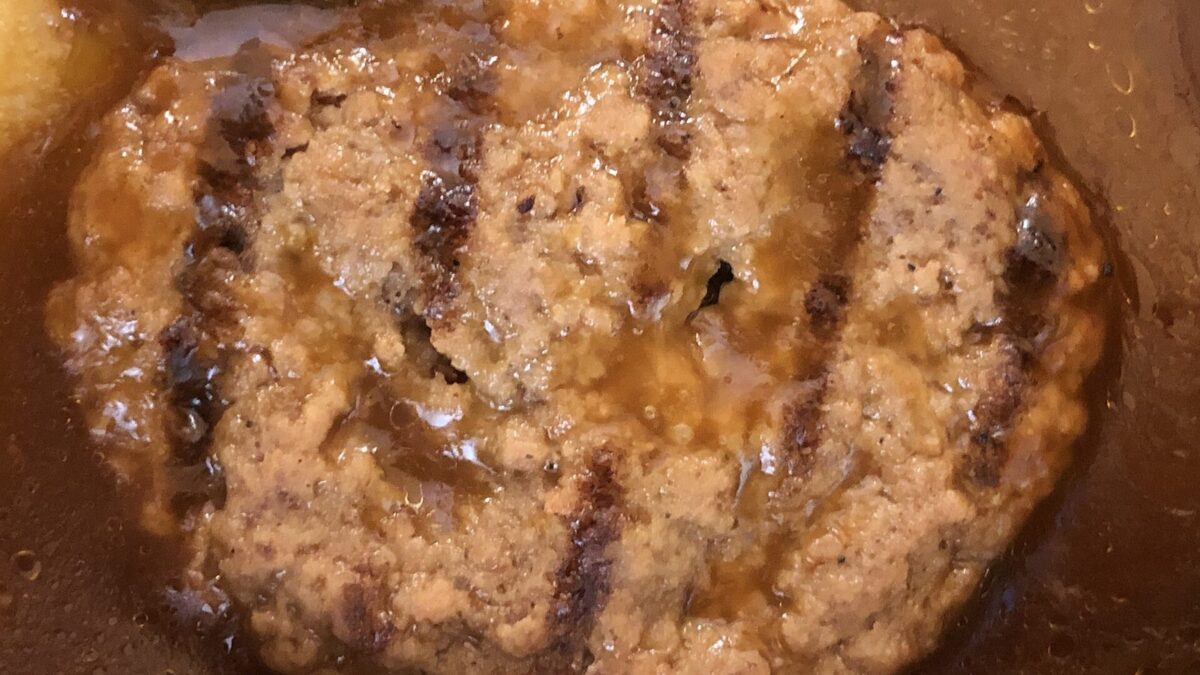
Shop-bought breakfast sausage patties cost roughly three times what a pound of ground pork does, and the pound of pork makes eight patties. That’s the practical argument. The better argument is control: you decide how much sage, how much sweetness, and whether there’s heat in there at all.
This is the long version of the recipe, with the pan comparison, the freezing rules and the scaling maths, because those are the parts I had to work out by getting them wrong.
Kit You Actually Need
Not much, and none of it is a sausage stuffer — these are patties, so there’s no casing involved.
- A wide mixing bowl. Wide beats deep. You want to fold spices through the pork in a shallow layer rather than dig at it.
- A digital instant-read thermometer. The one genuinely non-optional item. Pork patties are done at 160°F (71°C) and the visual cues are unreliable at that temperature.
- A 12-inch skillet, cast iron or heavy stainless. Eight patties need two batches in anything smaller.
- A kitchen scale, if you have one. 2 oz portions cook evenly; eyeballed ones don’t.
- Baking parchment for stacking and freezing.
A meat grinder is a nice-to-have, not a requirement. I’ve used shop-ground pork for this every time and nobody has ever asked.
Picking the Pork
Fat percentage is the single decision that changes the outcome. Aim for around 20 percent, sold in most supermarkets as ground pork shoulder or pork butt.
Ground pork loin sits nearer 8 percent and makes patties that go dry and crumbly the moment they pass 160°F, which they will, because there’s no margin. If lean pork is all you can get, mix in 2 tablespoons of very cold grated butter per pound. It isn’t a perfect substitute for pork fat — it renders faster and at a lower temperature — but it keeps the crumb together.
Keep the meat cold right up until it goes in the pan. Fat that warms up past about 15°C smears rather than staying in distinct pieces, and smeared fat renders out into the skillet instead of staying in the patty. If your kitchen is warm, mix the pork straight from the fridge and put the bowl back in between steps.
The Spice Blend, and Three Ways to Move It
Sage is what makes a sausage read as breakfast sausage. Everything else is adjustable.
Maple, the sweet one. Swap the brown sugar for 1 1/2 tablespoons of pure maple syrup and drop the red pepper flakes. The extra liquid makes the mix slightly tackier to shape, so wet your hands.
Hot Italian-leaning. Double the red pepper flakes to 1/2 teaspoon, add 1 teaspoon fennel seed cracked under a heavy pan, and cut the sage to 1/2 teaspoon. It stops tasting like breakfast sausage at that point, in a good way.
Sage-forward and plain. 2 teaspoons dried sage, no sugar, no flakes, no garlic or onion powder. Closest to the old-fashioned country style. This is the one I make most often and my family finds it the least interesting, which tells you something about my palate rather than the recipe.
Rub dried sage between your palms before it goes in the bowl. It’s woody and it distributes badly straight from the jar.
Ingredients
- 1 pound ground pork — around 20 percent fat so the patties stay juicy.
- 1 teaspoon dried sage — the signature breakfast-sausage flavour.
- 1/2 teaspoon dried thyme
- 1 teaspoon fine salt
- 1/2 teaspoon black pepper, freshly ground if possible.
- 1 tablespoon brown sugar or pure maple syrup.
- 1/4 teaspoon red pepper flakes (optional).
- 1/4 teaspoon garlic powder
- 1/4 teaspoon onion powder
- 1 tablespoon cooking oil for the pan.
Instructions
- In a large bowl, combine the sage, thyme, salt, black pepper, brown sugar, red pepper flakes, garlic powder, and onion powder. Mixing the spices first is what gets them evenly through the meat.
- Add the ground pork to the bowl. Using your hands or a fork, gently mix the seasonings into the meat just until combined. Overworking it makes the patties dense and springy.
- Cover the mixture and rest it in the refrigerator for at least 30 minutes, or overnight. The salt needs that time to work into the meat.
- Divide the mixture into eight equal portions and shape each into a patty about 1/2 inch thick. Press a dimple into the centre of each so they cook flat instead of doming.
- Heat the oil in a large skillet over medium heat until shimmering. Add the patties in a single layer without crowding the pan, working in batches if needed.
- Cook about four to five minutes on the first side, until a deep golden-brown crust forms. Flip and cook another three to four minutes.
- Check the internal temperature has reached 160°F (71°C). The centres should be no longer pink and the juices should run clear.
- Transfer to a paper-towel-lined plate and rest a minute before serving hot.
Skillet, Oven or Air Fryer
All three work. They give you noticeably different patties, and the right choice depends on how many you’re cooking.
| Method | Settings | Time | Best for | Trade-off |
|---|---|---|---|---|
| Skillet | Medium heat, 1 tbsp oil | 4–5 min, then 3–4 min | 1–8 patties | Best crust. Needs attention and splatters. |
| Oven | 400°F (205°C), on a rack over a tray | 15–18 min, flip at 10 | 16+ patties | Even, hands-off, but pale on top. Broil 2 min to fix. |
| Air fryer | 375°F (190°C), single layer | 10–12 min, flip at 6 | 4–6 patties | Crisp edges, drier centre. Drop to 1/3 inch thick. |
Whichever you use, the 160°F check is the same. Oven patties fool people most often because they look done at 10 minutes and read 140°F in the middle.
Scaling for a Crowd
Scale the pork, sugar, and aromatics linearly. Scale the salt linearly too, but weigh it: 1 teaspoon of fine salt is about 6 g, while 1 teaspoon of coarse kosher salt is closer to 3 g, and tripling the wrong one is how a batch becomes a brine.
Past 3 pounds, mix in two bowls rather than one huge one. Mixing 3 pounds in a single bowl takes long enough that the fat warms up, and I’ve ended up with a greasy pan and pale patties doing exactly that. Two bowls, four minutes each, back in the fridge.
For a brunch of twelve, budget two patties a head, so 3 pounds of pork and 24 patties. Cook them on racks in the oven, then hold at 200°F (95°C) for up to 30 minutes without them drying out.
One thing that doesn’t scale is the sage. Doubling the pork and doubling the sage gives you a batch that tastes noticeably more herbal than the single batch did, because dried sage keeps releasing into a larger mass over the same resting time. At 2 pounds I use 1 3/4 teaspoons rather than 2, and at 3 pounds about 2 1/2. Taste-check it by frying a teaspoon of the raw mix flat in a pan for a minute before you shape anything — that thirty-second test has saved me from a bland batch and an over-saged one.
Freezing Raw Versus Freezing Cooked
Freeze them raw. It isn’t close.
Raw patties, shaped, with parchment squares between them, stack in a bag and keep 3 months. They cook from frozen in the skillet: same medium heat, about 7 minutes on the first side and 5 on the second, and the crust is nearly as good as fresh. The salt and sage keep developing in the freezer, so month-two patties taste slightly more seasoned than day-one ones.
Cooked patties freeze too, and they’re convenient, but reheating drives out more fat and the texture goes tight. If you do it, reheat from frozen in a covered skillet over low heat with a tablespoon of water for about 6 minutes — the steam is the only thing keeping them from turning into pucks.
Make-Ahead Timeline
- Night before: mix, cover, refrigerate. This is the version that tastes best. Shape in the morning.
- Two days ahead: mix and shape, layer between parchment in a covered container.
- Three months ahead: shape and freeze raw, as above.
- Morning-of, cooked: cook, hold at 200°F (95°C) on a rack for up to 30 minutes.
Raw mixed pork keeps 2 days in the fridge, not longer.
When They Come Out Dry, Dense or Flat-Tasting
Dry usually means either lean pork or an overshot temperature. Pull at 160°F, not 170°F; carryover adds a couple of degrees on the plate.
Dense and bouncy means overmixing. Ground pork develops a springy protein network the same way a sausage emulsion does, and 30 seconds of enthusiastic kneading is enough to get there. Stop while the mix still looks slightly ragged.
Flat-tasting is almost always the rest. I’ve cooked a batch straight after mixing when I was short on time and it read as seasoned pork rather than sausage — the sage sat on top instead of running through. Thirty minutes in the fridge is the minimum that makes a difference.
Questions People Send Me
Can I use ground turkey or chicken?
Yes, and you’ll need to add fat. Ground turkey thigh runs about 15 percent fat and works with 1 tablespoon of olive oil mixed in. Ground turkey breast is too lean at any oil level; the patties fall apart at the flip. Cook poultry patties to 165°F (74°C) rather than 160°F.
Why did my patties puff into balls?
No dimple. The centre of a patty cooks last and expands as the proteins contract around it. A thumbprint about 1 cm wide and half the patty’s depth gives it somewhere to go.
Do I have to use sugar?
No, but it does more than sweeten. Sugar helps the surface brown at a lower temperature, so a sugarless patty needs a slightly hotter pan or an extra minute to reach the same colour.
Can I make them without a thermometer?
You can, and I did for years. Cut into the thickest patty of the batch at the 8-minute mark. No pink, clear juices, and the cut surface uniform grey-brown means done. You lose that one patty’s looks and it’s still a worse method than a £12 thermometer.
How thick should they be?
1/2 inch for the skillet, 1/3 inch for the air fryer. Thicker than 3/4 inch and the outside is past brown before the centre reaches 160°F.
Serving Them Beyond the Breakfast Plate
The two-patty-and-eggs plate is fine. The better use is a split biscuit or English muffin with the patty still hot enough to melt a slice of cheddar against it, which needs about 40 seconds under the lid of the switched-off skillet.
Chopped rather than left whole, one patty seasons a whole pan of home fries. And if you’ve got the raw mix in the fridge, skip shaping altogether: crumble it into a skillet, brown it, and stir it through sausage gravy. Same 30-minute rest rule applies.