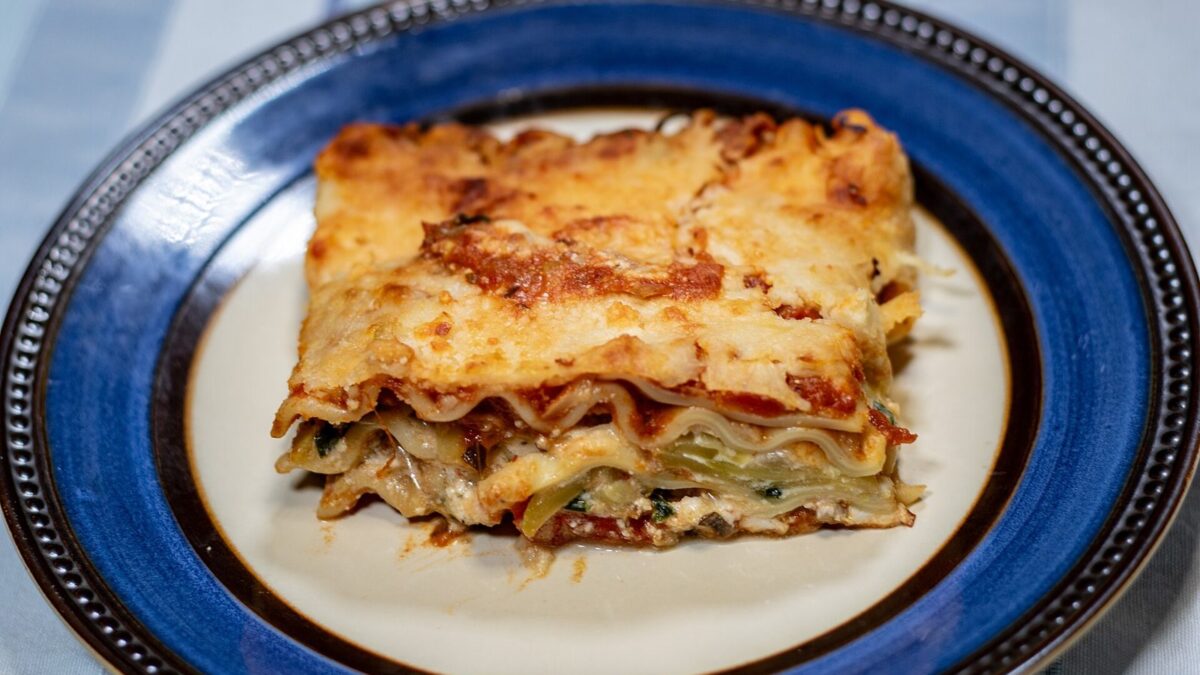
The lasagna that taught me this recipe came out of the oven looking flawless and hit the plate as soup. My sister’s birthday, nine people round a table meant for six, and I cut the first square with a lot of confidence. A puddle of pale orange water ran across the plate, under the garlic bread and off the edge. The layers slumped sideways. Everyone was very kind about it, which somehow made it worse.
I had followed the recipe exactly. What it never mentioned was that two medium courgettes and one aubergine hold roughly a cup and a half of water between them, and all of it has to go somewhere. In a beef lasagna the meat browns in a pan and most of that liquid boils off before it reaches the dish. Slice the veg raw and layer it straight in, and the water leaves during those 50 minutes in the oven with nowhere to go but your sauce.
So this version is built around the water. The ricotta, the marinara, the 9×13-inch pan: all standard, and if you make our meat-sauce lasagna this will feel familiar. The moisture handling is the part worth reading.
Prep: 45 mins · Cook: 50 mins · Rest: 15 mins · Serves 8
Where the Water Actually Comes From
Three sources, and they are not equal.
Courgette is the worst offender by volume. It’s over 90 percent water and releases most of it between 60°C and 80°C, exactly the band the middle of your lasagna sits in for half an hour. Aubergine holds less but its spongy structure soaks up oil and then squeezes out both. Mushrooms lose a lot of liquid fast and early, so they’re the easiest to fix. The ricotta is the fourth source nobody warns you about.
The fixes are all pre-oven, and cost about 25 minutes of mostly waiting:
- Salt the courgette and aubergine before roasting. A teaspoon of fine salt over the cut pieces in a colander, tossed, left 15 minutes. Water beads on the surface within about 5 minutes. Blot with a tea towel, don’t rinse.
- Roast, don’t sauté. A hot oven drives moisture off into the air. A crowded pan just traps it.
- Drain the ricotta in a fine sieve set over a bowl while the veg roasts. It needs no attention.
Does salting make the aubergine less bitter? Modern aubergines are bred mild enough that I can’t tell in a blind taste. I do it for the water.
Two Trays, Not One
This is the mistake I made for years, and the one that quietly undoes the salting. Two courgettes, one aubergine, 8 oz of mushrooms and a bell pepper is close to five packed cups. On one half-sheet pan they sit two deep, and the pieces underneath steam at 100°C rather than roast. You’ll pull the tray out after 25 minutes and find grey, floppy courgette in a shallow pool.
Split it across two pans, or do the mushrooms separately in a dry frying pan over high heat for 6 to 8 minutes, which is faster anyway. You want browned edges and pieces that have visibly shrunk by about a third. If nothing has coloured, it isn’t done, whatever the clock says.
Ingredients
- 12 lasagna noodles, cooked according to package instructions
- 2 medium zucchini (courgettes), sliced into thin rounds
- 1 medium eggplant (aubergine), diced small
- 1 teaspoon fine salt, for drawing water out of the zucchini and eggplant
- 8 oz cremini mushrooms, sliced
- 1 red bell pepper, diced
- 3 tablespoons olive oil, for roasting
- Salt and black pepper, to taste
- 15 oz ricotta cheese, drained in a sieve for 20 minutes
- 1 large egg, for binding the ricotta mixture
- 1/4 cup chopped fresh basil, plus more for garnish
- 1/2 teaspoon dried oregano
- 3 cups marinara sauce, store-bought or homemade
- 3 cups shredded mozzarella cheese, divided
- 1/2 cup grated Parmesan cheese, divided
Instructions
- Toss the sliced zucchini and diced eggplant with the 1 teaspoon of fine salt in a colander and leave for 15 minutes. Blot dry with a tea towel; do not rinse. Meanwhile, tip the ricotta into a fine sieve set over a bowl and leave it to drain.
- Preheat the oven to 400°F (200°C). Spread the zucchini, eggplant, mushrooms, and bell pepper across two large baking sheets in a single layer, drizzle with olive oil, and season with pepper and a little more salt. Roast for 20-25 minutes, stirring halfway, until the edges are browned and the pieces have shrunk noticeably. Set aside.
- Reduce the oven temperature to 375°F (190°C). Discard the whey from the ricotta bowl. In a medium bowl, mix the drained ricotta, egg, chopped basil, oregano, a pinch of salt, and pepper until smooth.
- Spread a thin layer of marinara sauce over the bottom of a 9×13-inch baking dish.
- Lay 4 lasagna noodles over the sauce, slightly overlapping if needed. Spread a third of the ricotta mixture over the noodles, then a third of the roasted vegetables, a third of the remaining marinara, and about 1 cup of mozzarella.
- Repeat the layering twice more: noodles, ricotta, vegetables, marinara, mozzarella, finishing with the last of the mozzarella and a sprinkle of Parmesan.
- Cover tightly with foil, tented so it doesn’t touch the cheese, and bake for 30 minutes.
- Remove the foil and bake another 15-20 minutes, until the cheese is bubbling and golden in patches and the sauce is visibly simmering at the edges of the dish.
- Rest the lasagna 15 minutes before cutting. Set a timer. This is the step everyone skips and it is the difference between a slice and a landslide.
- Garnish with fresh basil and extra Parmesan.
The Ricotta Step I Used to Skip
Twenty minutes in a sieve. That’s it. I ignored it for about four years because it sounded fussy.
Then I made two 9×13 pans on the same afternoon, one with drained ricotta and one straight from the tub, to settle it. A 15 oz tub gave up nearly three tablespoons of whey. The drained pan held a clean edge when I cut it; the undrained one wept along the cut line within a minute. Whole-milk ricotta sheds more than part-skim, so buying the good stuff means you need this more, not less.
The egg isn’t there for richness. One large egg sets the ricotta layer just enough that it behaves like a soft custard instead of a spreadable cheese. The same drained-ricotta trick carries over to our spinach and ricotta stuffed shells, where stray liquid has nowhere to hide either.
What I’d Change Next Time
Two things, honestly.
I’d cut the courgette thicker. Thin rounds practically dissolve after 25 minutes of roasting plus 50 in the oven; half-inch half-moons keep some bite. That’s a preference, not a rule.
And I’d hold back half a cup of the mozzarella for the last 10 minutes uncovered instead of loading it all on before the foil. Cheese that spends 30 minutes under foil goes greasy and pulls into strings rather than browning. The late handful gives you the dark blistered spots.
One thing I wouldn’t change: three cups of sauce is already generous for veg you dried out on purpose, and adding more to “help” the noodles puts you back at square one. No-boil noodles are the exception, needing an extra quarter cup.
Serve it with something sharp. Garlic bread is the obvious partner, and baked ziti uses the same drained-ricotta logic with a fraction of the assembly.
Reader Questions I Get About This One
Can I assemble it the day before?
Yes, and it’s better for it. Assemble fully, cover, refrigerate up to 24 hours, and add 10-15 minutes to the covered bake because it goes in fridge-cold. No-boil noodles sitting overnight in sauce turn gummy, so use regular cooked ones.
Why did mine still come out watery after roasting?
Almost always a crowded pan, so the veg steamed. Check whether anything actually browned. If the pieces are pale and the size they went in at, that’s your answer.
Can I freeze it?
Up to 3 months wrapped tightly in plastic and foil, baked or unbaked. From frozen, bake covered at 375°F (190°C) for about 75 minutes, then uncovered for 20.