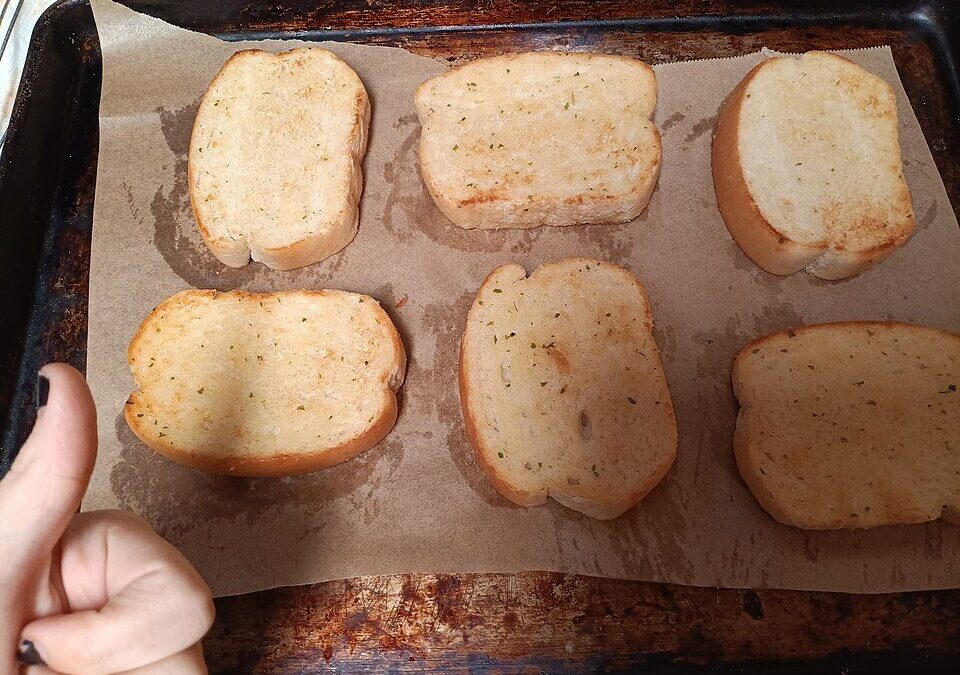
Garlic bread goes wrong in about five specific ways, and every one of them happens before the bread ever hits the oven. Wet middle, scorched garlic, cheese that peels off in a single sheet, bread like a cracker, a yellow puddle in the foil. Fix those and the recipe at the bottom of this page is almost incidental.
I make this two or three times a month, usually on a weeknight when there’s pasta on the stove and nothing else planned. The first dozen times I made it, at least half came out with a stripe of damp bread down the centre. So this is written in the order things actually fail, not in the order recipes usually list steps.
Prep: 12 mins Bake: 12 mins Serves: 6
The damp stripe down the middle
Cut into a bad piece of garlic bread and you’ll find a band of bread just under the cheese that’s gone from crumb to paste. It hasn’t been undercooked. It’s been soaked and then steamed.
Two causes, and they compound. The first is butter volume. Most recipes I’ve followed call for 6 tablespoons on a single loaf, and on a soft-crumbed supermarket Italian loaf that’s too much: the crumb has nowhere to put it, so it sits and turns the interior greasy-wet before the oven can drive any of it off. Four tablespoons on a loaf around 14 inches long is enough to cover both cut faces with a thin, even film. If you can see the butter as a layer rather than as a sheen, it’s too much.
The second cause is foil. Covering the tray, or wrapping the loaf to “heat it through”, traps every bit of steam the bread releases and sends it straight back into the crumb. Twelve minutes uncovered at 200°C (400°F) gives you crisp edges. Twelve minutes wrapped gives you a hot damp sponge with melted cheese on it. Bake it open, always. And use a loaf that’s a day old: drier crumb, more room for butter, the same reason stale bread beats fresh for tomato bruschetta.
Black flecks that taste like ash
Raw minced garlic sitting exposed on top of the bread is the single most common mistake, and the standard recipe instruction causes it. Garlic pieces that small, uncovered, at 200°C, are burnt in around 8 minutes. Burnt garlic isn’t merely strong — it’s bitter in a way that carries across the whole slice, and no amount of parsley on top covers it.
Two fixes, and I use the second one.
Fix one: bury it
Mash the garlic thoroughly into softened butter until no piece is sitting proud of the surface, then cover every bit of it with cheese. Cheese shields the garlic from direct radiant heat. This works, but it only works if your cheese coverage is genuinely complete, and edges are usually where it fails.
Fix two: warm the garlic in the butter first
Melt the butter in a small pan over the lowest heat, drop in the minced garlic, and leave it 2 to 3 minutes — just until it smells sweet rather than sharp and has gone the palest gold. Take it off before it colours properly. Let it cool until it’s thick and spreadable again, about 10 minutes on the counter, or 4 in the fridge with a stir halfway. The garlic is already cooked at that point, so the oven can’t scorch it, and the flavour is rounder. It costs you ten minutes and it’s the difference between good and very good.
Cheese that lifts off in one sheet
You pick up a slice and the entire cheese layer comes away like a lid, leaving bare bread underneath. Annoying, and avoidable.
It’s a binder problem. Cheese needs something tacky beneath it to grip, and a fully-melted butter layer isn’t tacky — it’s slick. Softened butter mashed to a paste holds cheese; butter that’s gone liquid on warm bread does not. That’s why I chill the garlic butter back to spreadable rather than pouring it on melted.
Cheese choice matters just as much. Low-moisture mozzarella sold in a block, grated at home, melts into the surface. Fresh mozzarella packed in water releases liquid and floats on its own whey, which is exactly the sheet you’re peeling off. Pre-shredded bagged mozzarella is coated in potato starch or cellulose to stop it clumping, and that coating keeps it from bonding properly too — it melts, but it melts as a separate layer.
The reliable combination: grate a block of low-moisture mozzarella for stretch, and mix through a third as much parmesan. Parmesan has less moisture and more protein, and it effectively glues the mozzarella down. A thin scatter of parmesan directly onto the butter, before the mozzarella, works even better.
Bread that bakes into a rusk
Hard all the way through, no soft crumb left, shatters into shards instead of tearing. Two causes.
Slice thickness is the first. Halving a loaf lengthwise leaves each piece around 1.5 inches deep, and that survives 12 minutes fine. Cutting a baguette into thin diagonal slices leaves maybe half an inch, and half an inch dries right through in the same time. If you’re using a baguette, cut it lengthwise, not across.
The second is reheating. Garlic bread survives exactly one reheat. Five minutes at 175°C in a toaster oven brings back the crisp edge on day-old pieces. A second trip after that and there’s no moisture left to protect — you get something closer to a crouton. My honest advice is to bake only what’s going on the table and freeze the rest assembled and unbaked, wrapped tight, then bake from frozen with 5 extra minutes. Frozen-then-baked is noticeably better than baked-then-reheated, and I say that having done both for the same dinner to compare.
The yellow pool in the foil
If there’s a slick of clear fat in the tray when you pull it out, the butter has broken: the water and milk solids have separated out and the fat has run off the bread instead of soaking in.
Usually it’s simply too much butter again. Sometimes it’s oil — a tablespoon of olive oil stirred into the butter sounds like extra richness but it lowers the mixture’s ability to hold together and it’s the first thing to run. I’ve stopped adding it. Butter also splits if you cool it without stirring, so stir the pan mixture every few minutes as it sets; a teaspoon of cold water whisked in usually brings a grainy batch back.
Salted butter is fine here, incidentally. Just drop the added salt to a pinch.
Ingredients
- 1 loaf Italian or French bread, about 14 inches — a day old, halved lengthwise
- 4 tablespoons unsalted butter
- 4 cloves garlic, finely minced
- 1/2 cup grated parmesan, divided
- 1 1/2 cups low-moisture mozzarella, grated from a block
- 2 tablespoons flat-leaf parsley, chopped
- 1/4 teaspoon salt (a pinch only if using salted butter)
- 1/4 teaspoon black pepper
- 1/4 teaspoon red pepper flakes (optional)
Instructions
- Melt the butter in a small pan over the lowest heat. Add the garlic and cook 2 to 3 minutes, stirring, until it smells sweet and is barely pale gold. Pull it off the heat before it takes on real colour.
- Scrape into a bowl and let it cool to a thick, spreadable paste, stirring every few minutes so it doesn’t separate. Roughly 10 minutes on the counter. Stir in the parsley, salt, pepper and chilli flakes.
- Heat the oven to 200°C (400°F). Line a baking sheet with parchment. Halve the loaf lengthwise.
- Spread the garlic butter thinly and completely over both cut faces, right to the edges and corners. You want a sheen, not a layer.
- Scatter half the parmesan directly onto the butter. This is the grip layer.
- Cover with the mozzarella, then the remaining parmesan. Push cheese right out to the edges — bare edges burn.
- Bake uncovered, 10 to 12 minutes, until the cheese is fully molten and the crust underneath is firm when tapped.
- Grill (broil) 60 to 90 seconds for browned patches if you want them. Stay at the oven door; it turns in seconds.
- Rest 2 minutes before slicing so the cheese sets enough to stay put, then cut into thick pieces.
If you’re serving this alongside something already rich, cut the parmesan back — with classic beef lasagna or baked ziti the extra salt is genuinely too much, and I’ve learned that at my own table more than once. With creamy tomato soup, keep it as written and cut the pieces small enough to dunk.