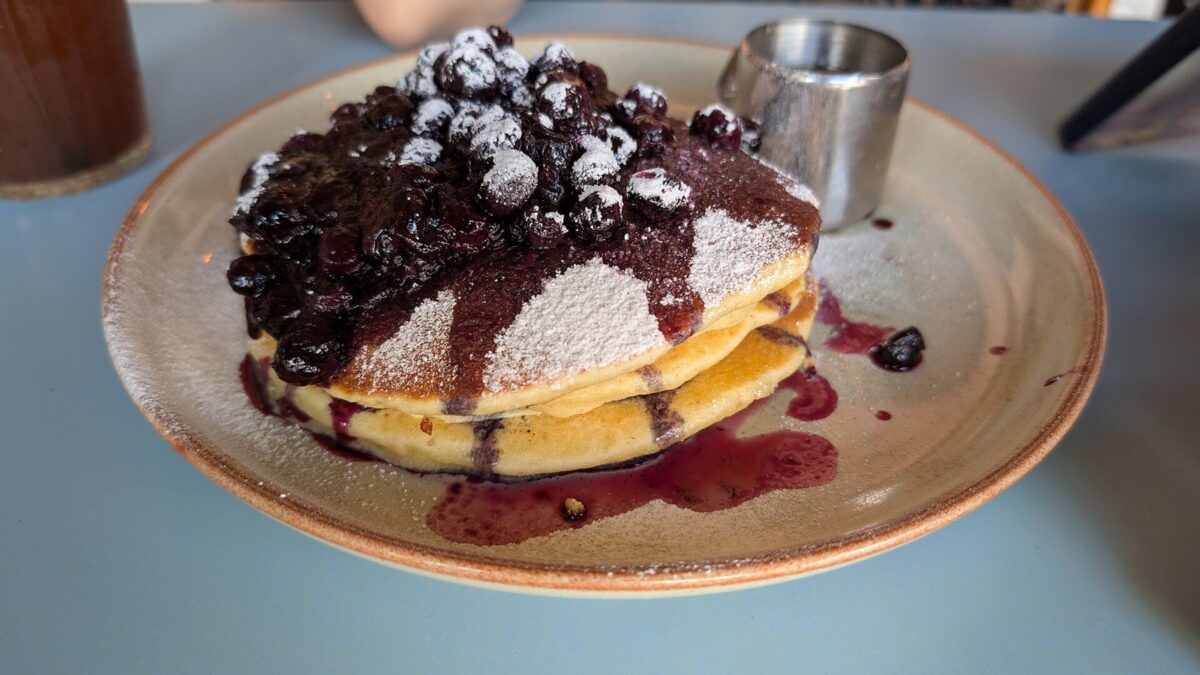
A blueberry is a cold, wet, heavy little sphere with a waxy skin, and you are asking it to sit still inside a hot batter that is trying to rise around it. Almost everything that goes wrong with blueberry pancakes comes from that one sentence.
Sinking to the bottom. Bleeding grey-green streaks instead of purple. A raw, gluey patch in the middle while the outside is already brown. Those aren’t three separate problems, they’re three consequences of the same physical facts, and once you know which fact causes which, the fixes are obvious and take no extra time.
This post is about the fruit, not the batter. If you want the batter itself pulled apart — resting, gluten, buttermilk, why yours came out flat — that’s covered in my fluffy buttermilk pancakes post, and I’d rather send you there than repeat it badly here.
Why They Sink
Pancake batter at the moment it hits the pan is loose, roughly the consistency of thick double cream, and a blueberry is denser than it is. Gravity does the rest before the batter has set enough to hold anything in place.
The setting is the key part. Batter poured onto a 175°C surface takes something like 45 to 60 seconds before the underside firms into a structure that can support weight. Anything you stir in before that has a full minute to travel downwards, and it will use it. That’s why folded-in berries end up in a purple stripe at the bottom of the pancake, in contact with the hottest surface, scorching while the top is still pale.
The fix costs nothing: don’t stir them in at all. Pour the plain batter, count two or three seconds, then drop the berries onto the surface one at a time. They sink a little way in and stop, suspended in batter that’s already thickening. You also get to control the distribution, which no amount of gentle folding gives you — I aim for six to eight berries per 1/4-cup pancake, spaced so no two touch.
Frozen berries sink less than fresh ones, oddly enough. They’re stiffer, they don’t deform against the batter, and the batter around them chills and thickens on contact. That’s an advantage for placement and a problem elsewhere, which I’ll get to.
Why the Batter Turns Grey-Green, Not Purple
This one genuinely confused me for years. I’d make a batch that came out attractively lilac and a batch that came out the colour of a bruise, from the same bag of berries.
The pigments in blueberry skin are anthocyanins, and anthocyanins change colour with pH. In acidic conditions they read red and pink. Push them alkaline and they slide towards blue, then a murky green. Pancake batter contains baking soda, which is alkaline, so any juice that escapes the skin and meets the soda directly turns exactly that unappetising green-grey — usually as a halo around each berry on the underside of the pancake.
So the colour problem is really a burst-skin problem. Three things burst skins:
- Stirring. A spatula folding berries through batter crushes a percentage of them every time. This is the biggest single cause.
- Thawing frozen berries. Ice crystals rupture the cell walls from inside, so a thawed berry leaks the moment you touch it. Use them straight from the freezer, no rinse, no thaw.
- Overripe fruit. Berries that have gone slightly wrinkled or that leave a purple smear in the punnet are already leaking. They’re fine to eat and bad in pancakes.
If you want to nudge the chemistry as well, a teaspoon of lemon juice in the wet ingredients keeps things fractionally more acidic and the halos come out closer to violet than green. It’s a small effect. Not bursting the berries is a large one.
Why the Middle Stays Raw
A frozen blueberry is at roughly -18°C. Drop eight of them into a pancake and you’ve put a set of little cold sinks into the middle of something you’re trying to cook in three minutes.
The heat arriving from the pan gets spent thawing them instead of setting the batter around them, so you get a properly browned base, a cooked rim, and a wet gluey ring circling each berry. Slicing into it, it looks underbaked, because it is.
Two fixes, and I use both:
- Drop the pan heat by a notch and extend the cook. Medium-low, around 2:30 to 3 minutes on the first side rather than 2, gives the heat time to travel inward rather than just browning the outside.
- Make the pancakes smaller. A 1/4-cup pancake, about 11cm across, cooks through with frozen fruit in it. A half-cup pancake at 15cm usually doesn’t.
Fresh berries at fridge temperature cause a mild version of the same thing. Taking them out 15 minutes before you cook is a small kindness that costs you nothing.
Fresh, Frozen, or Dried
Fresh is best in July and August, when they’re firm and the skins snap. Out of season I buy frozen without hesitation — February blueberries have usually travelled a long way and go soft and mealy in the pan, which is exactly the leaking you’re trying to avoid.
Dried I’d skip. They rehydrate unevenly in the two or three minutes a pancake gets, so half stay chewy and half go leathery where they touch the pan.
Sizing and Prepping the Berries
Small berries, around 6 to 8mm across, are the best pancake fruit by some distance. They hold their shape, they don’t leave a wet cavity when they do burst, and you fit more per pancake so every bite gets some.
The big fat cultivated ones, 14mm and up, hold a surprising amount of juice, and when one goes it goes properly. If big is what you’ve got, halve them and set them cut-side up on the batter. Takes fifteen seconds and stops the blowouts.
Dry fresh berries properly on a tea towel after rinsing. Wet ones slide on the batter and drag a wash of pale juice across the top. I skipped that step once in a hurry and the first batch came out looking tie-dyed.
Ingredients
- 1 1/2 cups all-purpose flour, spooned into the cup and levelled
- 2 tablespoons granulated sugar
- 2 teaspoons baking powder
- 1/2 teaspoon baking soda, which reacts with the buttermilk
- 1/2 teaspoon fine salt
- 1 1/4 cups buttermilk, or milk with 1 tablespoon lemon juice stirred in and left 5 minutes
- 1 large egg, lightly beaten
- 3 tablespoons unsalted butter, melted and cooled slightly
- 1 teaspoon vanilla extract
- 1 cup blueberries, fresh and dried on a towel, or frozen and still frozen solid
- Butter or neutral oil for the pan
- Maple syrup, to serve
Instructions
- Whisk the flour, sugar, baking powder, baking soda and salt together in a large bowl for a good 20 seconds, so the soda is evenly dispersed. Pockets of undispersed soda are where the worst green halos come from.
- In a second bowl, whisk the buttermilk, egg, melted butter and vanilla until smooth.
- Pour the wet into the dry and fold with a spatula just until no dry flour is visible. Roughly ten strokes. The batter should be lumpy and thick enough to mound briefly on the spatula. Leave it to rest 5 minutes.
- Heat a heavy pan or griddle over medium-low, about 175°C. Add a small knob of butter. A drop of water flicked on should skitter and hiss rather than vanish instantly.
- Pour 1/4 cup of batter per pancake, leaving space between them. Count to three.
- Now place 6 to 8 blueberries onto each pancake, one at a time, spaced apart. Don’t stir. Don’t press them under.
- Cook 2 1/2 to 3 minutes, until bubbles break at the surface and the edges look matte and set rather than glossy.
- Flip once. Cook another 1 1/2 to 2 minutes. The berry side needs less time than you’d think and will darken fast where a berry has leaked.
- Move them to a rack in a 90°C oven while you cook the rest — a rack, not a plate, so the base doesn’t steam soft. Wipe the pan with kitchen paper between batches to lift the burnt sugar from any leaked juice, then add fresh butter.
- Serve hot with maple syrup and a few extra raw berries scattered over.
The Pan Temperature Blueberries Force You Into
Plain pancakes are happy at a fairly brisk medium. Blueberry ones aren’t. Fruit means lower heat and longer time, always.
Sugar in the leaked juice caramelises and then burns well before the pancake is done at high heat — near-black rings on the second side while the crumb is still wet. On my hob that’s one notch below where I’d cook a plain stack, and about a minute longer per batch. You’ll also need to wipe the pan more often: by the third batch the scorched sugar left behind turns everything after it bitter and patchy. Ten seconds with kitchen paper and fresh butter resets it.
Wild Blueberries Change the Rules
Frozen wild blueberries, the tiny ones in a lot of freezer aisles, beat anything fresh outside high summer. About a third the size, much more intense, and their skins are tougher relative to their volume, so they burst far less.
Use more, around 12 to 15 per pancake, and scatter rather than place — at that size individual placement isn’t worth the effort. Each one carries less ice than a big frozen berry too, so the raw-middle problem mostly goes away.
If Yours Still Bleed
Assuming you’ve stopped stirring them in and you’re not thawing frozen fruit, one culprit is left: the spatula on the flip. Landing a pancake hard, or pressing it down after the flip, crushes every berry sitting in it. I did this for years out of a vague belief that pressing helps them cook. It doesn’t. It squeezes out the air the baking powder just made and it ruptures the fruit at the same time.
Lift, turn wrist, lower gently, hands off. If a pancake comes off the pan cleanly and lands without a splat, the berries inside stay whole and each one delivers a warm burst instead of a stain.
One last practical note, worth more than anything else here if you cook for a crowd: batter with berries already on it can’t wait. Mix the batter, and only add fruit as each pancake goes into the pan. A bowl of pre-mixed blueberry batter sitting on the counter for ten minutes will be grey by the time you get to the bottom of it, and there’s no reversing that.