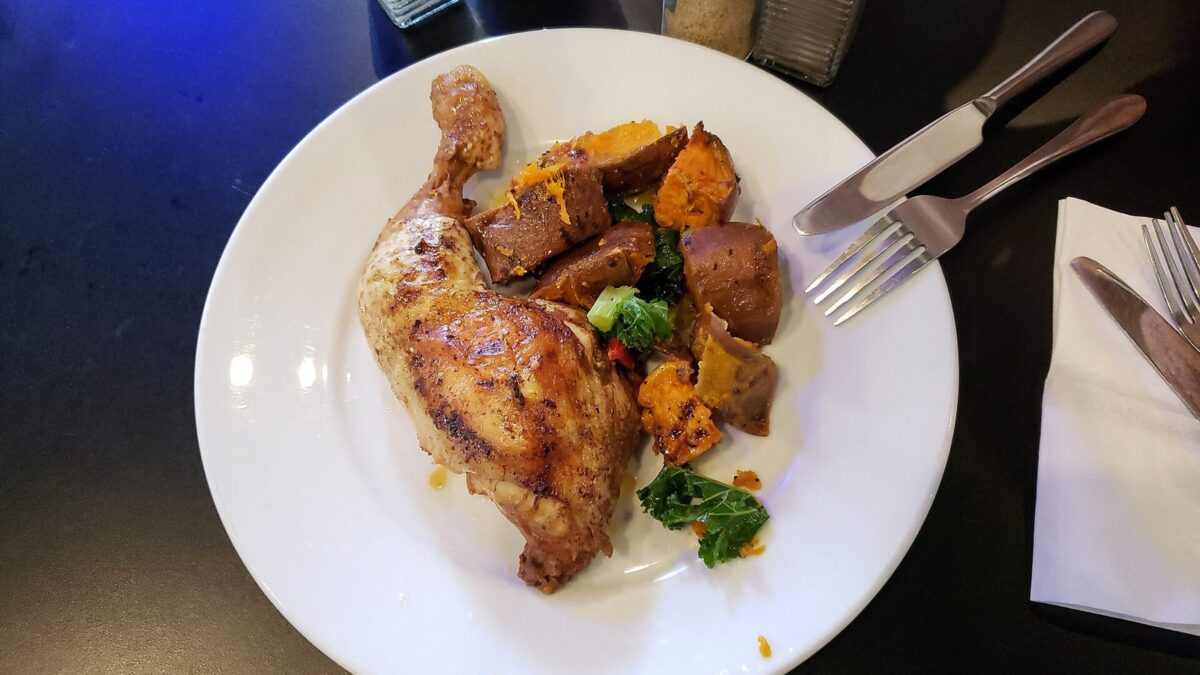
A roast chicken is five or six ingredients and one oven, which is exactly why it is annoying when it goes wrong. There is nothing to blame. Here are the five failures I have personally produced, what causes each one, and the fix, before the recipe itself.
Prep: 20 mins, plus overnight dry-brine Cook: 80 mins Serves: 4
Failure one: pale, flabby skin
Skin browns when it is dry. Water on the surface has to boil off before anything above 100C can happen there, and while it is boiling off the skin is steaming, not roasting.
Supermarket chickens come out of the packet genuinely wet. A single wipe with kitchen paper does not do it, and neither does an hour on the counter.
The fix is to salt the bird and leave it uncovered on a rack in the fridge overnight. The salt draws moisture out, then the fridge air, which is dry, takes that moisture away. By morning the skin feels like parchment and looks slightly translucent. That is the texture you want going into the oven. Eight hours makes a clear difference; twenty-four is better. If you have twenty minutes and not twenty hours, pat it hard, then blast it with a hairdryer on cool for two minutes, which sounds ridiculous and does work.
Salting ahead does two jobs at once: dries the skin, and seasons the meat all the way through rather than just the surface. My ratio is roughly 1 teaspoon of fine salt per 500g of bird, so about 3 to 3.5 teaspoons for a 1.7kg chicken. Scatter it evenly over the whole surface including the back, get a little inside the cavity, and then leave it alone. Do not add more salt to the outside afterwards.
Cut the salt in the herb butter to a large pinch if you have dry-brined. I forgot that once and the gravy was inedible.
Failure two: dry breast, thighs still pink at the bone
The commonest one, and it is structural, not a mistake. Breast meat is done at about 65C / 150F. Thigh meat is technically safe at 74C / 165F but only tastes right, with the connective tissue softened, closer to 75 to 80C. The two are attached to the same bird and one of them sits proud of the surface while the other is tucked into a joint.
Three things narrow the gap. Roast the bird breast up but on a bed of onion and carrot chunks, which lifts the thighs into circulating hot air. Start the oven higher, at 220C for the first 20 minutes, then drop to 190C, so the skin gets its colour early rather than needing extra minutes at the end. And if you own an instant-read thermometer, use it as the actual decision-maker: thigh at 74C / 165F, measured in the thickest part without touching bone. An air fryer closes the same gap differently, by starting the whole bird breast-side down in the basket.
Time-per-weight rules are a starting estimate only. My oven runs about 12 degrees cool at the back, which I found out with a cheap oven thermometer, and every chart I had ever followed was wrong for me because of it.
Failure three: herbs burnt black on top of the bird
Chopped rosemary and thyme sitting on the surface of a 200C chicken for 80 minutes will scorch. Burnt rosemary is properly bitter and it gets into the pan juices.
So put the herb butter under the skin, not on it. Loosen the skin over each breast with your fingers, working from the neck end, and push the butter into the gap. The skin shields it, the butter melts down through the meat, and nothing burns. Rub the outside of the bird with plain oil or plain butter and salt only.
Whole sprigs, tucked in the cavity along with the lemon, perfume the meat from the inside and cannot burn.
Failure four: pan juices scorched to a bitter crust
You lift the chicken out and the bottom of the pan is black, not brown, and everything you try to make gravy with tastes of ash.
Usually the pan was too large. In a big roasting tin the fat and juices spread into a thin film that hits the metal, dries out, and burns. Use a pan that the bird roughly fills, so the liquid pools deep enough to stay liquid.
The vegetable bed does double duty here: it holds moisture and keeps the drippings off the hot base. And if you look in at the 45-minute mark and the pan is dry, add 100ml of water or stock. Not over the bird, into the corner of the pan.
Failure five: the chicken welded itself to the pan
You go to lift it and the skin tears off the back in a sheet, which is heartbreaking after all that work on the skin.
It happens when the bird sits on hot metal and the rendered fat and protein glue it down. The onion-and-carrot bed prevents it almost entirely, and a small V-rack does the same job. Lift with tongs inside the cavity and a fish slice underneath, never by grabbing the legs.
Ingredients
- 1 whole chicken, about 1.6-1.8 kg / 3.5-4 lb
- 3 teaspoons fine salt, for the dry brine (about 1 tsp per 500g)
- 4 tablespoons softened butter, for under the skin
- 3 cloves garlic, finely minced
- 2 tablespoons fresh thyme leaves, or 2 teaspoons dried
- 2 tablespoons chopped fresh rosemary, plus 3 whole sprigs for the cavity
- 1 tablespoon chopped fresh parsley
- 1 lemon, halved
- 1/2 teaspoon black pepper, freshly ground
- 1 onion, quartered
- 2 carrots, cut into thick chunks
- 1 tablespoon olive oil, for the vegetables and the skin
Instructions
- The night before. Pat the chicken dry, scatter the 3 teaspoons of salt evenly over every surface including the back and inside the cavity, and set it on a rack over a plate. Refrigerate uncovered for 8 to 24 hours.
- Take it out 45 minutes before roasting. Heat the oven to 220C / 425F. The skin should look dry and tight.
- Make the herb butter. Mash the softened butter with the garlic, thyme, chopped rosemary, parsley, pepper and only a large pinch of salt.
- Get it under the skin. Slide your fingers between skin and breast from the neck end, working carefully so you do not tear it, and push the butter into the pocket over both breasts and as far down the thighs as you can reach. Rub the outside with a little olive oil.
- Fill the cavity with the lemon halves and rosemary sprigs. Tie the legs together and tuck the wing tips under.
- Build the bed. Toss the onion and carrot with olive oil in a roasting tin roughly the size of the bird, and set the chicken on top, breast up.
- Roast hot, then drop. 20 minutes at 220C / 425F, then reduce to 190C / 375F for a further 55 to 65 minutes. Check the pan around the 45-minute mark and add 100ml water if it looks dry.
- Test the thigh. 74C / 165F in the thickest part, away from bone. The breast will read 68 to 70C, which after resting is exactly right. If the thigh is short, give it 10 more minutes and check again.
- Rest 15 to 20 minutes on a board, loosely tented. Carry the pan juices and the vegetables to the table separately.
- Carve. Legs and thighs off first, then the wings, then run your knife down either side of the breastbone and take each breast off whole before slicing it across the grain.
Where the thermometer goes, and the resting rise
Into the joint between thigh and body, pushed in sideways towards the centre of the thigh muscle, angled away from the bone. Bone conducts heat faster than meat and will read high, which is how people pull an underdone chicken out feeling confident.
Expect the temperature to keep climbing 2 to 4C during the rest. On a bird this size that is not enough to plan around, but it is why 74C in the thigh at the moment you pull it is genuinely done and not borderline.
Juices running clear is a rougher test than people think. It tells you the meat is not raw. It does not distinguish 68C from 82C, and 82C is a dry chicken.
The carcass is worth more than the leftovers
Strip the meat, then put the whole frame into a pot with the roasted onion and carrot from the pan, cover with cold water, and simmer for three hours at the barest bubble. You will get about a litre of stock that sets to jelly in the fridge, and that stock is the difference between a decent chicken noodle soup and a memorable one.
Cold roast chicken is also better than reheated roast chicken, and I will argue that with anyone. Reheating drives more moisture out of meat that is already cooked. Slice it cold into sandwiches instead.
If a whole bird feels like too much on a Wednesday, the garlic butter chicken with herb rice gets you most of the same flavours in about 35 minutes, and crispy fried chicken is the place to go if what you actually wanted was the skin. The roasted vegetable medley shares the oven happily on the shelf below, as long as you accept it will need a few extra minutes at the lower temperature.