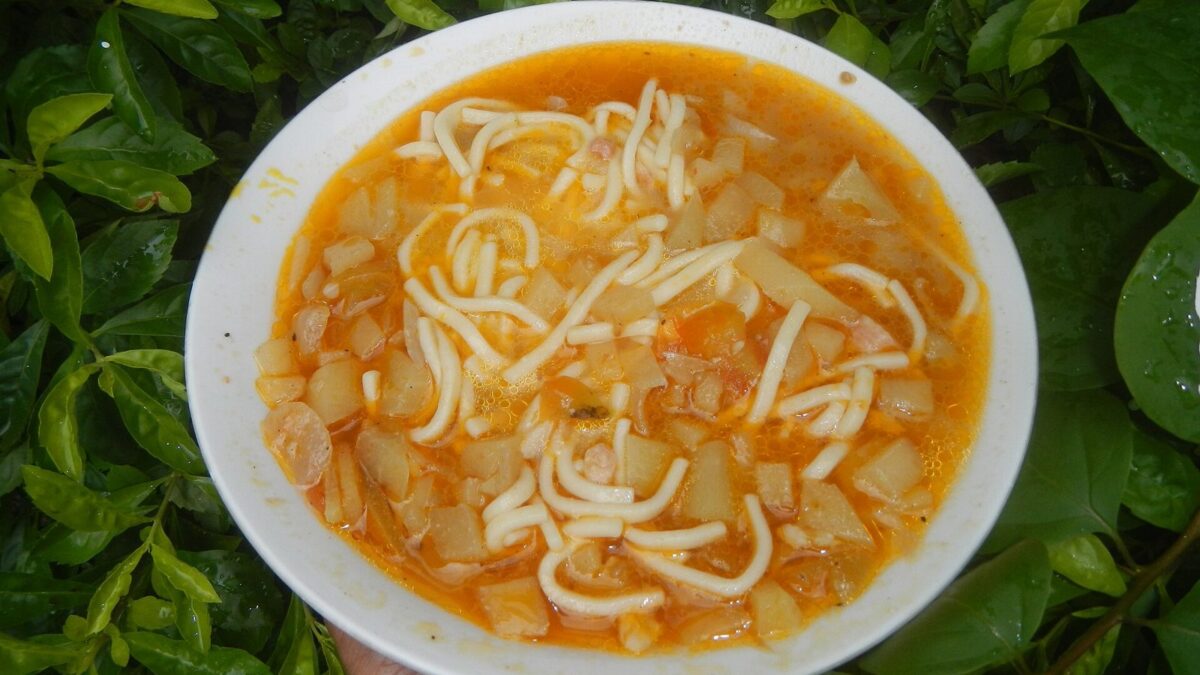
Every chicken noodle soup recipe claims to be from scratch, and almost none of them agree on what that means. There are three honest ways to get the broth, they take between 25 minutes and a little over two hours, and the results are genuinely different. Here’s what each one gives you, and which I actually make on a Tuesday.
Serves 6 · Total time 25 mins to 2 hrs 15 mins depending on the route you take
Route One: Poaching a Whole Chicken
A 1.6kg/3.5lb bird, breast down in a tall pot, covered with about 3 litres of cold water, brought slowly to a bare simmer and held there for 75 to 90 minutes. You lift out the chicken, pull the meat, and put the bones back in for another 30 minutes if you have the patience.
What you get is broth with body. The skin, wings, and the cartilage at every joint release collagen that turns to gelatin, and a properly made batch will set to a soft wobble in the fridge overnight. That’s the texture nobody can fake with a carton. It coats the spoon slightly. It tastes of chicken and nothing else.
What it costs is time and attention. It also produces about 2.5 litres of broth and roughly 700g of cooked meat, which is more than one pot of soup needs — a fair chunk of the value is what you do with the surplus.
Route Two: Shop-Bought Stock and Chicken Breast
Twenty-five minutes, start to bowl. Soften the vegetables, pour in 8 cups of carton stock, poach the breasts in it, shred, add noodles.
I want to be fair about this one because it’s what most people will actually do. The flavour is fine. The problem is body: carton stock is thin, it doesn’t coat anything, and the soup reads as vegetables and chicken floating in seasoned water rather than as one thing. You notice it most on the second spoonful, when the broth is already gone from your mouth.
Three things narrow the gap. Use bone-in, skin-on thighs instead of breasts — they take 30 to 35 minutes rather than 18, and the bones and skin give the carton stock something to work with. Simmer a parmesan rind in the pot and fish it out at the end. And add half a teaspoon of fish sauce, which nobody will identify and everybody will notice.
Route Three: Roasting the Bones First
Take a chicken carcass, or 1kg of wings and backs, spread them on a tray and roast at 220°C/425°F for 30 to 35 minutes until they’re properly browned, then simmer them in 2.5 litres of water for 90 minutes.
The broth comes out darker, deeper, faintly roasty. It’s excellent. It is also not really chicken noodle soup broth — it leans towards the flavour you want under a gravy or a French onion, and next to a poached-bird broth it tastes cooked rather than clean. The vegetables in the finished soup have to compete with it instead of sitting inside it.
Where it makes total sense is when you already have a carcass. If Sunday was roast chicken, the bones are already browned, and simmering them on Monday costs you nothing but 90 minutes of a back burner.
The Comparison at a Glance
| Route | Hands-on | Total | Broth body | Best for |
|---|---|---|---|---|
| Whole poached chicken | 25 mins | 2 hrs 15 | Sets in the fridge | A pot worth planning for |
| Carton stock + breast | 20 mins | 25 mins | Thin, no set | Weeknights, sick days |
| Carton stock + bone-in thighs | 20 mins | 50 mins | Slight richness | The realistic middle |
| Roasted bones | 15 mins | 2 hrs | Full, darker | Leftover roast carcass |
Which One I Make
The poached whole bird, when I have a free afternoon. It’s the best soup by a clear margin and I’m not going to hedge about it.
But I make the middle option four times as often: carton stock plus bone-in thighs, 50 minutes, one pot. It gets maybe 70 percent of the way there for a third of the time, and on a weeknight that’s the trade I’ll take every time. The recipe below is written that way, with the whole-bird variation noted where it diverges.
The one I’d skip entirely is carton stock with boneless breast. It’s the fastest and it’s also the version that tastes like a compromise, which is a strange thing to serve someone who isn’t well.
Noodles In the Pot or Cooked Apart
In the pot if you’re eating it all tonight. The noodles release starch as they cook, which thickens the broth very slightly and makes it cling — a real gain, and it costs nothing.
Separately if there will be leftovers, and there always are. Egg noodles left sitting in hot broth keep swelling. By the next morning they’ve bloated, gone soft at the edges and drunk about a third of your liquid, so you reheat a bowl of noodles in damp vegetables. Cook them in salted water, drain, toss with a teaspoon of oil, and keep them in their own container. Two minutes of extra washing up buys you a second day of actual soup.
Wide egg noodles take 6 to 8 minutes. If you’re going in the pot, add them when the broth is at a proper simmer and start tasting at 5.
Ingredients
- 2 tablespoons butter or olive oil
- 1 medium onion, diced
- 3 carrots, sliced into coins
- 3 celery stalks, sliced
- 3 garlic cloves, minced
- 8 cups low-sodium chicken stock
- 1.5 lbs bone-in, skin-on chicken thighs — about 4; boneless breasts work but see the note on timing
- 2 bay leaves
- 1 teaspoon dried thyme, or 3 fresh sprigs
- 1 parmesan rind, optional
- 7 ounces wide egg noodles, about 3 cups dry
- Salt and black pepper
- 2 tablespoons fresh parsley, chopped
- Juice of half a lemon
Instructions
- Melt the butter in a large pot over medium heat. Add the onion, carrots and celery and cook 6 to 7 minutes, until the onion is translucent and the carrots have lost their squeak.
- Stir in the garlic for 30 seconds. Don’t let it colour.
- Pour in the stock, add the bay leaves, thyme and the parmesan rind if you’re using it, and bring to a gentle simmer.
- Slide in the chicken thighs, skin side up. Partially cover and simmer 30 to 35 minutes. Boneless breasts need only 15 to 18 minutes, so add those later. Either way the meat must reach 74°C/165°F at the thickest point; thighs are actually better at 80°C, where the connective tissue has softened.
- Lift the chicken out and rest it 5 minutes. Pull off and discard the skin, then shred the meat off the bones. Drop the bones back into the pot for as long as you have — even 10 more minutes helps.
- Fish out the bones, bay leaves and rind. Bring the broth back to a simmer and add the noodles, 6 to 8 minutes, tasting from 5. Skip this step and cook them separately if you’re expecting leftovers.
- Return the shredded chicken. Warm through for 2 minutes.
- Season with salt and pepper now, not earlier. Stir in the parsley and the lemon juice, and serve.
Season Last, and Season Twice
Broth concentrates as it simmers. If you salt it at the 10-minute mark you’re salting a different liquid to the one you’ll eat, and carton stocks vary so wildly in sodium — I’ve seen 350mg to 900mg per cup on the same supermarket shelf — that no recipe can tell you the amount. Taste at the end, add a quarter teaspoon, stir, taste again.
The lemon isn’t optional in my kitchen, whatever the ingredient list says. Half a lemon over 8 cups won’t taste of lemon; it’ll just make the soup taste more like itself. If a batch comes out flat and you’ve already salted it twice, acid is nearly always the missing piece.
The Fat on Top
A well-made chicken broth develops a layer of golden fat, and there’s a real argument about whether to remove it. I leave most of it. It carries flavour, it makes the broth feel substantial, and skimming a poached-chicken broth completely leaves it oddly hollow.
What I do skim is the grey-brown foam that rises in the first 10 minutes of any long simmer — that’s coagulated protein and it clouds the broth without adding anything. A ladle and about four passes clears it. Chilling overnight makes the whole question easier: the fat sets into a pale disc you can lift off in one piece and keep for frying the vegetables in the next batch.
Vegetable soups play by their own rules on this, since the body has to come from the vegetables themselves — the beans in minestrone and the split peas in split pea soup do the thickening that gelatin does here, and a creamy mushroom soup gets there with dairy instead. Chicken soup is the only one of the four where doing nothing at all still gives you texture, provided you started with bones.