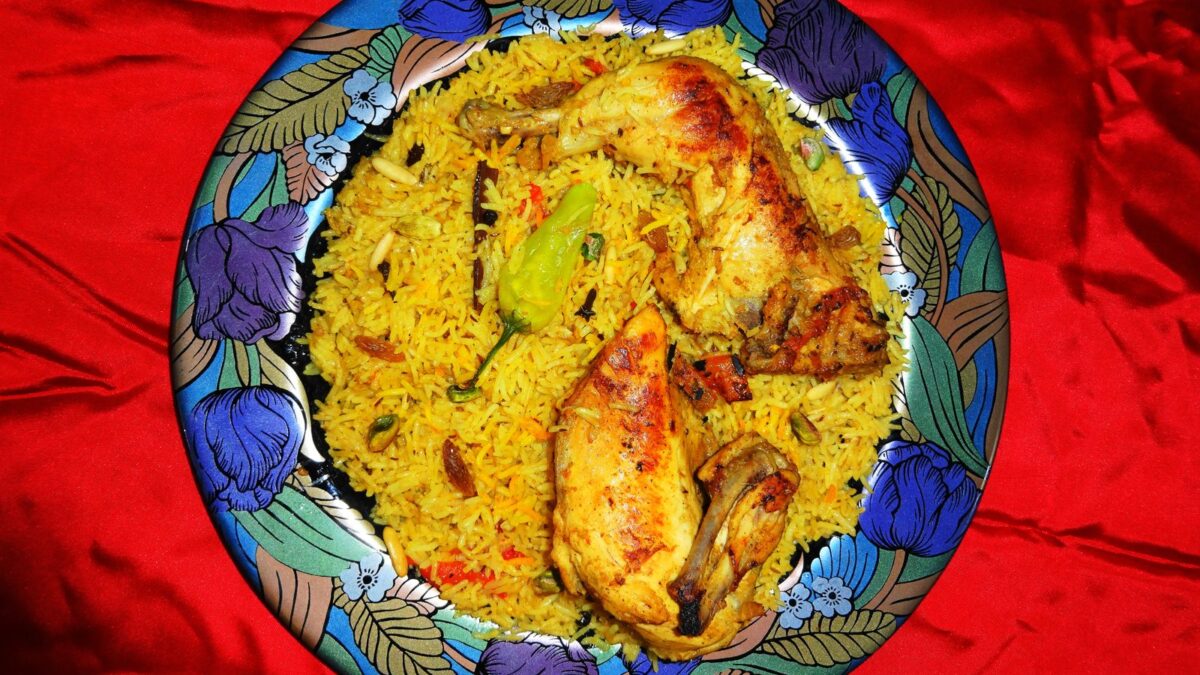
Garlic butter chicken with herb rice takes about 30 minutes and goes wrong in four predictable places. This version is written around those four, because after making it most weeks for the last three years or so, they’re the only things I still think about while I cook.
Prep: 10 mins Cook: 22 mins Serves: 4
Why is my chicken dry on a weeknight?
Because you cooked it to 74C and then kept cooking, almost certainly by accident.
Chicken breast is safe at 74C (165F). Past about 68C the muscle fibres have already contracted and squeezed out most of their water, and every degree after that is loss you can’t get back. The gap between juicy and dry is maybe 90 seconds on a hot pan. Nothing in a weeknight kitchen is that precise if you’re going by the clock.
The second cause is thickness. A supermarket breast is often 4 cm at the fat end and 1 cm at the tip, so the thin end is at 80C while the thick end is still raw in the middle. Butterfly it, or lay it under cling film and whack it to an even 1.5 cm with a rolling pin. Even thickness matters more than any marinade.
Third: no rest. Straight off the heat the juices sit at the surface. Two or three minutes on a warm plate and they redistribute; cut immediately and they end up on the board.
The fix that costs nothing is a thermometer, in the thickest part, from the side. Mine lives in the drawer next to the hob and it’s why I stopped serving chalky chicken.
Ingredients
- 4 boneless chicken thighs, or 2 large breasts butterflied into 4
- 1 teaspoon fine salt, plus black pepper
- 1/2 teaspoon sweet paprika
- 1 tablespoon neutral oil
- 4 tablespoons unsalted butter, divided
- 6 garlic cloves, thinly sliced (not minced, see below)
- 1/2 cup chicken stock
- 1 tablespoon lemon juice
- 2 tablespoons chopped parsley
- 1 and 1/2 cups long-grain white rice or basmati, rinsed
- 2 and 1/4 cups chicken stock or water, for the rice
- 2 tablespoons chopped parsley, chives and thyme, for the rice
Instructions
- Rinse the rice in a sieve until the water runs almost clear, about 40 seconds. Bring it to the boil with 2 and 1/4 cups stock, lid on, then drop to the lowest heat for 12 minutes. Off the heat, lid still on, 10 minutes more. Don’t lift the lid.
- Butterfly or pound the chicken to an even 1.5 cm. Pat dry, season with salt, pepper and paprika.
- Heat the oil and 1 tablespoon butter in a large skillet over medium-high until the butter stops foaming. Lay the chicken away from you and leave it alone.
- Cook 4 to 5 minutes until deep gold, flip, then 3 to 4 minutes more. Start checking at 70C; pull at 74C (165F) in the thickest part. Thighs can go to 80C and stay juicy.
- Move the chicken to a plate and rest, loosely covered, while you make the sauce.
- Drop the heat to medium-low and wait 30 seconds for the pan to cool. Add the remaining 3 tablespoons butter and the sliced garlic. Cook 60 to 90 seconds, stirring, until the slices turn pale gold at the edges only.
- Pour in the stock, scrape the browned bits off the base, and let it reduce by half, about 2 minutes. Off the heat, stir in the lemon juice and parsley.
- Fluff the rice with a fork, fold through the herbs, and spoon the garlic butter over chicken and rice both. Serve with any resting juices tipped back in.
Thighs or breast?
Thighs. On a weeknight it isn’t close.
Thigh meat has more fat and more connective tissue, which means it stays palatable across a range of maybe 74C to 85C instead of a narrow window. You can forget it for two minutes and it forgives you. It also browns better, because the extra fat renders into the pan and feeds the sauce.
Breast wins on two counts: faster once pounded thin, and leaner, at roughly 165 calories per 100 g cooked against about 210 for thigh. If someone won’t eat dark meat, pound the breast thin, use the thermometer, and it’ll be fine.
Bone-in, skin-on thighs are the best-tasting option of the three and the worst weeknight option, because they need 30 to 35 minutes and a stint in the oven. Save those for a herb roast chicken sort of evening when you’re not watching the clock.
How do I stop the garlic burning in butter?
Slice it instead of mincing it. Minced garlic has enormous surface area and almost no mass, so it goes from raw to bitter in about 20 seconds in hot butter. Thin slices take 60 to 90 seconds and give you time to react.
Then take the pan off the heat for half a minute before the garlic goes in. Straight after searing chicken, a steel pan is sitting somewhere near 200C, well above the point where butter solids scorch and garlic sugars burn. Letting it drop to medium-low first is the single change that fixed this for me.
Watch the colour, not the timer. Garlic is done when the slice edges are pale gold and the smell turns sweet rather than sharp. Brown all over is too far, and the bitterness spreads through the whole sauce with no way back. Tip it out and start again; you’ve lost two minutes and 3 tablespoons of butter.
If the pan really is too hot, add the stock first and the garlic 20 seconds later. Less browning, less flavour, nothing bitter. Same order of operations as my classic chicken piccata.
Can the rice cook in the same pan, and at what ratio?
It can, and mostly I’d rather it didn’t.
The one-pan version: sear the chicken, remove it, cook the garlic, toast the rinsed rice for a minute in the butter, pour in the liquid, sit the chicken on top, lid on, 15 minutes low, 10 minutes off the heat. The rice picks up all the fond. You give up the crust, which softens under the lid, and control, since you can’t check the rice without losing steam. If that is the route you want, cooking the chicken and rice together in one pan goes through the ratios and the rescues properly.
Now the ratio, which is where most recipes mislead. The old 2:1 liquid-to-rice rule assumes unrinsed rice in an uncovered pot. For rinsed long-grain or basmati under a tight lid, use 1.5 cups liquid to 1 cup rice. So 1 and 1/2 cups rice takes 2 and 1/4 cups stock, not 3. Rinsed rice has already absorbed water in the sieve, and a good lid loses very little to steam.
Brown rice needs 2.25 cups liquid per cup and 40 minutes, which puts it outside a one-pan chicken timeline. Cook it separately or on another night.
One more thing: salt the rice liquid. If you’re using water rather than stock, that’s 3/4 teaspoon of salt for this quantity. Unsalted rice under a well-seasoned sauce tastes like a mistake, and you can’t fix it at the table.
Can I actually meal-prep this?
The rice, yes. The chicken, partly. The sauce, no.
Cooked rice keeps 4 days in the fridge and reheats well, as long as you cool it within an hour in a shallow container rather than a deep tub. Sprinkle a tablespoon of water over before microwaving, and cover it.
Chicken breast reheated is chicken breast overcooked, because it passes back through the drying range. Thighs survive it. So if you’re cooking Sunday for Wednesday, cook thighs, slice them cold, and warm the slices in the sauce rather than blasting whole pieces.
Garlic butter sauce is the part that won’t wait. It’s an emulsion of butter and stock, and chilling breaks it into a solid yellow disc that reheats greasy and separated. Make it fresh in the 90 seconds it takes, or double the chicken and rice and pair the leftovers with something that needs no live sauce, like a Caesar salad with the chicken sliced over it.
Rice freezes well for 3 months in portions and thighs freeze fine. Don’t freeze anything with the sauce already on it.