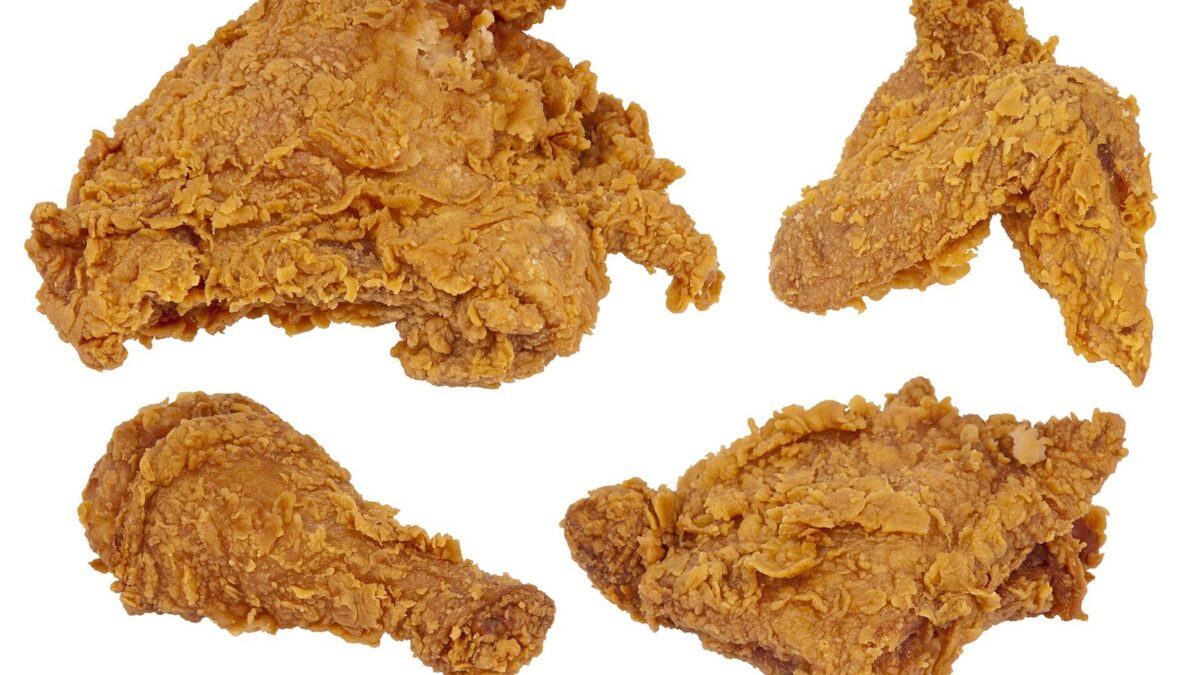
Most of what I was confidently told about fried chicken turned out to be wrong, or a rule borrowed from a different dish. I’ve fried chicken most Sunday afternoons for about six years in the same heavy 26cm cast-iron pot, and these five beliefs are the ones I had to give up before the crust stopped sliding off in the oil.
Myth: Buttermilk Tenderises the Meat
This is the one that took me longest to let go of. Buttermilk sits at roughly pH 4.4 to 4.6, which is acidic, but it’s a weak acid in a thick liquid, and thick liquids move through muscle slowly. After twelve hours in the fridge, the acid has meaningfully changed maybe the outer two millimetres of a thigh. The middle, where you’d actually notice tenderness, is untouched.
What the soak is really doing:
- Carrying salt inward. The salt you whisk into the buttermilk is the part that genuinely reaches the meat, and salt is what keeps chicken juicy after 15 minutes in hot oil. Leave it out and the difference disappears.
- Gluing the flour on. Buttermilk is thick enough to hang on the chicken instead of running off, and that clingy layer turns dry flour into a crust rather than dust.
- Browning faster. A slightly acidic, slightly sugary surface hits deep golden a minute or two sooner than a plain-water soak would.
Four hours is enough, overnight is better, and past about 24 hours the surface goes soft and faintly chalky. I found that out over a long weekend when I forgot a bowl at the back of the fridge and fried it anyway on the Tuesday. Edible. The skin never crisped.
Myth: Double-Frying Always Gives You a Better Crust
Double-frying works, and it belongs to a different kind of chicken. It was built for thin, wet-battered pieces: Korean wings, boneless nuggets, chips. Those cook through in three or four minutes, not long enough to drive out the water under the crust, so you fry, rest, and fry again to finish the drying.
Bone-in chicken doesn’t have that problem. A drumstick spends 12 to 16 minutes in oil, so by the time the inside hits 74°C (165°F) the coating has had plenty of time to dehydrate. A second pass mostly darkens what’s already dark.
I fry twice in one situation only: cooking for eight, when pieces have to sit half an hour. Ninety seconds back in 190°C (375°F) oil restores the snap.
Myth: The Hotter the Oil, the Crispier the Chicken
Crispness comes from water leaving the coating, not from heat as such. Push the oil past about 190°C (375°F) and the crust goes deep brown in roughly four minutes while the thigh underneath still needs eight or nine more to be safe. That’s a choice between burnt and pink, which is not a choice.
The working band is 163°C to 177°C (325°F to 350°F). Start at the top of it, because three cold pieces dropped into a pot pull the temperature down 15 to 20°C almost immediately. A clip-on thermometer on the side of the pot is the cheapest upgrade I’ve made to home frying; mine cost under 500 rupees and I look at it every ninety seconds or so.
Too low is its own failure, not a safe default. Under about 150°C the coating takes on oil faster than it releases steam, and you get chicken that’s heavy and slick.
Myth: A Wet Batter Beats a Dry Dredge
I’ll say plainly which is better for bone-in chicken: the dredge.
A wet batter sets into a continuous shell. Steam off the meat has nowhere to go, collects between chicken and shell, and ten minutes later the whole jacket lifts off in one piece. Anyone who has picked up a drumstick and watched the coating slide has met this.
A seasoned flour dredge is porous: shaggy, uneven, hundreds of gaps for steam, and those craggy bits are where the crunch lives. Batter is still right for boneless strips and for fish, and it’s what I use on southern fried catfish, where the fillet cooks in five minutes and never has time to go soft. Battered cubes are also the point of sweet and sour chicken, since a smooth shell holds the glossy sauce.
Myth: You Can Dredge and Fry Straight Away
This one costs people their crust more often than any other, and it takes ten minutes to fix.
Dry flour pressed onto wet chicken is still dry flour. Straight into oil, the loose surface layer floats off, seasons the oil and burns. Rest the dredged pieces on a wire rack for 10 to 15 minutes and the buttermilk underneath wicks up into the flour, turning it into a thin paste that bonds to the skin. You can see it: powdery-white goes damp and slightly grey at the edges. That’s the cue.
Ingredients
- 8 pieces bone-in chicken (thighs, drumsticks, and breasts cut in half), about 3 to 4 pounds
- 2 cups buttermilk
- 1 tablespoon hot sauce (optional)
- 2 teaspoons salt for the soak, plus 2 teaspoons for the flour
- 2 cups all-purpose flour
- 1 tablespoon paprika
- 2 teaspoons garlic powder
- 2 teaspoons onion powder
- 1 teaspoon cayenne pepper, more or less to taste
- 1 teaspoon black pepper, freshly ground if possible
- 1 teaspoon baking powder
- Neutral oil for frying: vegetable, canola, or peanut
Instructions
- Whisk the buttermilk, hot sauce, and 2 teaspoons of salt together in a large bowl. Add the chicken, turn every piece over, cover, and refrigerate at least 4 hours, ideally overnight. Don’t go past 24 hours.
- Take the bowl out and let it stand on the counter 20 minutes while you set up. Fridge-cold chicken drags the oil temperature down further than it needs to.
- Whisk the flour, paprika, garlic powder, onion powder, cayenne, remaining salt, black pepper, and baking powder in a wide shallow dish.
- Lift one piece from the buttermilk, let the excess run off for a couple of seconds, then press it hard into the flour, into every fold and crease. Set it on a wire rack and repeat.
- Rest the dredged pieces 10 to 15 minutes, until the coating looks damp rather than powdery.
- Pour about 2 inches of oil into a heavy deep pot and heat to 177°C (350°F).
- Lower in three or four pieces at a time, skin side down, with space between them. The temperature will dip; nudge the heat up to bring it back.
- Fry 6 to 8 minutes per side, holding the oil between 163°C and 177°C (325°F and 350°F). Adjust the burner rather than the oil.
- Done at deep golden brown and an internal temperature of 74°C (165°F) at the thickest part, clear of the bone. Thighs and drumsticks run 2 to 3 minutes longer than breast pieces.
- Move each piece to a clean wire rack over a tray. Not paper towels, which steam the underside soft. Salt it while hot and rest 5 minutes before eating.
The Two Numbers That Actually Decide Everything
163 to 177°C in the pot. 74°C in the meat. Get both right and almost everything else becomes a matter of taste.
Probe the thigh from the side, angled toward the middle, staying off the bone — bone reads hotter than the meat around it and will tell you the chicken is ready when it isn’t. On a large breast half I check twice, because the tapered end runs a good 5°C ahead of the thick end.
Rest it. Five minutes on the rack lets trapped steam escape and the crust firm up. Cut into a drumstick straight out of the oil and you lose most of what the overnight salt bought you.
Where People Still Go Wrong on the Second Attempt
Crowding. Four pieces in a 26cm pot is my limit; five turns a fry into a slow simmer, and I’ve done it enough times to hear it happen. The sharp crackle flattens to a dull hiss within seconds.
Then tired oil. Strain it through a coffee filter once cool, jar it in the dark, reuse two or three times. When it smells faintly of fish and has darkened toward maple syrup, it’s done, and a crust fried in it tastes stale no matter what you got right beforehand.
For the rest of the plate, the vinegar in creamy coleslaw cuts the richness better than anything else I’ve tried, and buttermilk biscuits use up the soak liquid you’d otherwise pour away. The same dredge-and-rest logic carries over to buffalo chicken wings, though there you want the wings drier before saucing than you’d ever want a drumstick.