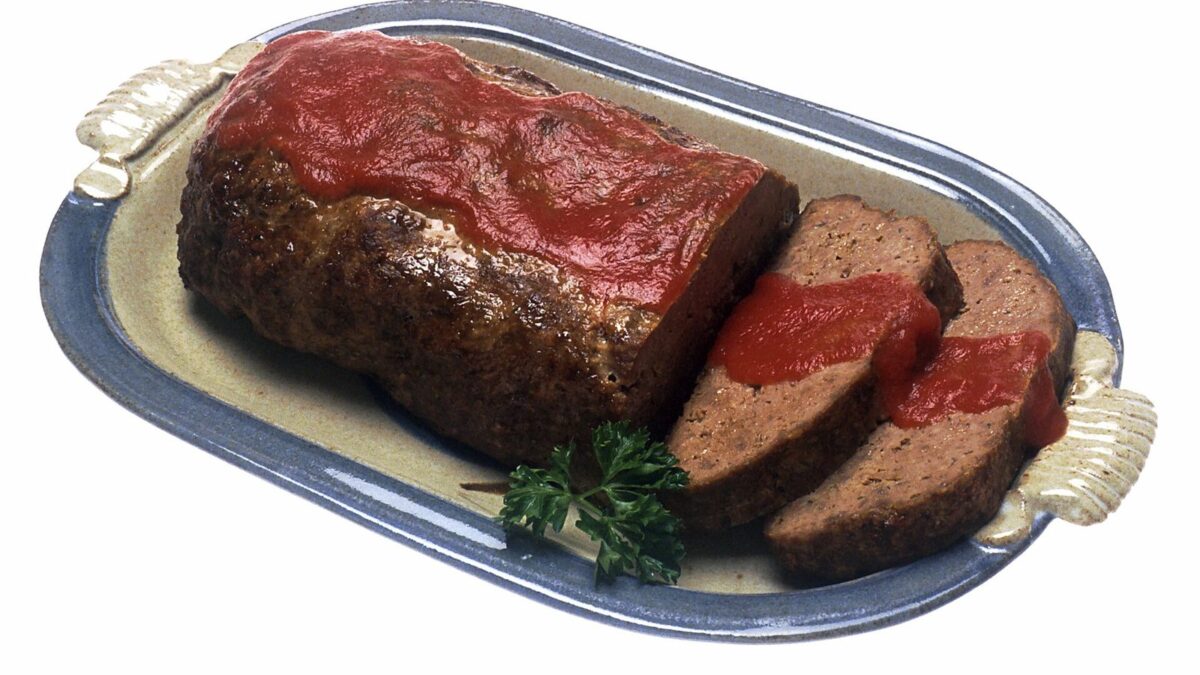
Three decisions change meatloaf more than anything else on the ingredient list: the shape you bake it in, what you use to keep it moist, and when the glaze goes on. I’ve cooked this both ways on each count, usually side by side in the same oven, and I’ve landed firmly on one combination.
Here’s the short version, then the reasoning. Free-form on a sheet pan, milk-soaked bread rather than dry crumbs, glaze in two coats with the second one late. Pull it at 71°C / 160°F.
Prep: 15 mins Cook: 55 mins Serves: 6
Loaf tin against sheet pan
A loaf tin holds the meat in a snug rectangle with the fat and juices trapped against all four sides. What that produces is a loaf that’s partly braised in its own fat. The sides come out pale and soft, and the bottom is genuinely wet — I’ve tipped an inch of liquid out of a tin more than once.
Shaped free-form on a parchment-lined sheet pan, the fat runs away from the meat instead of pooling around it. Every surface gets dry oven heat. You end up with a browned crust on five sides rather than one, and the slices hold together better because the outside has set into a firm shell.
The counter-argument for the tin is real, so I’ll give it fairly: a tin guarantees an even shape, which means even cooking, and it’s much harder to end up with thin over-done ends. If you’re nervous about shaping, or you’re doubling the recipe, the tin is the safer tool.
But I’ve stopped using one. A free-form loaf about 23 cm long, 12 cm wide and 7 cm tall cooks in roughly the same 50 to 60 minutes, and the crust is not a small difference — it’s most of the reason people go back for a second slice. If you want to hedge, bake in the tin for 35 minutes and then turn the loaf out onto a sheet pan for the final 20. That works, and it’s fiddly.
Panade against dry breadcrumbs
A panade is starch soaked in liquid, mixed into ground meat. It works because the starch traps water in a gel that survives the heat, so the meat can reach a safe internal temperature without squeezing all its moisture out.
Dry breadcrumbs stirred straight in do something different and worse. They pull moisture out of the meat to hydrate themselves, on their own schedule, mid-bake. The loaf ends up drier and the texture is faintly sandy.
So the soak isn’t optional, but the material matters too. Panko soaked in milk gives a light result that I find slightly bouncy, almost meatball-like. Torn fresh bread — two thick slices of white sandwich bread, crusts off, torn small and soaked in 1/2 cup whole milk for 5 minutes — gives a softer, more tender crumb that reads as meatloaf rather than as a big meatball. That’s the one I use.
Whole milk over skim, and it’s not fussiness: the fat contributes to the tenderness. Buttermilk works and adds a slight tang. Water works in an emergency and you can taste the difference.
Glaze early against glaze late
Glaze applied at the start of a 55-minute bake spends nearly an hour over direct heat, and ketchup and brown sugar both burn. What you get is dark, slightly bitter patches at the corners and a glaze that’s been absorbed into the surface rather than sitting on it.
Glaze applied only in the last 5 minutes stays glossy and bright, but it hasn’t had time to tighten. It slides off the slice and pools on the plate.
The split works better than either. Half the glaze at the 35-minute mark, so it sets and grips, and the second half at 50 minutes, so it stays shiny. Two coats, about 15 minutes apart. I resisted this for a while because it means opening the oven twice, and it’s plainly better.
The three choices side by side
| Decision | Option A | Option B | My pick |
|---|---|---|---|
| Shape | Loaf tin: even cooking, soft pale sides, fat pools underneath | Free-form on a sheet pan: crust on five sides, fat drains away | Free-form |
| Binder | Dry crumbs: pull water out of the meat, faintly sandy | Bread soaked in milk: holds water through the bake, tender crumb | Soaked bread |
| Glaze | All at the start: burns at the corners, absorbed and dull | All at the end: glossy but loose, slides off the slice | Split, at 35 and 50 minutes |
Ingredients
- 2 pounds ground beef, 80/20
- 2 thick slices white sandwich bread, crusts removed, torn small (or 1 cup panko)
- 1/2 cup whole milk
- 2 large eggs, lightly beaten
- 1 medium onion, finely diced
- 2 cloves garlic, minced
- 2 tablespoons Worcestershire sauce
- 1/4 cup ketchup, for the mixture
- 1 teaspoon salt
- 1/2 teaspoon black pepper
- 1 teaspoon dried thyme and oregano, mixed
- For the glaze: 1/2 cup ketchup, 2 tablespoons brown sugar, 1 tablespoon apple cider vinegar
Instructions
- Heat the oven to 190°C / 375°F and line a sheet pan with parchment.
- Tear the bread into a small bowl, pour over the milk, and leave 5 minutes until it collapses into a soft paste with no dry patches. Mash it smooth with a fork.
- Soften the diced onion in a little oil over medium heat for 5 minutes and let it cool. Raw onion in the mix stays crunchy and weeps water; this step is worth the pan.
- Combine the beef, bread paste, eggs, cooled onion, garlic, Worcestershire, the 1/4 cup ketchup, salt, pepper and herbs in a large bowl.
- Mix with your hands until the ingredients are just evenly distributed, no more than about 30 seconds. Overworking makes it dense and springy.
- Tip the mixture onto the sheet pan and shape a loaf roughly 23 cm long, 12 cm wide and 7 cm tall. Smooth the surface and press the ends in so they aren’t thin.
- Whisk the glaze ingredients together. Bake the loaf 35 minutes, then brush on half the glaze.
- Bake another 15 minutes, brush on the rest of the glaze, and return it to the oven.
- Bake a final 5 to 10 minutes, until a thermometer in the thickest part reads 71°C / 160°F.
- Rest on the pan for 10 minutes before slicing. Cut with a serrated knife using a sawing motion, not downward pressure.
Temperature is the only test that holds up
Ground beef needs to reach 71°C / 160°F throughout, because grinding distributes surface bacteria through the whole mixture. That’s not a preference like it is with a steak. If you’re using ground pork or a beef-pork mix, the same 71°C applies; a mix with poultry in it needs 74°C / 165°F.
Timing alone won’t tell you. My loaf hits 71°C anywhere between 50 and 62 minutes depending on how tall I shaped it and how cold the meat was going in. Push the probe into the thickest part horizontally from the end, so you’re reading the centre and not the crust.
Carryover is real but small here — about 2 degrees during the rest, not the 5 or more you get from a large roast. Don’t pull it at 65°C hoping it’ll climb.
The rest itself is non-negotiable. Slice it straight out of the oven and the juices, which are still mobile, run out onto the board and the slices crumble at the edges. Ten minutes and it cuts clean.
For what it’s worth, the leftovers case is the strongest argument for the free-form loaf: those firm browned edges make a much better cold sandwich the next day. Two slices, white bread, more ketchup than is respectable. That’s the real reason I make a 2-pound loaf for four people.
If you liked the panade logic here, it’s the same principle doing the work in my homemade meatballs, and the reason they stay tender through a long simmer. On the plate, this wants something soft alongside — baked mac and cheese is the version I get asked for most, though loaded baked potatoes do a better job of catching the glaze that runs off. And if you’ve got half a loaf left and no appetite for sandwiches, crumble it into beef chili; it dissolves into the pot and nobody asks questions.