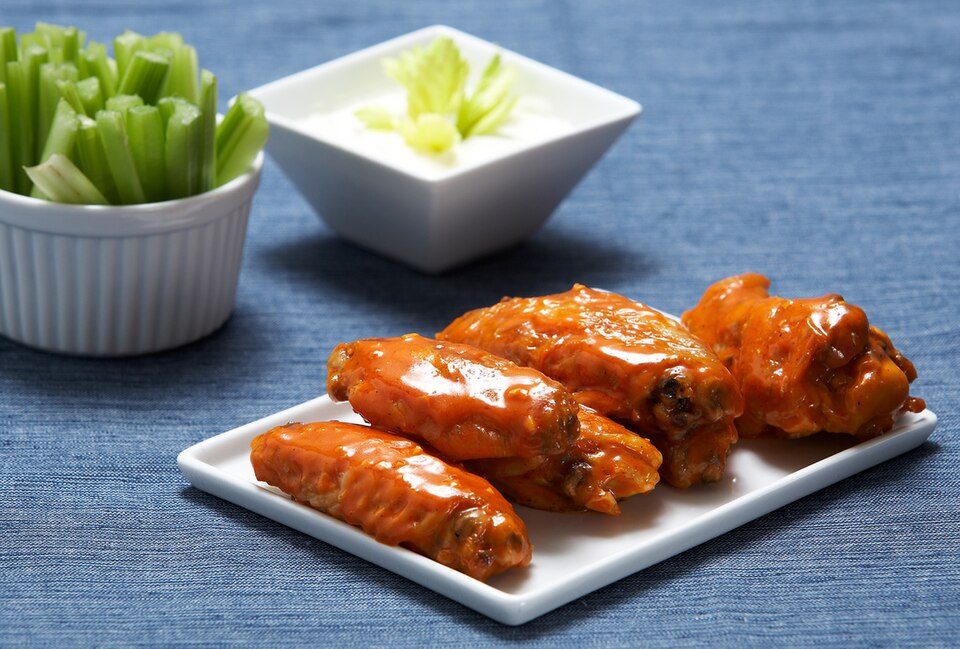
Wings are one of the few things where the home version can genuinely beat the bar version, because the bar tossed yours in sauce four minutes before it reached you and mine goes into the bowl straight out of the oven.
What follows is longer than a wing recipe needs to be. That’s deliberate. Almost every failure I’ve had came from not knowing why a step was there.
Prep: 15 mins, plus optional overnight dry Cook: 45 mins Serves: 4
What Baking Powder Actually Does to Chicken Skin
It’s not a coating and it’s not a batter, which is why one tablespoon per two pounds is enough and why more makes things worse.
Baking powder is sodium bicarbonate plus a dry acid salt. The bicarbonate is alkaline, and raising the pH of the skin surface does two useful things at once. First, alkaline conditions speed up the Maillard reaction, so the skin browns at a lower temperature and in less time than it otherwise would. Second, the raised pH loosens the proteins in the skin, which lets it dry and blister rather than shrink and tighten into leather.
It also meets the moisture left on the wing and throws off carbon dioxide, pitting the surface with microscopic bubbles. More surface area, more skin exposed to dry oven air, more crisping.
Two things to get right. Use baking powder, not baking soda; soda is pure bicarbonate with no acid to buffer it and at this dose it tastes soapy and metallic. And use an aluminium-free brand if you can, because sodium aluminium sulfate leaves a faint tinny aftertaste that’s most noticeable in a plain unsauced wing.
Overdo the quantity and you’ll taste it. I once eyeballed two heaped tablespoons onto about 900 g of wings and they came out crisp, brown, and faintly chemical. Measure this one.
The Fridge Dry: Overnight, Uncovered
Water on the skin has to boil off before the skin can get above 100°C and start browning. Every minute spent evaporating is a minute not spent crisping, and it’s also a minute of steam softening whatever crust has formed.
Paper towel takes the surface water and nothing else. For the water bound up in the skin itself, salt the wings, rack them over a tray, and leave them uncovered in the fridge for 8 to 24 hours. A fridge is a dehumidifier that happens to be cold; circulating air pulls moisture out and the salt brings more to the surface where it can go. The skin ends up faintly translucent and papery to the touch.
I do 12 hours as a rule, salting them the night before, and the difference against a same-day batch is not subtle. If you don’t have the time, the recipe still works. Just dry them harder with towels than feels necessary and accept slightly less crackle.
Buying Wings, and Breaking Them Down
Whole wings cost less per pound than pre-cut party wings and take about four minutes to break down for two pounds. Feel for the joint between the drumette and the flat, bend it back until it pops, and cut through the gap with a heavy knife; you’re cutting cartilage, not bone. Do the same at the tip.
Keep the tips. Six or seven plus an onion and a bay leaf makes about 500 ml of stock in 90 minutes, and because tips are almost pure collagen it sets to jelly in the fridge.
Two pounds is four generous servings as a main, or eight as a starter alongside loaded beef nachos. Frozen wings work but must be thawed fully in the fridge and dried aggressively, because ice crystals rupture cells and the thawed skin holds more free water than fresh does.
Ingredients
- 2 lbs chicken wings — split into drumettes and flats, tips removed and saved
- 1 tablespoon baking powder — aluminium-free; not baking soda
- 1 teaspoon fine salt — applied the night before if you’re drying them
- 1/2 teaspoon black pepper
- 1/2 teaspoon garlic powder — powder, not granules, so it clings evenly
- 1/2 cup cayenne pepper hot sauce — Frank’s RedHot is the original; anything vinegar-and-cayenne based works
- 4 tablespoons unsalted butter — cut into cubes, cool, not melted in advance
- 1 teaspoon Worcestershire sauce
- 1 tablespoon honey — optional, and it does mute the heat
- 1/2 teaspoon cayenne powder — optional, for people who mean it
- Celery and carrot sticks
- Blue cheese dressing — or ranch, and I’ll come back to that argument
Instructions
- The night before if possible: pat the wings dry, toss with the salt, spread on a wire rack over a tray, and refrigerate uncovered 8 to 24 hours.
- Heat the oven to 220°C / 425°F with a rack in the upper third. Set a wire rack over a foil-lined baking sheet.
- Toss the wings with the baking powder, pepper, and garlic powder until the coating is invisible and even. If you can see white patches, keep tossing.
- Lay them out on the rack in a single layer, not touching, skin side up. Bake 25 minutes.
- Flip each wing and bake another 15 to 20 minutes, until the skin is deep golden and visibly blistered and an instant-read thermometer in the thickest drumette reads at least 74°C / 165°F. Push on to 80–82°C / 175–180°F if you can (see below).
- In the last five minutes, warm the hot sauce and Worcestershire in a small pan over low heat until steaming but nowhere near boiling.
- Take the pan off the heat and whisk in the cold butter cubes one or two at a time, letting each disappear before the next goes in. The sauce should go glossy and slightly thick and cling to the whisk.
- Tip the wings straight from the oven into a large bowl, pour over the sauce, and toss for about 15 seconds. Serve now, on a warm platter, with celery, carrots, and dip.
Oven, Air Fryer, or a Pot of Oil
I’ve done all three in the same week to settle the argument in my own kitchen. Here’s what each is genuinely good for.
| Method | Temperature | Time | Crispness | Best for |
|---|---|---|---|---|
| Oven, wire rack | 220°C / 425°F | 40–45 min, flip at 25 | Good, thin and crackly | 2 lb or more, hands-off |
| Air fryer | 190°C / 375°F, then 205°C / 400°F for the last 6 | 18–22 min, shake twice | Very good, closest to fried | Up to about 1 lb per basket |
| Deep fry | 175°C / 350°F | 9–12 min per batch | Best, with a shattering shell | When you already have oil out |
The air fryer wins on results per unit of effort and loses badly on capacity. Mine holds about 450 g in a single layer, which is one and a bit servings, so feeding four means three rounds and the first batch going cold. For a crowd the oven is the honest answer.
Deep frying gives the best texture and I still rarely do it, because two litres of oil for four people’s dinner is a decision about your evening. If you do, hold the oil at 175°C / 350°F; it drops about 25 degrees the moment cold wings go in, so fry six at a time and let it recover. Same batch discipline that makes crispy fried chicken work.
Why the Butter Has to Go In Cold
Classic buffalo sauce is hot sauce and butter, and the ratio that keeps it recognisably buffalo is about 2:1 by volume. Half a cup of Frank’s to four tablespoons of butter is exactly that. Go to 1:1 and you get something rich and mild that people will enjoy without calling it buffalo; go to 3:1 and the vinegar takes the whole thing over.
Butter isn’t in there mainly to soften the heat. Hot sauce is mostly water, vinegar, and chili, and water-based sauce runs off skin and pools on the plate. Butter is about 80% fat, 16% water, and a few percent milk solids, and those milk solids include proteins that act as emulsifiers. Whisked into warm sauce, they hold the fat in suspension as tiny droplets, and the result is a sauce thick enough to coat and stay put.
Which is why the method matters. Melted butter poured into hot sauce gives you a two-layer sauce that separates on the plate within a minute. Cold butter whisked into warm sauce off the heat gives you an emulsion. Keep it under about 60°C; boil it and the emulsion breaks and you’ll see a clear oil slick form on top. If that happens, take it off, add a teaspoon of cold water, and whisk hard. It usually comes back.
Clarified butter and most plant-based butters have fewer of those emulsifying proteins, so a dairy-free version needs a small extra helper. A quarter teaspoon of Dijon whisked in first works and nobody has ever detected it.
When to Sauce, and How Long You Have
You have about four minutes.
Sauced skin starts reabsorbing water immediately. At two minutes it’s still crisp under the coating. By five, the crackle has become a chew. By fifteen it’s soft, and reheating won’t bring it back.
So: toss last, serve immediately, use a warmed bowl, and don’t sauce a batch that’s waiting for a second batch. If you’re feeding people who arrive at unpredictable times, hold the wings unsauced in a 90°C / 200°F oven, which keeps them dry, and sauce each plate as it goes out. Same goes for leftovers. Any wing you think you won’t eat tonight should stay naked in the fridge and get sauced fresh after ten minutes at 200°C / 400°F.
74°C Is Safe. 82°C Is Better.
Chicken is safe at 74°C / 165°F, and that’s the number to check if you’re cooking for anyone who needs certainty. Measure at the thickest part of a drumette, avoiding the bone, and don’t judge by color; wings near the bone can stay pink at temperature.
But wings aren’t breast meat. They’re mostly skin, connective tissue, and small muscles that work hard, which means a lot of collagen. Collagen doesn’t start converting to gelatin in any meaningful way until around 70°C and it does the job properly between 76 and 85°C, held for a while. Take a wing to exactly 74°C and pull it and the meat is safe but slightly rubbery at the joint. Take it to 80–82°C / 175–180°F and the connective tissue has softened, the meat pulls cleanly off the bone, and the extra rendering time has done your skin a favour too.
There’s no real dryness penalty; the fat protects them. This is the one place I’d argue against the usual advice to pull chicken the second it hits 165.
Where Wings Usually Go Wrong
- Pale skin. Crowded tray, or no rack. Wings need air underneath; sitting in their own rendered fat, the bottom side steams. Leave 2 cm between them and use two trays if you must.
- Soggy within minutes. Sauced too early, or sauced into a cold bowl that dropped the wings below crisping temperature.
- Bitter or soapy. Baking soda instead of baking powder, or too much powder.
- Greasy sauce with an oil layer. The butter was melted in, or the sauce boiled.
- Burnt tips, raw joints. Oven too hot, usually a fan oven at a conventional temperature. Drop 20 degrees if yours is fan-assisted.
Blue Cheese, Celery, and the Rest of the Table
Blue cheese is correct and ranch is a compromise. Capsaicin is fat-soluble, so a fat-heavy dip physically carries it off the tongue, and blue cheese brings a salty funk that stands up to vinegar in a way ranch’s herby buttermilk doesn’t. I make both anyway. I lost that argument years ago.
Celery isn’t decoration either. It’s about 95% water, and one between wings resets your palate. Cut the sticks and drop them in iced water for 20 minutes while the wings bake.
Round out the table with something starchy that doesn’t compete: loaded baked potatoes hold up well, and a sharp vinegary creamy coleslaw does more work against the heat than another fried thing would.
One last thing worth knowing: the wings improve if you make the sauce first and let it sit in a warm pan while they finish. Not because of the sauce, but because it removes the only step that can go wrong in the four minutes when the wings are at their absolute best.