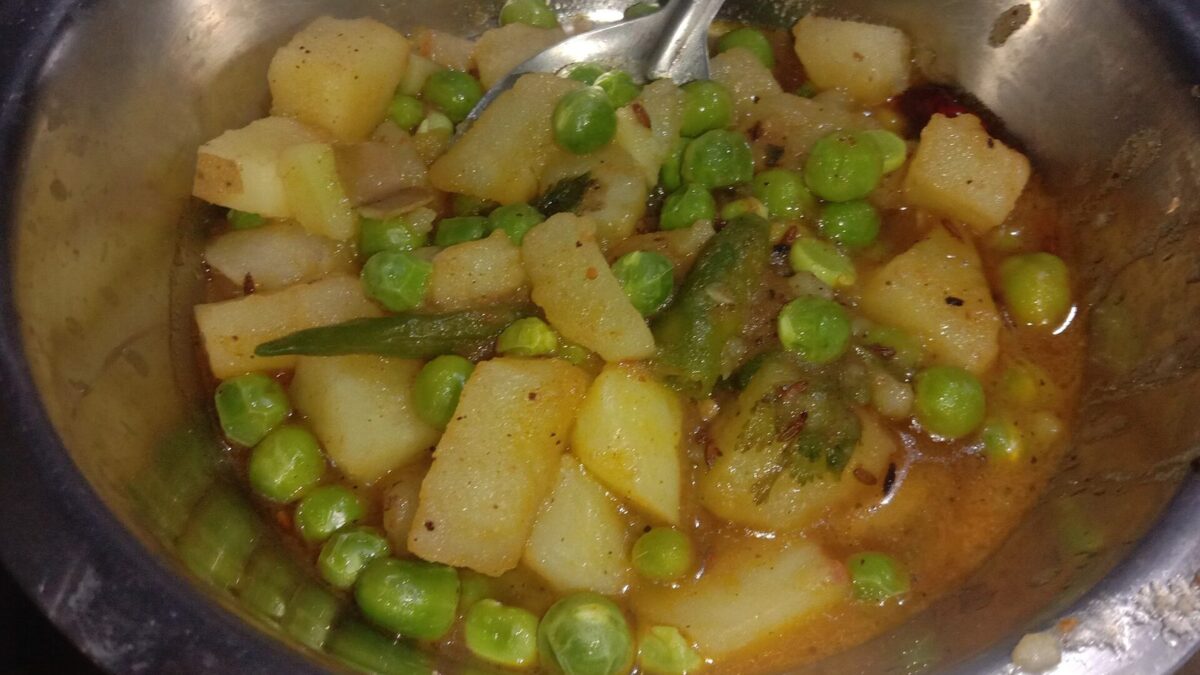
I’ve split the coconut milk in this pot twice, and both times for the same stupid reason: I turned the heat up and walked away. The second time was the worse one. The base was right — onion soft after 6 minutes, garlic and ginger just past raw, the curry powder toasted until the whole kitchen smelled of it — and then I poured in the tin, cranked the burner to get things moving, and went to answer the door. Four minutes later the sauce had gone grainy. A slick of clear oil on top, little curds of solid underneath, the texture of something that had been left out.
It’s edible. It’s just not what you wanted. You can whisk it back part of the way off the heat with a splash of water, but the velvet doesn’t fully return.
So that’s the first thing worth knowing: coconut milk is not a boiling ingredient. Almost everything else in this pot will forgive you.
The other failure: a pot that tasted like warm soup
The flat one came earlier, when I was in a hurry and tipped two tablespoons of curry powder straight into the liquid. The pot looked exactly right — golden, thick, generous — and tasted of hot vegetables and almost nothing else. Dusty at the back of the throat.
I rescued it by ladling some sauce into a small frying pan with a spoonful of oil, heating another teaspoon of curry powder in it until it darkened, and stirring that back in. Ten minutes of faffing to recover thirty seconds I’d skipped.
Ground spices carry their flavour in oil-soluble compounds. Water can’t pull them out. Hot fat can, in under a minute.
Prep: 15 mins Cook: 30 mins Serves: 4
Ingredients
- 2 tablespoons coconut or vegetable oil — you need enough fat to actually coat the spices, so don’t cut this back.
- 1 large onion, diced — about 200g once peeled.
- 4 cloves garlic, minced
- 1 tablespoon fresh ginger, grated — a thumb-length piece, skin scraped off with a teaspoon.
- 2 tablespoons curry powder — or roughly 1 tbsp ground coriander, 2 tsp cumin, 1 tsp turmeric, ½ tsp chilli.
- 1 teaspoon ground turmeric
- 1 can (400ml / 14 oz) full-fat coconut milk — the light stuff splits more readily and tastes watery.
- 1 can (400g / 14 oz) diced tomatoes
- ½ cup water or vegetable stock — see the note in the staging section below.
- 4 cups mixed vegetables — cauliflower, carrot, bell pepper and potato, cut to roughly 2cm.
- 1 cup chickpeas, drained and rinsed
- 2 cups fresh spinach
- 1 teaspoon salt, plus more at the end
- Juice of half a lime and a handful of fresh coriander
Instructions
- Heat the oil in a wide pot over medium heat. Add the onion and cook 5 to 6 minutes, stirring occasionally, until it’s soft and just starting to turn gold at the edges.
- Add the garlic and ginger. Cook 60 seconds, no longer — garlic goes bitter fast at this heat.
- Tip in the curry powder and turmeric and stir constantly for 30 to 45 seconds. The spices should darken half a shade and the smell should change from raw and dusty to warm and nutty. If the pan looks dry and the spices are sticking, add another teaspoon of oil.
- Pour in the tomatoes first and scrape the base of the pot clean with a wooden spoon. Let them bubble for 3 minutes so the raw tinned edge cooks off.
- Add the potatoes and carrots plus the water or stock. Bring to a simmer, cover, and cook 10 minutes.
- Turn the heat down to low. Now pour in the coconut milk and stir it through. From here the surface should show lazy bubbles breaking every second or two, not a rolling boil.
- Add the cauliflower and peppers, plus the chickpeas. Simmer uncovered, still gently, for 10 to 12 minutes until a knife slides into a potato piece with no resistance.
- Fold in the spinach and let it collapse, about 2 minutes. Add the salt, taste, and adjust.
- Off the heat, squeeze in the lime and scatter the coriander. Rest it 5 minutes before serving over rice or with flatbread.
Blooming the spices: the thirty seconds that decide the pot
Watch the colour, not the clock. Turmeric goes from bright yellow to a deeper ochre when it’s ready, and the smell shifts — a point where it stops smelling like the inside of the jar and starts smelling like food. On my hob that’s about 35 seconds over medium. On a stronger burner, 20.
Two things go wrong. The pan is too dry and the spices scorch instead of frying: a teaspoon more oil fixes it. Or the heat is too high and you get a bitterness no amount of lime will cover. If you smell anything sharp or acrid, tip it out, wipe the pot, start again. Two minutes and half a spoon of powder.
Why the coconut milk goes in after the boiling is done
Coconut milk is an emulsion — fat suspended in water, held together by the coconut’s own proteins and whatever gum the manufacturer added. Sustained hard boiling breaks that suspension. Fat coalesces and floats, solids clump, and you get the grainy pot from the top of this page.
So I’ve reordered this recipe from the way I used to cook it. Tomatoes and the harder vegetables take their aggressive simmer first, in water and tomato juice, where nothing can split. The coconut milk arrives afterwards over low heat and never sees more than a gentle bubble. Same ingredients, same 30 minutes, better sauce.
If it does split, pull it off the heat, add 2 tablespoons of cold water and whisk hard. It comes back most of the way. Don’t boil it again after that.
Staging the vegetables by how long each one honestly takes
The mushy-curry problem is a scheduling problem. Everything goes in at once, so by the time the potato is done the peppers have dissolved.
Rough timings for 2cm pieces at a gentle simmer, from my own kitchen: potato 20 to 22 minutes, carrot 18, cauliflower 10 to 12, green beans 8, bell pepper 6 to 8, courgette 5, frozen peas 3, spinach 2. Tinned chickpeas are already cooked and only need long enough to warm through and take on sauce — 10 minutes is plenty, 25 turns them to paste.
One correction to my own written-down version, made while testing this: there wasn’t enough liquid. A tin of coconut milk and a tin of tomatoes sounds generous until 4 cups of chopped vegetables start drinking it. Ten minutes covered with the potatoes and my pot was closer to paste than sauce. Half a cup of water or stock fixes it, and you can simmer it back down at the end if you want it tighter.
What I’d change next time
Hold back 3 tablespoons of the coconut milk and spoon it over unheated at the table. It sits in a pale swirl on the surface and gives the first mouthful a hit of raw coconut that cooking flattens out.
I’d also drop the pre-mixed curry powder for this particular pot. It’s what most people have and it’s fine, but the ready-mixed jars run heavy on turmeric and fenugreek and light on coriander, which is why the sauce can taste one-note. Grinding coriander and cumin seed fresh takes ninety seconds and changes the character completely.
A small confession: I don’t always add the spinach. If the fridge hasn’t got any I don’t go and buy it, and nobody at my table has ever noticed. The lime matters far more.
If you want the same warmth in a thinner, spoonable form, my coconut curry lentil soup uses the same blooming step but leans on red lentils for body instead of coconut fat. For a sharper, more aromatic profile built on paste rather than powder, the Thai green curry is the one to make — it’s a different technique with a different acid balance. Leftover curry over vegetable fried rice is better than it has any right to be, and if you’re feeding a crowd from one pan, vegetable paella scales more gracefully than this does.