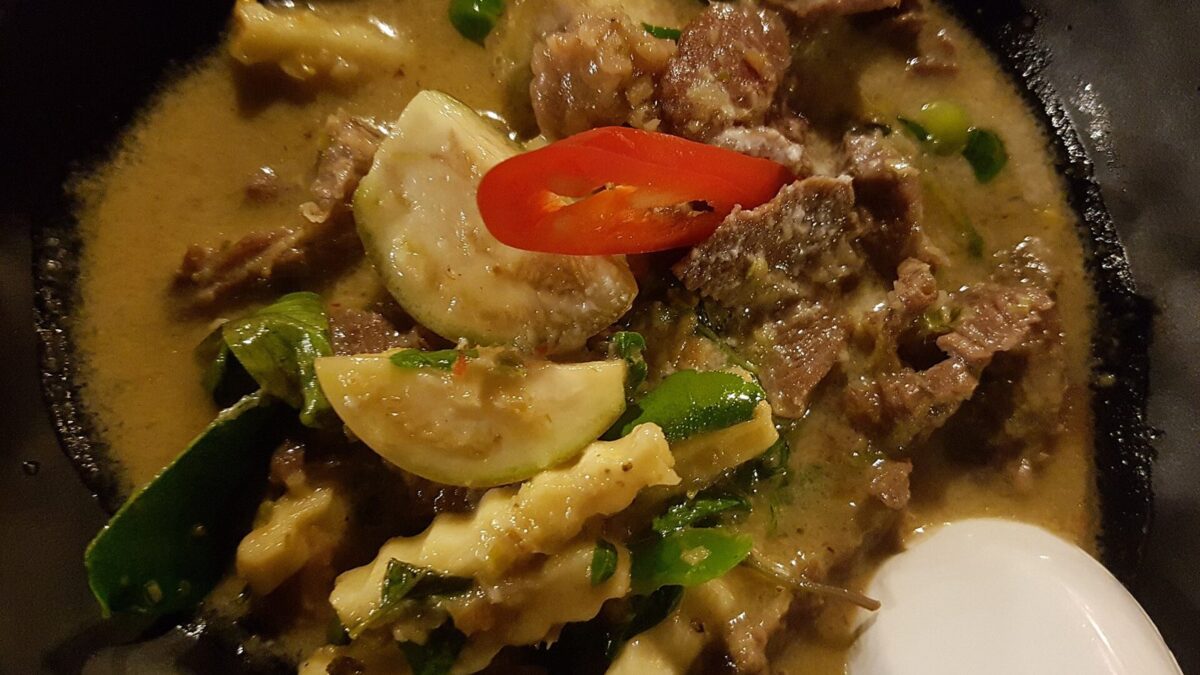
Green curry collects more bad advice than anything else I cook regularly, and most of it sounds reasonable, which is why it keeps getting passed around. I believed four of the five things below for two years while my curry came out flat and grey-green, tasting of warm coconut and not much else.
The recipe is further down. The recipe was never what was wrong.
Prep: 15 mins Cook: 20 mins Serves: 4
Myth: Green Is the Mild One
People assume green means gentle because red looks angrier. It’s backwards more often than not.
Green curry paste is built on fresh green bird’s eye chilies, the small ones sold as prik kee noo, which land somewhere around 50,000 to 100,000 on the Scoville scale. Red paste is built on dried red spur chilies, which are long, mild, and mostly in there for color; they sit closer to 1,500 to 2,500. Spoon for spoon, green usually bites harder.
Brand matters as much as color. The small 4 oz Maesri can runs hotter in my kitchen than the same measured tablespoon from a Mae Ploy tub. Cooking for people whose tolerance you don’t know? Start at 2 tablespoons for four servings and stir in more at step 4. You can always add paste. Taking it out costs you another can of coconut milk and a bigger pot.
Myth: Shop-Bought Paste Can’t Make a Good Curry
A well-made commercial paste beats a homemade one blitzed in a food processor for ninety seconds, and I say that having made both. A blender cuts; a granite mortar crushes, and crushing is what ruptures the oil cells in lemongrass and galangal. A homemade paste worth the twenty minutes of pounding needs fresh galangal, fresh kaffir lime peel, coriander root, and shrimp paste. Missing two of those, buy the can.
What to look for on the label, in order:
- The first three ingredients should be chili, lemongrass, and galangal in some order. If water, salt, or vegetable oil is first, you’re buying diluted paste.
- Kaffir lime peel and coriander root should appear. Their absence is the single most common reason a curry tastes generically hot instead of Thai.
- Shrimp paste, sometimes written kapi. It smells alarming in the jar and it is a large part of why the finished curry tastes savory.
- Nothing thickening. Cornstarch, xanthan gum, or “curry powder” high up the list means a sauce-flavored product rather than a paste.
A 14 oz tub keeps about six months in the fridge if you smooth the surface and press cling film onto it. I gave up on that and freeze mine in an ice cube tray, a tablespoon per well, so a curry now starts with me prising out three brown-green cubes.
Myth: The Coconut Milk All Goes In Together
This is the one that changed my curry most.
Don’t shake the can. Stand it in the fridge two hours if you can, then spoon off the thick cream from the top, roughly half a cup. That alone goes into the pan over medium heat for three to five minutes. It bubbles, thickens, starts to sputter, and clear oil pools at the edges. That’s cracking the cream, and the pooled oil is what you fry the paste in.
Paste fried in that oil releases the aromatics that only dissolve in fat. Paste stirred into two cans of liquid never gets above about 100°C, because the water won’t let it, so half the flavor stays locked in. Same ingredients, different curry.
One catch: stabilized coconut milk with guar gum won’t crack, it just goes gluey. Check the can. Aroy-D and Chaokoh are the two I can buy locally that are coconut and water only.
Myth: Any Basil Will Do
Thai basil and Italian sweet basil are not interchangeable, and the substitution doesn’t produce a slightly different curry, it produces one that tastes wrong.
Thai basil, sold as horapha, has purple-tinged stems, narrow pointed leaves, and a clear anise note. Italian sweet basil has big floppy leaves and tastes of clove and mint; in hot coconut sauce it goes black and slack within a minute and drags the dish somewhere Mediterranean. Holy basil, kaphrao, is the peppery one and belongs in pad kaphrao.
No Thai basil at your shop? Leave it out and finish with extra lime. A curry with no basil reads as incomplete. A curry with the wrong basil reads as a mistake.
It goes in off the heat either way. Thirty seconds of residual warmth wilts it; a simmer destroys it.
Myth: Fish Sauce Is Optional
You can leave it out. The curry will then taste like it’s missing something you can’t name, and you’ll keep adding salt trying to fix it.
Fish sauce isn’t doing the job of salt. Anchovies fermented in salt for twelve to eighteen months break down into free glutamates, and that’s a different sensation entirely. Look for a label that reads anchovy, salt, and nothing else; Red Boat and Squid Brand both do. Sugar and hydrolysed protein on the list means a cheaper build, and you’ll need more of it.
One tablespoon for four servings is the floor. I usually end up at a tablespoon and a half after tasting.
Ingredients
- 2 boneless chicken thighs — about 350 g, sliced into bite-sized pieces; thighs stay tender through the simmer better than breast
- 3 tablespoons Thai green curry paste — start at 2 if you’re unsure of the brand
- 2 cans (400 ml each) full-fat coconut milk — unshaken, and check for guar gum
- 1 tablespoon fish sauce — plus more at the end if it tastes thin
- 1 teaspoon palm sugar or brown sugar — balance, not sweetness
- 1 Thai eggplant or half a regular eggplant — cut into 3 cm chunks
- 1 red bell pepper — sliced into strips
- 1 cup green beans — trimmed and halved
- 4 kaffir lime leaves — torn along the spine, or the zest of one lime
- 1 handful Thai basil leaves — stirred in off the heat
- 1 tablespoon neutral oil — only if your coconut cream refuses to release enough of its own
- 1 lime — cut into wedges for the table
Instructions
- Open one can of coconut milk without shaking it and spoon about half a cup of the thick cream from the top into a wide pot or deep pan. Set the rest aside.
- Heat the cream over medium for 3 to 5 minutes until it stops looking like cream, starts sputtering, and clear oil separates out at the edges. Add the tablespoon of oil only if very little separates.
- Stir the curry paste into that oil and fry it for 2 to 3 minutes, moving it constantly. It will darken and the smell will change from raw and grassy to deep and roasted. Don’t skip ahead here.
- Add the chicken and stir until every piece is coated. Cook about 4 minutes, until the outside is opaque.
- Pour in the remaining coconut milk from both cans, then the fish sauce, sugar, and torn lime leaves. Bring to a gentle simmer, never a rolling boil.
- Add the eggplant and green beans and simmer 8 minutes.
- Stir in the bell pepper and cook another 4 to 5 minutes, until the vegetables are tender with some resistance left and the chicken reaches 74°C / 165°F at the thickest piece.
- Taste. Salt means more fish sauce, dullness means more sugar, heaviness means lime. Adjust before it leaves the pan, not on the plate.
- Kill the heat, fold in the Thai basil, and serve over jasmine rice with lime wedges.
And No, It Isn’t Vegetarian
Worth saying plainly, because green curry gets listed as a vegetarian option constantly. Standard green curry paste contains shrimp paste, and this recipe adds fish sauce on top. Neither is negotiable in the original.
Two swaps make it genuinely meat-free: a paste labelled vegetarian on the front, and a tablespoon and a half of light soy in place of the fish sauce plus half a teaspoon of white miso for the glutamates you’ve lost. Press tofu 20 minutes, pan-fry it separately, and add it in the last two minutes so it doesn’t collapse. For something built meat-free from the start rather than converted, my vegetable stir-fry is the easier route.
If Your Sauce Splits or Tastes Flat
A split, oily-looking sauce almost always means it boiled. Coconut emulsions hold at a lazy simmer and break at a hard one. Pull it off the heat, add two tablespoons of cold coconut milk, and stir in one direction until it comes back; it usually does.
Flat is nearly always one of three things: the paste never met hot fat, there’s no acid at the end, or you were shy with the fish sauce. Check in that order. A curry that tastes of nothing after twenty minutes of simmering has almost never been under-spiced. It’s been under-fried.
Leftovers are better on day two and better still on day three, by which point I’ve stopped pretending it’s dinner and I’m eating it at the counter with a spoon. Four days covered in the fridge, reheated low with a splash of water. Coconut sauces generally do this, and a one-pot coconut vegetable curry improves the same way overnight. Cook fresh rice; day-old rice is for vegetable fried rice, not for this.
That paste-frying step is the same principle behind weeknight butter chicken, and the same salt-sour-sugar balance runs through chicken pad Thai. Learn it once and you’ve learned it for a dozen dishes.