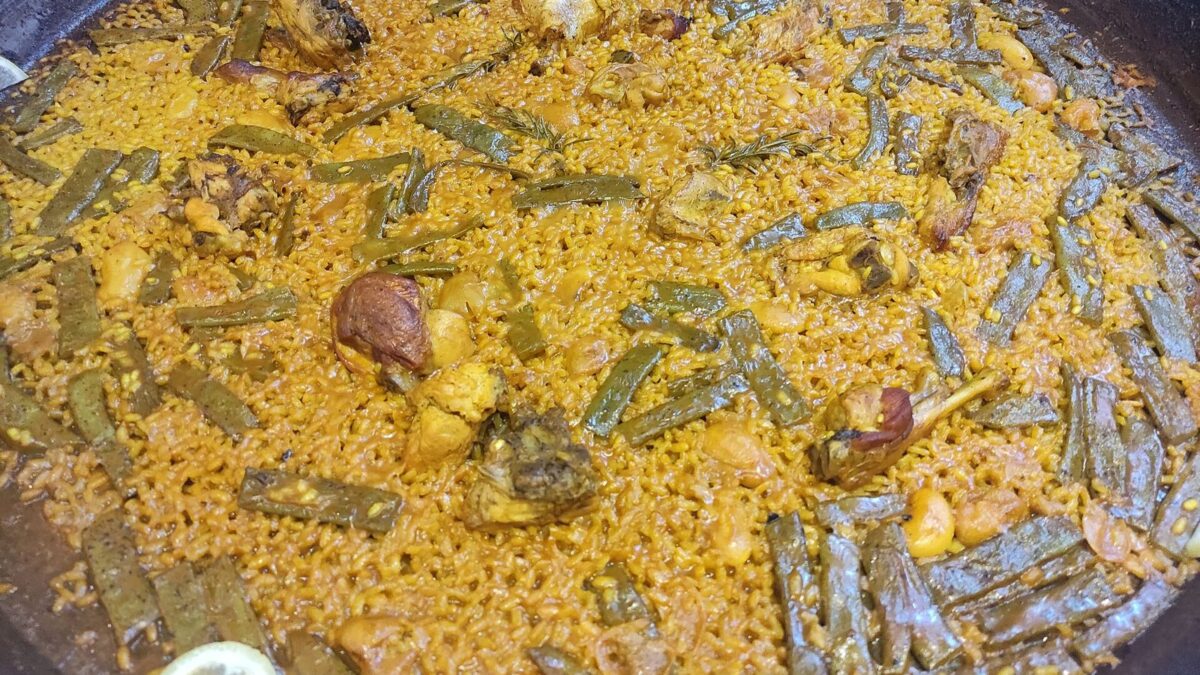
Paella attracts more confident bad advice than anything else I cook. Most of it sounds reasonable, which is exactly why it keeps circulating. This vegetable version, with peppers, green beans, artichokes and peas, is the one I’ve made most often on an ordinary four-burner hob, and getting it right had less to do with any technique I added than with habits I dropped.
If you’re already standing at the stove: stop stirring, use a wider pan than feels necessary, and don’t panic when the base starts to crackle.
The Stirring Habit Is the First One to Break
Paella is not risotto, and that confusion wrecks more pans than anything else. Risotto is agitated on purpose. You’re rubbing grains against each other to pull starch off the outside, and that loose starch is the sauce. Paella wants the opposite: once the broth goes in, the rice sits in a shallow layer and cooks undisturbed, drinking liquid from below and steaming from above, so the finished grains stay separate instead of bound.
Stir it and three things go wrong at once. Starch comes off and the pan turns gluey. The even layer collapses into drifts, so some rice drowns and some sits dry. And you’ve lifted the rice off the hot base, which is where the crust was supposed to form.
I stirred for years out of nerves. The first few times I made this I gave it a turn at the ten-minute mark because the surface looked dry and I assumed it was catching. It wasn’t. Dry on top at ten minutes is right, because the liquid is where it belongs, down at the base. If you want the pan that rewards fussing, make a creamy mushroom and spinach risotto and stir it as much as you like.
Ingredients
- ¼ cup olive oil
- 1 onion, diced
- 1 red bell pepper, sliced
- 1 yellow bell pepper, sliced
- 4 cloves garlic, minced
- 2 medium tomatoes, grated or finely chopped
- 1 teaspoon smoked paprika
- ½ teaspoon saffron threads, steeped in 2 tablespoons warm water
- 1½ cups Bomba or Arborio rice, short-grain only
- 4 cups vegetable broth, warmed
- 1 cup green beans, trimmed and halved
- 1 cup canned artichoke hearts, quartered
- 1 cup frozen peas
- 1 lemon, cut into wedges, for serving
- 2 tablespoons fresh parsley, chopped, for garnish
Instructions
- Heat the olive oil in a paella pan or wide shallow skillet of at least 30 cm over medium heat. Add the onion and bell peppers and cook 6 to 7 minutes, until soft and slumped but not browned.
- Stir in the garlic for 30 seconds, then add the grated tomatoes and smoked paprika. Cook 4 to 5 minutes, stirring now and then, until the mixture darkens and thickens into a jammy sofrito that pulls away from the pan base when you drag a spoon through it.
- Add the rice and stir for about 1 minute, until every grain is coated and slightly toasted.
- Pour in the warm broth with the saffron and its soaking liquid. Stir once to level everything, then put the spoon down and leave it alone until the very end.
- Bring to a simmer and scatter the green beans and artichoke hearts evenly over the surface. Drop to medium-low and cook uncovered for 15 to 18 minutes. No lid, no stirring.
- In the final 5 minutes, scatter the frozen peas across the top. Keep cooking until the liquid is gone and the rice is tender with a slight bite at the centre.
- For the socarrat, raise the heat to medium-high for the last 1 to 2 minutes. Listen for a light crackle rather than watching for colour, then pull the pan off the heat the moment the sound sharpens.
- Rest the pan 5 minutes under a clean kitchen towel. Scatter parsley over the top and serve from the pan with lemon wedges.
Saffron Does a Job Turmeric Can’t
“Saffron is optional, just use turmeric” is a colour argument wearing a flavour costume. Turmeric turns rice yellow. It does not smell of saffron, and it carries its own faint earthy bitterness that sits awkwardly next to smoked paprika. You end up with a yellow pan that tastes like it’s missing something, because it is.
What saffron contributes is aroma, somewhere between dried hay and warm honey, and it lands in the back of your nose rather than on your tongue. Half a teaspoon of threads is roughly 0.3 g, so a 1 g tube covers about three pans this size. That’s the cost argument, spread over three dinners.
Steeping matters more than quantity. Crumble the threads between dry fingers into 2 tablespoons of warm water, not boiling, and leave them 10 to 15 minutes until the water goes deep orange. Threads dropped in dry give up maybe half of what they’ve got before the rice is done.
My honest position: no saffron, cook it anyway, lean harder on the paprika and the sofrito, and call it a smoky vegetable rice. Just don’t reach for turmeric to fake the colour.
“Any Short-Grain Rice” Is Doing a Lot of Work
Bomba, Calasparra, Arborio, sushi rice and pudding rice are all short or medium grain and they behave nothing alike. Bomba takes up close to three times its volume in liquid and holds its shape hard, which is why it forgives a slightly wet pan. Arborio drinks less and sheds far more starch, so it edges towards creamy if you look at it wrong. Sushi rice is bred to cling. Pudding rice collapses.
The 1½ cups rice to 4 cups broth ratio assumes a wide pan cooking uncovered, where a real share of that liquid leaves as steam. Move the same quantities into a deep 24 cm saucepan and you’ll finish with wet rice, because nothing evaporated. That’s the ratio failing the pan, not the recipe.
Long grain is the flat no. Basmati and jasmine are structurally done long before they’ve absorbed that much broth, so you get cooked rice sitting in a puddle. I tried it once on a night I’d run out of everything else and served it with a straight face. Nobody was fooled.
The Crackle at the End Isn’t a Mistake
Socarrat is the thin layer of rice that toasts against the metal at the finish, and it’s the part people in Valencia scrape for. Calling it burnt rice misses what’s happening. Burnt is carbon and bitterness. Socarrat is caramelised starch, chewy at the edges, closer to the crust on good toast.
Here’s the home-hob truth nobody puts in the recipe. A standard gas burner heats a circle roughly 20 cm across; your pan is 30 cm or more. You’ll get socarrat in a ring over the flame and nothing at the edges unless you move the pan, so give it a quarter turn every 20 to 30 seconds through that final 90 seconds. Induction is more even but still leaves the rim cooler. Two burners on medium beats one on high.
Go by ear. A soft irregular popping, like light rain on a window, means it’s working. When it tightens into fast ticking and you smell toast rather than rice, you’ve gone too far. Two minutes is the ceiling. I overshot by about 40 seconds once while answering the door, and the bitterness carried through the whole pan, not just the base.
A Paella Pan Is Nice. A Wide Pan Is the Requirement.
The pan does one job: it keeps the rice shallow. Under about 1.5 cm deep, the layer cooks evenly and the base can toast. Above that, the top steams while the bottom stews. A 30 cm skillet handles this quantity for four. A 28 cm one works if you accept a thicker layer and add 2 to 3 minutes.
A 38 cm paella pan on a domestic hob is genuinely worse than a 30 cm skillet, and this is where the equipment advice goes wrong. Those pans are built for a wide gas ring or a wood fire. Over one home burner the middle scorches while the outer 8 cm barely simmers, and no amount of rotating closes that gap. Buy the pan when you buy the outdoor burner.
Two things the pan won’t fix. Don’t cover it, because a lid returns condensation to the surface and you lose the dry top. And warm the broth first, since 4 cups of fridge-cold liquid drops the pan out of a simmer for several minutes.
Leftovers are the one place where stirring is finally allowed. Microwaved paella goes leathery, so spread it in a dry frying pan over medium heat with a tablespoon of water, cover 3 minutes, then uncover and let the base crisp again. From there it’s two steps from vegetable fried rice, and leftover sofrito peppers go into a slow-cooked ratatouille or onto a tray of roasted vegetables the next evening.