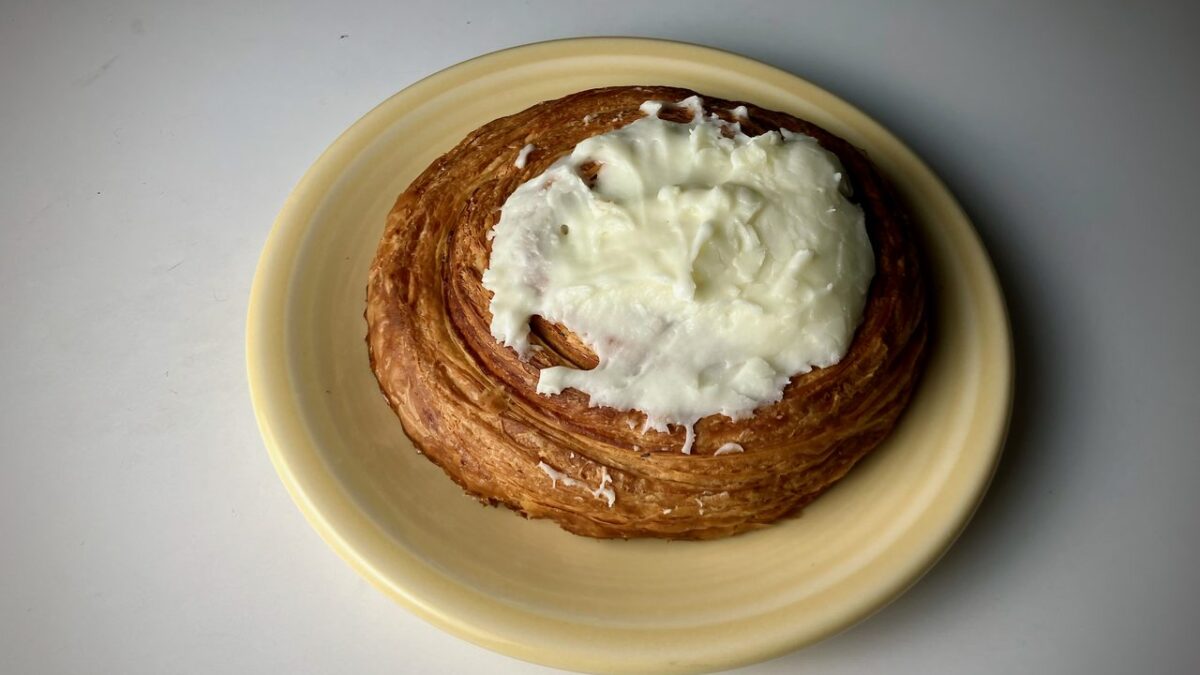
Can You Make Cinnamon Rolls The Night Before?
Yes, and the fridge is the best thing that can happen to this dough. Assemble the rolls fully, stop right before the second rise, cover the pan tightly and refrigerate for 12 to 16 hours. The cold slows the yeast almost to a stop while the enzymes keep working on the flour, which is why an overnight batch tastes noticeably more like something and less like sweet bread.
The morning timing is where people trip. Pull the pan out and leave it on the counter for 45 to 60 minutes before it goes in the oven. A fridge-cold 9×13 dish takes that long to lose its chill, and rolls that go in cold set on the outside before the middle has any chance to catch up. If you’re desperate, bake straight from cold at 350°F (175°C) and add 6 to 8 minutes, tenting foil over the top at the 20-minute mark.
Don’t push past 18 hours. After that the dough over-proofs in the cold, the spirals slacken, and they bake up with a coarse, bready crumb. I’ve done 20 hours once and they were fine, not good.
I make these about six times a year, always the night before, because nobody in this house can knead dough at 7am.
Prep: 30 mins Rise: 2 hrs Bake: 22-25 mins Makes: 12 rolls
Ingredients
- 1 cup whole milk, warmed to 110°F
- 2 1/4 teaspoons (1 packet) active dry yeast
- 1/3 cup granulated sugar, divided
- 1/3 cup unsalted butter, melted and cooled slightly
- 2 large eggs, room temperature
- 4 1/2 cups all-purpose flour, plus more for the bench
- 1 teaspoon salt
- 3/4 cup packed brown sugar
- 2 1/2 tablespoons ground cinnamon
- 1/3 cup unsalted butter, very soft, for the filling
- 4 oz cream cheese, softened, plus 2 tablespoons butter and 1 1/4 cups powdered sugar, for the icing
- 1/2 teaspoon vanilla extract and a pinch of salt, for the icing
Instructions
- Combine the warm milk, yeast and 1 tablespoon of the sugar. Leave 5 to 10 minutes until the surface is foamy. No foam means dead yeast, and no amount of hoping will fix it later.
- Add the melted butter, eggs, remaining sugar, salt and 3 cups of the flour. Mix, then add the rest of the flour gradually until you have a soft dough that’s still tacky to the touch.
- Knead 7 to 8 minutes by hand or 5 minutes with a dough hook, until smooth and springy. Put it in a greased bowl, cover, and let it rise somewhere warm for 1 to 1 1/2 hours, until doubled.
- Press the air out and roll the dough on a floured surface into a rectangle roughly 16 by 12 inches. Spread the soft butter right to the edges, then mix the brown sugar with the cinnamon and scatter it evenly over the top.
- Roll up tightly from a long edge. Slice into 12 rolls with unflavoured dental floss: slide it under the log, cross the ends over the top and pull. A knife squashes the spiral flat.
- Arrange the rolls in a greased 9×13-inch dish, close but not jammed. Cover loosely and rise 30 to 45 minutes until puffy and touching. (To go overnight, refrigerate at this point instead.)
- Heat the oven to 350°F (175°C) and bake 22 to 25 minutes, until the tops are golden and the centre of the middle roll reads 190°F.
- While they bake, beat the cream cheese and butter smooth, then add the powdered sugar, vanilla and salt and beat until spreadable.
- Rest the rolls 5 to 10 minutes, then ice them.
Why Do Mine Come Out Dry?
Three culprits, in the order they’re most likely.
Too much flour is the biggest. The dough should feel tacky at the end of kneading, tacky enough that your palm leaves a print. Dust the bench heavily and keep adding to stop the stick, and you can push in an extra half cup without noticing. That half cup is the difference between soft and stiff.
Overbaking is second. Twenty-five minutes is the outer limit, not the target. Start checking at 20 and use a thermometer in the centre roll: 190°F is done, 205°F is a bun.
Third, spacing. Rolls that touch on all sides protect each other’s soft edges. Spread them across a sheet pan for the sake of neat individual spirals and you’ll get four crisp sides on every one.
A dry batch is rescuable, just barely. Brush the warm tops with 2 tablespoons of milk before icing and cover the pan with foil for 10 minutes. Same repair I use on an over-baked cinnamon coffee cake.
Why Is The Centre Raw When The Tops Are Brown?
The oven is running hot, or the rolls are too big, or both.
Home ovens routinely run 15 to 25°F above their dial. An oven thermometer costs almost nothing and settles the argument permanently. If the tops are dark by minute 15, the oven is hot.
Roll size matters too. Twelve rolls from a 16-inch log makes each about 1 1/3 inches thick. Cut nine fat ones instead and the middles need longer than the tops can survive. Tent the pan with foil at 18 minutes and give them 5 extra.
And the middle roll is always the last to cook. That’s the one to test, never a corner.
Do I Need A Stand Mixer?
No. This dough is soft and enriched and it kneads by hand easily, 8 to 10 minutes, no special technique. Push, fold, quarter turn, repeat.
Test it with the windowpane: tear off a walnut-sized piece and stretch it slowly between your fingers. If it thins enough to let light through before it tears, the gluten is where it needs to be. If it rips straight away, keep going for another 2 minutes.
The one advantage of a mixer here is that you’re less tempted to add flour, since you’re not dealing with sticky hands. Working by hand, oil your palms lightly instead of flouring them. Same for soft dinner rolls, which are the same family of dough without the sugar.
Can I Freeze Them, And At Which Stage?
Two points work, and they suit different mornings.
Freeze unbaked, right after slicing: arrange in the greased dish, wrap tightly, freeze up to 6 weeks. The night before, move the pan to the fridge, then give it 90 minutes on the counter in the morning before baking as normal. This gives the better result by a clear margin.
Freeze baked and un-iced: cool completely, wrap individually, freeze up to 3 months. Reheat one roll for 25 seconds in the microwave or the whole pan, covered, at 300°F for 15 minutes. Ice after reheating, never before, since cream cheese icing separates when it’s frozen and thawed.
The overnight route is still better than either. If cold-proofing is the part that appeals to you, soft overnight cinnamon rolls are built for it from the start.
When Should The Icing Go On?
Five to ten minutes after they leave the oven, and this window is narrower than it sounds.
Straight out of the oven, cream cheese icing turns to liquid and runs off the tops into the gaps, which some people want and I don’t. Fully cooled, it sits on top as a stiff cap and never gets into the spiral. The five-minute mark leaves the rolls warm enough that the icing softens and sinks partway into the layers while still holding its shape on top.
If your icing is too stiff to spread, add milk a teaspoon at a time. If it’s too loose, it’s usually because the cream cheese was over-warm; 20 minutes in the fridge fixes it. Use full-fat block cream cheese, not the spreadable kind sold in tubs, which carries extra water and never firms up. For a glaze instead, thin the icing with 3 tablespoons of milk and pour it over hot rolls, the way you would over glazed doughnuts.