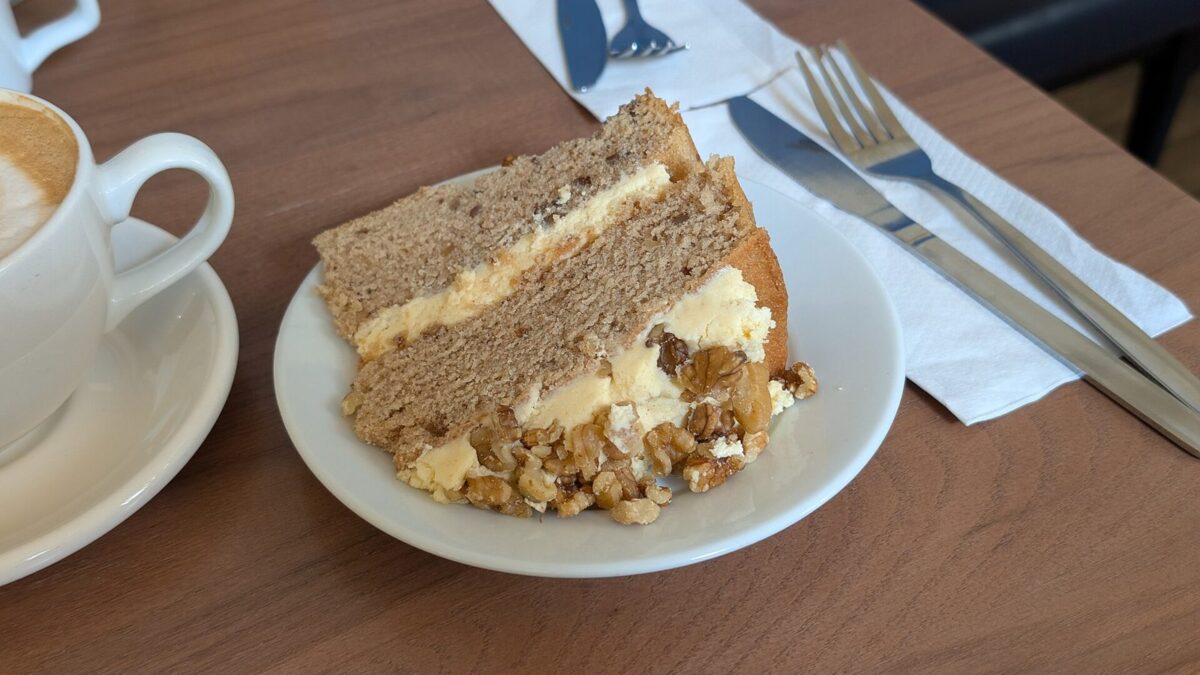
Two questions send most people to this page. One is about the name, one is about the streusel disappearing. Both have short, real answers, and the second one is fixable.
Prep: 20 mins Cook: 40 mins Serves: 9
Is There Any Coffee in Coffee Cake?
None. Not a spoonful.
The name describes the occasion, not the ingredients. It traces back to the German Kaffeekuchen, a plain sweet cake eaten with afternoon coffee, which travelled to America with German and Scandinavian immigrants and picked up the streusel along the way. It is named for what sits beside it on the table. Nobody asks what is in a teacake for the same reason.
You can add coffee if you want. A tablespoon of instant espresso powder rubbed into the crumb topping deepens the cinnamon without tasting of coffee. But that is an addition, not a restoration of something missing.
Why Does the Streusel Sink Into the Cake?
Because it is denser than the batter and the batter is still liquid when the streusel goes on. Gravity does the rest during the first ten minutes, before the cake sets. There are three separate reasons yours might be sinking.
The butter was too soft. Warm butter smears into the flour and sugar and makes a paste, and a paste has no structure to sit on. Use butter straight from the fridge, cubed small, rubbed in with your fingertips until you have lumps pea-sized and larger. If your kitchen is warm, chill the finished topping while you mix the batter. In an Indian summer mine goes in the freezer for ten minutes.
The clumps were too small. Fine sandy crumbs sink because there is nothing holding them together. Big irregular lumps bridge across the surface and support each other. When you think the topping is done, squeeze a handful into a fist and then break it up roughly. That gives you the craggy pieces you want.
The batter was too thin. A full cup of sour cream gives a batter you spread with a spatula rather than pour. If yours pours, something is off, most likely underweighted flour from scooping instead of spooning.
One trick that costs nothing: after spreading the second layer of batter, let the pan sit two minutes before topping. The surface skins over very slightly, and that film is enough to slow the sinking.
Ingredients
- 2 cups all purpose flour, spooned and leveled
- 1 cup granulated sugar
- 1/2 cup unsalted butter, softened
- 1 cup sour cream, for a tender, moist crumb
- 2 large eggs, at room temperature
- 1 1/2 teaspoons baking powder
- 1/2 teaspoon baking soda
- 1 teaspoon pure vanilla extract
- 1/2 teaspoon salt
- For the swirl and topping: 3/4 cup brown sugar, packed
- 2 tablespoons ground cinnamon, divided
- 1/2 cup flour and 4 tablespoons cold butter, for the crumb
Instructions
- Preheat the oven to 350°F and butter an 8 or 9 inch square baking pan. Line it with a strip of parchment for easy lifting later.
- Make the crumb topping first. In a bowl, stir together 1/2 cup flour, 1/2 cup of the brown sugar, and 1 tablespoon cinnamon. Rub in the cold butter with your fingertips until you have big, moist clumps. Set aside.
- Mix the swirl by combining the remaining 1/4 cup brown sugar with the remaining 1 tablespoon cinnamon in a small bowl.
- In a large bowl, cream the softened butter and granulated sugar until light. Beat in the eggs one at a time, then the vanilla and sour cream until smooth.
- In a separate bowl, whisk the flour, baking powder, baking soda, and salt. Gently fold the dry ingredients into the wet just until no streaks remain. Do not overmix.
- Spread half the batter into the pan. Sprinkle the cinnamon sugar swirl evenly over it, then dollop and spread the remaining batter on top.
- Scatter the crumb topping generously over the surface, pressing gently so it adheres. Do not be shy, pile it on.
- Bake for 38 to 42 minutes, until a toothpick in the center comes out clean and the top is golden. Cool in the pan for 20 minutes before slicing.
Why Sour Cream Instead of Milk?
Two reasons, and the second one is the interesting one.
Fat coats flour proteins and physically blocks gluten forming, so a cup of sour cream at roughly 20 percent fat gives a far more tender crumb than the same volume of milk. Straightforward enough.
The second reason is acid. Sour cream sits around pH 4.5, and that acidity reacts with the half teaspoon of baking soda to produce carbon dioxide, a good part of your lift. Swap in plain milk and the soda has nothing to react with, so the cake rises less and carries a faint soapy taste. Full-fat yoghurt or buttermilk substitute cleanly because they bring the same acidity. Cream, oddly, does not.
This is the same chemistry doing the work in buttermilk scones and in soda bread, where the acid and the soda are the entire leavening system.
Can I Bake This in a 9×13?
Not without doubling it. A 9×13 pan holds roughly twice the volume of a 9 inch square, so a single batch spread across it comes out about an inch thick, dry at the edges, and the streusel-to-cake ratio goes wrong.
Double everything including the topping, keep the oven at 350°F, and start checking at 45 minutes. Mine takes 48 to 52. The toothpick is unreliable near the swirl, since melted cinnamon sugar looks exactly like wet batter, so test the middle of a quarter section rather than dead centre.
Why Is the Middle Dense When the Edges Are Fine?
Usually overmixing, sometimes underbaking, occasionally both.
Once the flour goes in, fold with a spatula rather than a whisk and stop the moment the last dry streak vanishes. Fifteen or twenty folds. The batter should look slightly rough. A perfectly smooth one has been worked too long, and the middle, the last part to set, ends up tough.
If it is underbaking, the giveaway is a wet rather than merely dense centre and a top that sinks slightly as it cools. Add five minutes and tent the pan loosely with foil so the streusel does not darken.
One thing I got wrong for years: I was creaming the butter and sugar for barely thirty seconds. Give it a full two to three minutes until it turns visibly paler and increases in volume. Those air bubbles are the structural backbone of the cake and no amount of baking powder replaces them.
Does It Genuinely Taste Better the Next Day?
Yes, and not just as politeness about leftovers. Starch and fat keep redistributing for several hours after baking, and cinnamon’s aromatic compounds migrate outward from the swirl into the crumb around it. Day two the cinnamon reads through the whole slice rather than only where you put it.
The trade-off is the topping, which is craggiest within about four hours and softens overnight as it draws moisture from the cake. Fifteen minutes at 300°F on day two brings it back, and I think that is worth doing.
How Long Does It Actually Keep?
Three days at room temperature in an airtight container, five in the fridge, though the fridge firms the crumb and you should let a slice come back to room temperature before eating it. Two months in the freezer, wrapped tight in individual squares.
Do not cover it while it is still warm. Steam condenses on the lid, drips back onto the streusel, and by morning the topping is a damp layer instead of a crumbly one. Let it cool completely, at least two hours, then cover.
If you like this shape of bake, the closest relatives on the site are cinnamon rolls with cream cheese icing for the same flavour in a yeasted form, blueberry streusel muffins if the crumb topping is the part you are here for, and apple crumble, which is the same cold-butter rubbing technique applied to fruit.