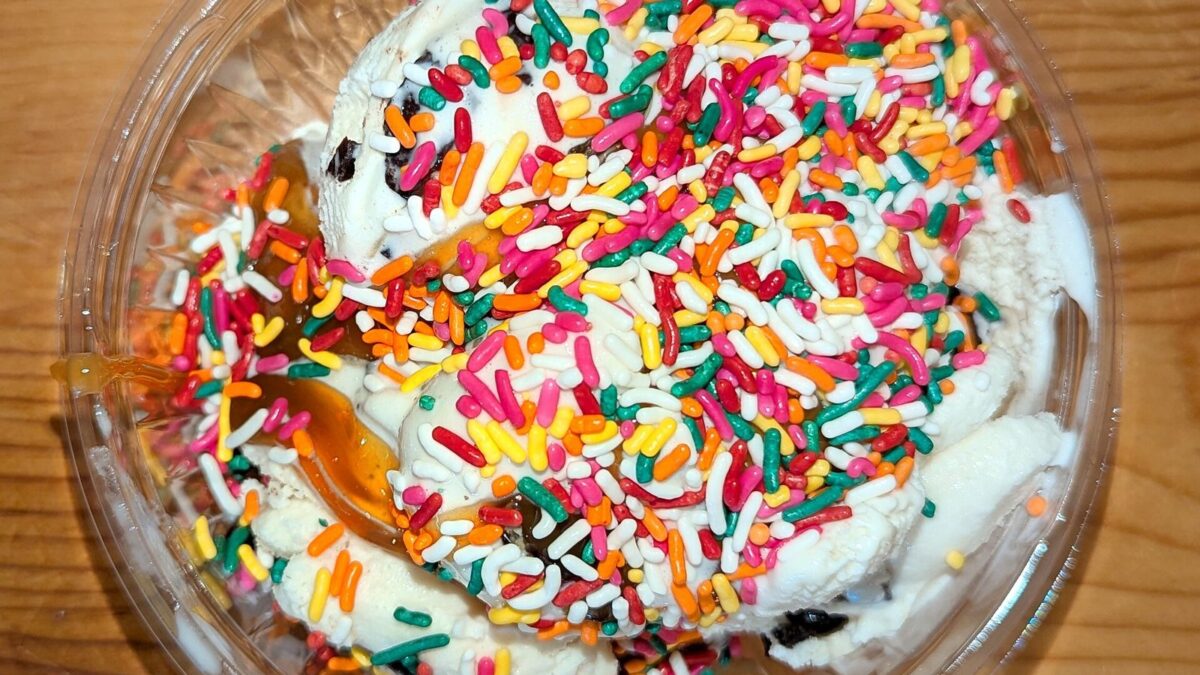
A hot fudge sundae is four scoops of assembly and one genuinely technical thing, and the technical thing is the sauce. Everything else — chilling the bowl, scooping, the cherry — takes about ninety seconds and no skill. So this is mostly about the sauce: what makes it fudgy instead of thin, why it does not set hard the way a chocolate shell does, and why it sometimes turns gritty on the tongue.
Ten minutes, one small pot, serves four with sauce left over.
Fudge sauce and chocolate sauce are not the same thing
Chocolate sauce is thin, pourable cold, and made mostly of cocoa, sugar and water. It runs off a scoop. Fudge sauce has cream and chopped chocolate in it, which means fat and emulsified solids, and it clings. The test I use is the back of a spoon: warm fudge sauce coats it opaquely and a finger drawn through leaves a channel that stays open. Chocolate syrup closes the channel instantly.
That difference matters on ice cream because fat is what seizes when it hits something cold. A watery sauce hitting a scoop at 0°F just freezes into a thin crackly sheet or a slick of brown ice. A fat-rich sauce firms into a chewy ribbon.
The sugar stage, and why we stop well short of it
This sauce is deliberately not a candy. If you simmer cream and sugar for two minutes at a gentle bubble you will land somewhere around 220°F, which is barely above the boiling point of the syrup and a good ten degrees below thread stage at 230°F, and nowhere near soft-ball at 235°F to 240°F.
Cook it to soft-ball and you have made proper fudge — it will set into a block in the jar and you will be chipping at it with a spoon. Stop before it boils at all and there is not enough sugar concentration to hold the sauce thick, so it slides straight off the ice cream into the bottom of the bowl.
Two minutes of visible bubbling is the whole window. I time it. I used to eyeball it and got a different sauce every single time, usually thinner, because I was pulling it at about ninety seconds while the surface was still just shivering.
Corn syrup is doing real work, not filling space
The two tablespoons of corn syrup are the reason the sauce stays smooth for a fortnight in the fridge. Table sugar wants to crystallise back out of a concentrated syrup, and once one crystal forms it seeds the rest and the whole jar goes sandy. Corn syrup is a different sugar with a different molecular shape, and it physically gets in the way of sucrose crystals lining up.
You can leave it out. I have. The sauce was fine the first evening and unpleasantly gritty by day three. Golden syrup works the same way if corn syrup is hard to find where you are — I use them interchangeably, though golden syrup brings a faint caramel note.
Why both cocoa powder and chopped chocolate
Cocoa powder is nearly all chocolate solids with the fat pressed out, so it delivers dark bitter flavour cheaply and thickens as it hydrates. Chopped bittersweet chocolate brings cocoa butter, which is the fat that sets firm at fridge temperature and makes the ribbon chewy on cold ice cream.
Use only cocoa and the sauce tastes strong but thin, and never gets that pull. Use only chocolate and it is rich but flat. Two separate jobs, not a compromise.
Sift the cocoa. It clumps, and a lump of dry cocoa that never dissolves reads on the tongue as grittiness and gets blamed on crystallisation when it was never sugar at all.
Ingredients
- 1 pint vanilla ice cream, or your favorite flavor
- 3/4 cup heavy cream, for the fudge sauce
- 1/2 cup granulated sugar
- 1/3 cup unsweetened cocoa powder, sifted to avoid lumps
- 4 ounces bittersweet chocolate, finely chopped
- 2 tablespoons unsalted butter, for shine
- 2 tablespoons light corn syrup, keeps the sauce smooth
- 1 teaspoon pure vanilla extract
- 1 pinch salt, to sharpen the chocolate
- Whipped cream, for topping
- 1/4 cup toasted chopped nuts, such as peanuts or almonds
- 4 maraschino cherries, because tradition demands it
Instructions
- Put four bowls or sundae glasses in the freezer. They want at least 10 minutes. Take the ice cream out to soften on the counter for 2 to 3 minutes, then put it straight back in.
- In a small heavy saucepan, whisk together the cream, sugar, sifted cocoa, corn syrup and salt while the pan is still cold. Whisking dry cocoa into hot liquid is how you get lumps.
- Set it over medium heat and whisk steadily until the sugar has dissolved and the mixture is uniformly glossy. Rub a drop between finger and thumb — no grit means the sugar is gone.
- Bring it to a gentle bubble and hold it there for a full 2 minutes, whisking often and scraping the base so nothing catches. It should bubble lazily across the surface, not spit.
- Pull the pan off the heat. Add the chopped chocolate and the butter, leave it undisturbed for 60 seconds, then whisk from the centre outward until it is smooth and shines.
- Stir in the vanilla. Let it stand 5 minutes off the heat. It thickens noticeably as it drops toward 130°F, which is roughly the temperature you want to pour at.
- Scoop two rounds of ice cream into each frozen bowl. Pour the warm sauce over so it runs down the sides.
- Top with whipped cream, toasted nuts and a cherry. Serve with a long spoon before the base starts to slacken.
Reading the sauce off a cold spoon
Hot sauce always looks thin. Judging it in the pan is how people overcook it. Dip a metal teaspoon, hold it under cold running water for three seconds, and look at what is left clinging to it. That is roughly how it will behave at pouring temperature.
If it slides off in a sheet, give it another 30 seconds of bubbling. If the spoon comes out with a stiff cap that will not drip, you have gone past pourable and want a tablespoon of cream whisked back in.
Grainy sauce: three causes, only one of them is crystallisation
Undissolved sugar is the most common. If you brought it to a boil before the sugar had gone, some of it never dissolves and you feel every grain. Whisk on medium until smooth, then raise the heat.
Unsifted cocoa is second. Those lumps hydrate on the outside and stay powdery in the middle.
Actual crystallisation is third and mostly shows up in storage, days later, in a sauce made without corn syrup or one that got splashed up the sides of the pan and had dried crystals stirred back in. Wiping the pan wall down with a wet pastry brush during the simmer is a candy-making habit that genuinely helps here too.
Seized, split sauce is a different failure — grainy in a coarse, oily way with fat pooling on top. That is chocolate added while the pan was still on the heat. Off the heat, always, and give it the full minute before you stir.
What happens the moment it lands on the ice cream
Ice cream out of a home freezer sits around 0°F. Sauce at 130°F meets it and two things happen almost at once. The cocoa butter and dairy fat drop below their setting point and go solid, and the sugar syrup gets so viscous so fast that it never has time to form crystals. Solid but uncrystallised is the definition of chewy, which is why the ribbon pulls rather than shatters.
Sauce that is too hot melts a crater before it can set, and you get chocolate soup. This is the single most common sundae mistake and it is entirely a temperature problem, not a recipe problem. Let the pan sit five minutes. Boiling-hot fudge on ice cream is a puddle in under a minute; I have made that puddle more than once trying to serve people quickly.
Frozen bowls buy you roughly an extra two minutes of structure. Not nothing, if you are feeding four people one at a time.
The assembly, which is honestly not the hard part
Two scoops, sauce, cream, nuts, cherry. There is no technique here worth writing four paragraphs about, and any article that tells you the order of the toppings is a craft is padding.
The only two things that make a visible difference: toast the nuts in a dry pan for two or three minutes until you can smell them, and run the ice cream scoop under hot water between scoops so you get rounds instead of shavings. If you want the parlour look, alternate scoop, sauce, scoop, sauce rather than pouring it all over the top, so the sauce reaches the bottom of the glass.
For a warm base underneath, a square of fudgy chocolate brownie is the standard move and it works. The same sauce is also what a proper classic banana split is built on.
Keeping the sauce and bringing it back
Into a clean jar, lid on once it stops steaming, fridge, two weeks. It sets to the texture of cold ganache and will not pour.
Reheat in 15-second bursts in the microwave, stirring between each, or stand the jar in a mug of just-boiled water for five minutes. Do not put it back on direct heat — a second boil pushes the sugar concentration up and you end up with something closer to a toffee, which is a good thing to eat but a bad thing to pour.
Half a jar of this sauce also turns a plain molten chocolate lava cake into something excessive, and it thins with a spoonful of hot cream into a decent dipping sauce. The one place I would not use it is anywhere it has to set hard and snap — for that you want chocolate and oil, not chocolate and cream, and no amount of simmering will get this sauce there.