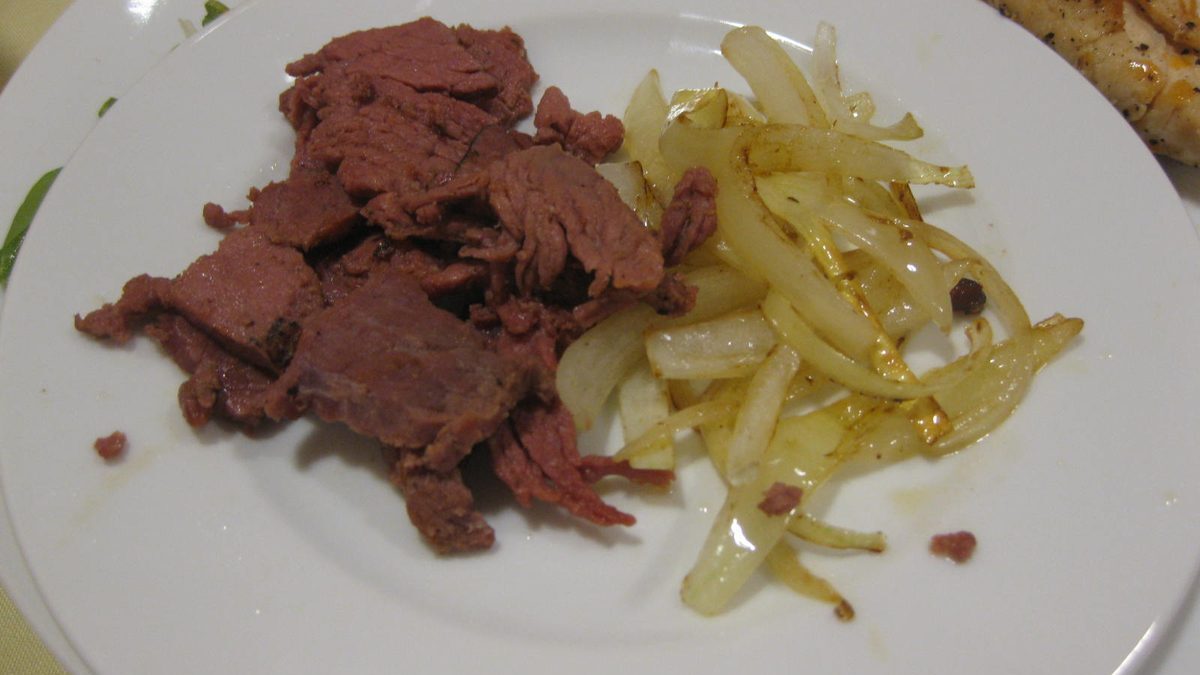
Cut into a steak straight off the pan and a puddle spreads across the board in about ten seconds. Wait eight minutes and cut the same steak, and you get a damp board instead of a flooded one. That difference is the whole argument for resting meat, and it comes down to what heat does to muscle fibres and what happens when you stop applying it.
I resisted this for years. Hot food should be eaten hot, and standing over a beautiful piece of pork doing nothing felt like an act of self-sabotage. Then I started weighing what came out on the board, and the numbers changed my mind more than any explanation had.
What the heat is actually doing to the muscle
Meat is roughly 70–75% water by weight, and almost none of it is free-floating. Most of it sits inside and between muscle fibres, held in place by proteins.
As those fibres climb past about 40°C, the proteins start to denature and the fibres contract, both in length and across their width. A contracting fibre squeezes. Because the outside of the piece is hottest, the squeeze starts at the surface and pushes moisture inward, toward the cooler centre. By the time a steak reaches 55°C in the middle, the outer band of muscle has already wrung a good part of its water toward that middle.
Collagen adds a second layer to this. In tougher cuts it begins shrinking around 60°C and tightens like a net around the fibre bundles, which is one reason a well-done piece of chuck loses so much more liquid than a medium-rare sirloin. That’s also why a slow-cooked beef stew plays by different rules entirely: the collagen has had hours to convert to gelatin, and the liquid it lost went into the pot rather than onto a board.
The relaxation nobody explains properly
Here’s the part usually skipped. Resting isn’t just about the meat cooling down. Protein contraction is partly reversible: as the temperature drops back through roughly 60°C to 50°C, some of the myosin structure relaxes, the fibres widen slightly again, and the internal pressure that had been driving moisture toward the centre eases off.
With the pressure equalised, that concentrated pool at the centre gets reabsorbed into the surrounding tissue instead of sitting there under tension waiting for a knife to release it. Slice too early and you cut into a pressurised zone. Slice after a rest and the same moisture is spread through the slice rather than sitting in one place.
Ask yourself where you’d rather the juice be: in the meat, or under it. That’s the whole decision.
How long to rest, by cut and thickness
The useful rule isn’t per kilo, it’s per thickness. A thick piece holds a steeper temperature gradient between the surface and the core, and a steeper gradient takes longer to even out. A 5 kg roast that’s been butterflied flat needs less rest than a 2 kg one that’s a compact ball.
| Cut | Rough thickness | Rest time |
|---|---|---|
| Steak, 2 cm | 2 cm | 5 minutes |
| Steak, 4–5 cm (ribeye, sirloin on the bone) | 4–5 cm | 8–10 minutes |
| Pork chop, thick-cut | 3–4 cm | 6–8 minutes |
| Chicken breast, off the bone | 3 cm | 5–8 minutes |
| Whole chicken, 1.5–2 kg | whole bird | 15–20 minutes |
| Roast beef or leg of lamb, 2–3 kg | compact joint | 20–30 minutes |
| Burger patty, 1.5 cm | 1.5 cm | 1–2 minutes, if that |
| Salmon fillet | 2–3 cm | 2–3 minutes |
The burger line surprises people. A patty is thin, it’s cooked fast, and crucially the muscle has already been ground, so there are no long intact fibres holding water under tension in an organised way. There’s very little internal gradient to equalise across 15 mm. Give a cheeseburger patty the 60 seconds it takes to melt the cheese and get the bun toasted, and you’ve done everything resting can do for it. Rest it ten minutes and you’ve just made a cold burger.
A whole bird sits at the other end. The breast, the thigh and the cavity air are all at different temperatures when it comes out of the oven, and 15–20 minutes is what it takes for that spread to narrow. I once carved a herb roast chicken after four minutes because guests were already at the table, and the platter had a shallow lake in it before the second person had been served.
Carryover cooking, and pulling the meat early
The surface of a roast can be 30°C hotter than the core when it leaves the oven, and heat keeps moving inward until that difference closes. So the centre temperature carries on rising after you’ve taken it out. Real figures, measured with a probe left in place:
- 2–3 kg beef roast: climbs 5–8°C after coming out
- Whole chicken: 4–6°C in the breast
- Thick steak, 4 cm, seared hard: 3–5°C
- Thin steak, 2 cm: 2–3°C
- Salmon fillet: 2–3°C, which matters more than it sounds at those temperatures
Which means the target you cook to isn’t the target you want to eat. For a medium-rare beef roast finishing at 54°C, pull it at 47–48°C. For a thick steak, pull at 51°C for a 54°C finish. Chicken breast pulled at 68°C will drift up past 72°C on the board.
Hotter ovens produce bigger carryover, because the temperature gradient is steeper. A joint roasted at 230°C the whole way will climb more than the same joint done at 150°C. It’s the difference between a 5°C overshoot and a 9°C one, and 9°C is the gap between medium-rare and medium-well.
Baked salmon is where I got caught out most. I kept pulling it at the temperature I wanted on the plate, and it kept arriving chalky. Now I take it out at 46–48°C and let it find 50°C on its own.
Foil or no foil
Tenting with foil slows the temperature drop and adds a degree or two to the carryover. It also softens crust. Both of those are true, and you can’t have one without the other.
Steam coming off the meat gets trapped under the foil and condenses on the surface. A crust you spent eight minutes building at 220°C goes from crackling to slightly leathery in about five minutes under a tent. For anything where the exterior is the point — seared steak, crisp chicken skin, the pastry on a beef Wellington — leave it uncovered. Say it plainly: foil is a trade, and for crusted meat it’s usually a bad one.
Where foil earns its place is on a large roast in a cold kitchen, resting 25 minutes or more, where the risk of serving something lukewarm outweighs a slightly softer outside. Even then, tent it loosely so steam can escape at the edges rather than sealing it like a parcel. A 2 kg joint uncovered in a 20°C kitchen loses roughly 1°C every two to three minutes at the core; tented, closer to half that.
Rest on a rack, not on a plate
Meat resting flat on a plate sits in whatever liquid it releases, and the underside steams in it. Ten minutes of that and the beautiful crust you built on the bottom face has gone soft while the top stayed crisp.
Put it on a wire rack over a tray. Air circulates underneath, the drips fall clear, and the tray catches something worth using — those juices plus the pan fond make a better sauce than either alone. This matters most for anything breaded or crisp-skinned. Fried chicken left on kitchen paper goes soggy underneath within four or five minutes; on a rack it holds.
Warm the rack and tray in the oven for a minute first if the kitchen is cold. A cold metal rack pulls heat out of the surface it touches faster than you’d expect.
Where resting genuinely does nothing
Braises, stews and anything cooked submerged. If the meat has spent three hours at 90°C in liquid, its fibres have already given up everything they’re going to give, and the liquid it lost is in the pot, ready to be spooned back over. Nothing redistributes on a board because there’s no pressure gradient left to equalise. Ladle it out and serve it.
The same goes for shredded or pulled meat, and for anything you’re going to slice thin and sauce heavily. Thin deli-style slicing releases juice regardless, and a sauce covers the difference. Resting a confit duck leg is just letting it get cold.
The honest counterpoint
Resting is presented as settled fact, and it isn’t quite. Several careful home and test-kitchen comparisons over the last few years have weighed steaks cut immediately against steaks rested, and the difference in liquid lost is real but often smaller than the standard advice implies — single-digit percentages of total weight rather than the dramatic figures that get repeated online. Some testers also argue the moisture doesn’t strictly get reabsorbed so much as it simply becomes more viscous as it cools, so it flows out more slowly.
I think both things can be true, and the practical advice barely changes. A 5–10 minute rest on a steak costs you nothing you can’t recover with a hot plate, and it buys you a cleaner board and slightly more even slices. But if someone tells you resting is the difference between a great steak and a ruined one, that’s oversold. Cooking it to the right temperature matters several times more.
What I’d defend: the carryover part is not in dispute at all. Pulling meat early is where the real gain sits, and resting is mostly the mechanism that lets carryover finish the job.
What I check before I slice
Probe the thickest part again after the rest, not just before it. On a thick pork chop I want 60–62°C on the board after six minutes, and if it reads 57°C I know I pulled it too early and I’ll give it 90 seconds back in the pan rather than serving it under.
Then touch the surface. If it’s still too hot to rest a fingertip on comfortably, the inside is still moving. If it’s warm but calm, the gradient has closed and there’s nothing left to wait for. A plate warmed to about 60°C under the tap or in a low oven does more for the eating temperature than another five minutes of resting ever will.