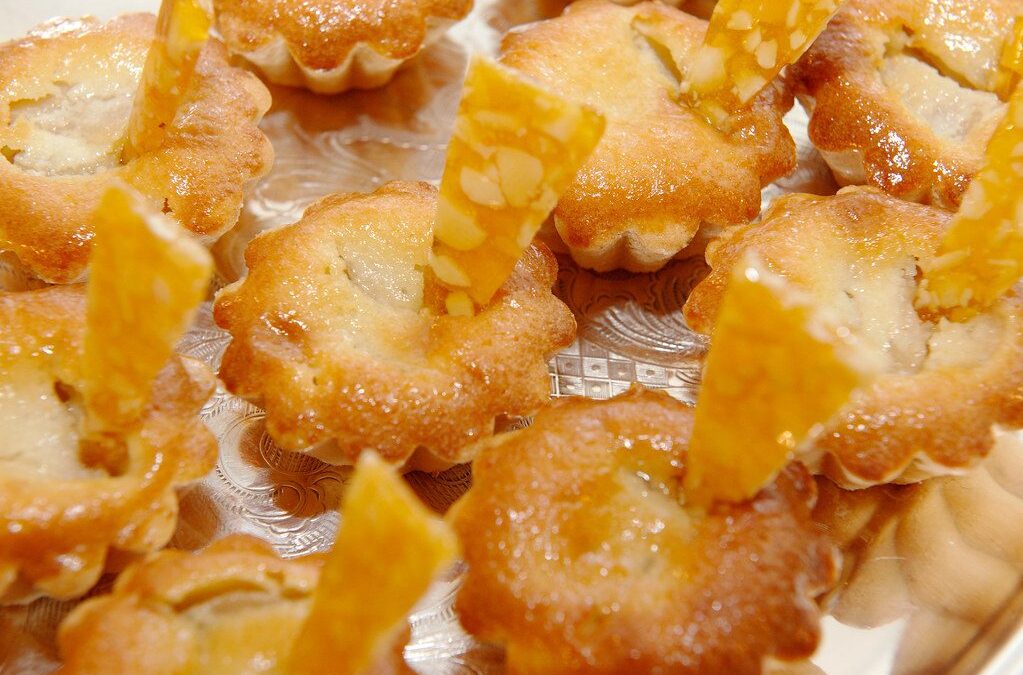
These are six small tarts built on frangipane, an almond cream that bakes somewhere between a cake and a set custard, topped with fanned pear and glazed with apricot jam. Prep runs about 25 minutes, the bake 25 to 30, and the whole thing survives being made a day ahead.
I make them in a standard muffin tin about half the time, because I only own four proper tartlet tins and buying two more has been on the list for years. The tin barely matters. What matters is the almond cream, the ripeness of the pears, and whether the base underneath is crisp or damp, and those three things are what most of this page is about.
What frangipane actually is, and why it holds
Frangipane, or crème d’amandes as the French bakeries write it, is traditionally equal weights of four things: butter, sugar, ground almonds and egg. That’s the ratio worth memorising, because once you know it you can build the filling for almost any fruit tart without a recipe in front of you.
This version runs 113g butter, 100g sugar, 96g almond flour and about 68g of egg (one whole egg plus one yolk). Deliberately light on egg. Less egg means less water in the mix and a denser, shorter, more almond-forward filling that doesn’t dome as aggressively in a small tin. Push the egg up to a full 100g and you get a puffier, cakier tart, which is lovely in a 9-inch shell and slightly unruly in a tartlet.
There’s no gluten anywhere in the filling, because almond flour has no gluten to give. So the structure comes entirely from two things: egg protein coagulating around 70C (158F), and butter setting firm again as the tart cools. That’s why a frangipane tart feels loose and fragile straight from the oven and sliceable an hour later. It hasn’t finished setting when you take it out.
The single tablespoon of all-purpose flour in the ingredient list looks pointless and isn’t. It absorbs the free liquid the eggs release as they heat, which is what stops butter weeping out and pooling at the pastry edge. Leave it out and you’ll sometimes get a greasy ring around the rim.
Two failure points, both in the creaming. Cold eggs hitting creamed butter split the emulsion, and though the almond flour mostly pulls it back, a split batch bakes greasier: sit the eggs in a mug of warm water for five minutes. The other is over-creaming. Two minutes on medium is right, five folds in so much air that the tartlets dome high and then crater. I set an actual timer now, having got that wrong twice in a row. A shallow 2 to 3mm dip as they cool is normal, though. That’s where the glaze sits.
Choosing pears, and what to do when they’re rock hard
Conference, Bartlett, Williams and Anjou all work. Conference holds its shape best and browns least, which for a tart you’re photographing or serving cold is the one I’d pick.
Ripeness is checked at the neck, not the belly. Pears ripen from the core outward, so the flesh just below the stem softens first. Press there with your thumb: a slight give means ready, no give at all means it needs days, and a soft belly means you’ve missed it and the slices will collapse into the frangipane and leak juice.
Mine from the corner shop are reliably a day or two short. Slow fix: a paper bag on the counter with a banana in it, two to three days, the banana’s ethylene doing the work. Fast fix: poaching, which honestly makes a better tart anyway.
To poach: 500ml water, 100g sugar, a strip of lemon peel, brought to a simmer. Halve and core the pears, drop them in, and simmer gently 12 to 18 minutes depending on how hard they started, until a knife slides in with a bit of resistance still there. Undercook rather than over. Then let them cool in the liquid, which is where they finish cooking and pick up flavour. Fish them out, pat dry with kitchen paper, and slice.
Patting dry is not optional. Wet pear slices steam under the glaze and leave a watery streak through the top of the filling.
Slice about 3mm thick, keeping the half intact at the stem end so you can fan it. Thicker than 5mm and the slices don’t cook through in 30 minutes; thinner than 2mm and they disappear into the almond cream. I keep the leftover poaching syrup in a jar in the fridge and use it over yoghurt, or reduce it down and pour it over an apple crumble the following week.
Pastry: buy it, or make it
Store-bought all-butter shortcrust is fine here, and I’ll say the slightly unpopular thing: a good chilled supermarket sheet beats a homemade shortcrust rushed in a warm kitchen. The same is true of shop-bought phyllo, which is what the honey-soaked walnut baklava is built on, and nobody misses the homemade version. Frangipane is rich enough to carry merely decent pastry. What it can’t carry is pastry that shrank down the sides or went soft underneath.
If you’re choosing, the two options behave differently. Plain shortcrust is flakier, less sweet, and shrinks more because it holds more water, which turns to steam and pulls the sides down. Pâte sucrée has more sugar and egg yolk and less water, so it bakes shorter and more biscuit-like and holds its height better. For pear and almond I prefer sucrée, but shortcrust is what’s in most fridges and it works.
Either way, the pastry must go into the oven cold and firm. Line the tins, then 15 minutes in the fridge minimum, or 10 in the freezer if you’re behind. Warm pastry slumps before the fat has a chance to set, and no amount of careful pressing fixes it after the fact. If you want proper pastry practice, a double-crust apple pie teaches more about handling dough in an afternoon than a month of tartlets will.
Ingredients
- Shortcrust pastry — one sheet, chilled (all-butter, store-bought is fine)
- Unsalted butter — 1/2 cup (113g), softened
- Granulated sugar — 1/2 cup (100g)
- Almond flour — 1 cup (96g), finely ground
- Large egg — 1, at room temperature
- Egg yolk — 1 extra
- Almond extract — 1/2 teaspoon (start with 1/4 if yours is strong)
- Vanilla extract — 1 teaspoon
- All-purpose flour — 1 tablespoon
- Ripe but firm pears — 2, thinly sliced
- Apricot jam — 2 tablespoons, sieved, for the glaze
- Sliced almonds — a small handful
- Pinch of salt
Instructions
- Heat the oven to 375F (190C). Roll the chilled pastry and cut it to line six tartlet tins or six holes of a standard muffin tin, pressing it gently into the corners without stretching it. Do not prick the bases.
- Chill the lined tins 15 minutes. Line each shell with a scrap of parchment and fill with baking beans or rice.
- Blind-bake 15 minutes, lift out the parchment and beans, and return the shells for 5 minutes more, until the bases look dry and sandy rather than glossy. Brush the insides with a little beaten egg white and give them 1 more minute to seal. Turn the oven down to 350F (175C).
- Beat the softened butter and sugar together for 2 minutes, until pale. Set a timer; longer is not better.
- Beat in the whole egg, the extra yolk, the almond extract and the vanilla until smooth. If it looks curdled, keep going, the almond flour will pull it back.
- Fold in the almond flour, the tablespoon of all-purpose flour and the salt until you have a soft, spreadable cream with no dry pockets.
- Spoon the frangipane into the cooled shells, filling them two-thirds full. It rises as it bakes, so leave the room.
- Fan the pear slices over each one and press them in very lightly, then scatter over the sliced almonds.
- Bake 22 to 25 minutes at 350F (175C), until the frangipane is golden and springs back when touched and a skewer in the centre comes out clean.
- Warm the sieved apricot jam with a teaspoon of water and brush it over while the tartlets are still warm. Cool in the tins 10 minutes before releasing.
Blind-baking, and the mistake I repeated for years
For a long time I did what the older version of this recipe said: prick the bases with a fork, pour in the frangipane, bake. That’s two techniques stapled together and they contradict each other.
Docking, those fork holes, exists to let steam escape from a shell you’re baking empty. Put a wet filling straight into a docked shell and the frangipane seeps through the holes, fries against the tin, and welds the tart in place. Meanwhile the base never really crisps, because it’s insulated by the filling above it for the whole bake.
So pick one. Either fill the shell raw and don’t dock it, accepting a softer base, or blind-bake properly and skip the fork entirely, since the parchment and beans do that job. The recipe above blind-bakes and the difference underneath is not subtle. The egg-white wash finishes it: a thin waterproof film that sets in a minute and keeps the base crisp for a full day rather than a few hours. Any wet-filled tart benefits, lemon meringue pie included.
One caution on blind-baking small tins: 15 minutes is right for tartlets, not for a large shell. Small shells go from dry to overbaked quickly, and an overbaked shell that then gets another 25 minutes with the filling comes out hard rather than short.
Turning six tartlets into one 9-inch tart
The filling scales at 1.5x for a 9-inch (23cm) fluted tin: 170g butter, 150g sugar, 144g almond flour, two whole eggs plus one yolk, and 1 1/2 tablespoons of all-purpose flour. Three pears instead of two.
The timings change more than the quantities do. Blind-bake the large shell 20 minutes with beans and 8 without, then fill and bake at 350F (175C) for 35 to 45 minutes. Frangipane in a deep single layer browns on top long before the middle sets, so lay a sheet of foil loosely over it at around the 30-minute mark if it’s colouring fast. The skewer test is the same, and so is the wobble rule: no wobble left in the centre.
Cool a large tart completely in the tin, an hour at least. A tartlet releases after 10 minutes; a 9-inch tart lifted warm cracks across the middle. If you’d rather the fresh, uncooked-fruit look, a pastry cream fruit tart uses the same blind-baked shell.
Freezing at three different stages
All three work, and they’re useful at different points.
Unbaked lined shells freeze in their tins for up to 3 months. Wrap the whole tin, and blind-bake from frozen, adding 3 to 4 minutes. These are better than fresh, because frozen pastry has no chance to slump before the fat sets.
The frangipane itself keeps 1 month in a sealed tub. Thaw overnight in the fridge and beat it for 20 seconds to bring the emulsion back together before spooning it in; straight from the fridge it’s too stiff to spread without tearing the shell.
Baked tartlets freeze 2 months if you leave the glaze off. Cool completely, wrap individually, reheat from frozen at 325F (160C) for about 8 minutes, then glaze. Glaze frozen with the tart thaws cloudy and tacky.
Where these go wrong
A crater in the middle is over-creamed butter, nearly always. Too much air goes in, the filling rises fast, then falls when the air escapes.
A greasy ring at the pastry edge means the tablespoon of flour got skipped, or the frangipane was over-warm going into the oven. If the kitchen is hot, chill the filled tartlets 10 minutes before baking.
Pears sinking to the bottom means the slices were too heavy or too wet, or the filling was too loose. Press them in only lightly, so they sit on the surface rather than in it.
An overwhelming marzipan taste is the almond extract. Half a teaspoon across six tartlets is already at the top of the sensible range and brands vary a lot, so start at a quarter if you don’t know your bottle. You can’t take it back out.
Streaky glaze means the jam wasn’t sieved. Apricot jam carries fruit pieces that drag under the brush. Push it through a fine sieve, thin with a teaspoon of water, and brush while both jam and tartlets are still warm.