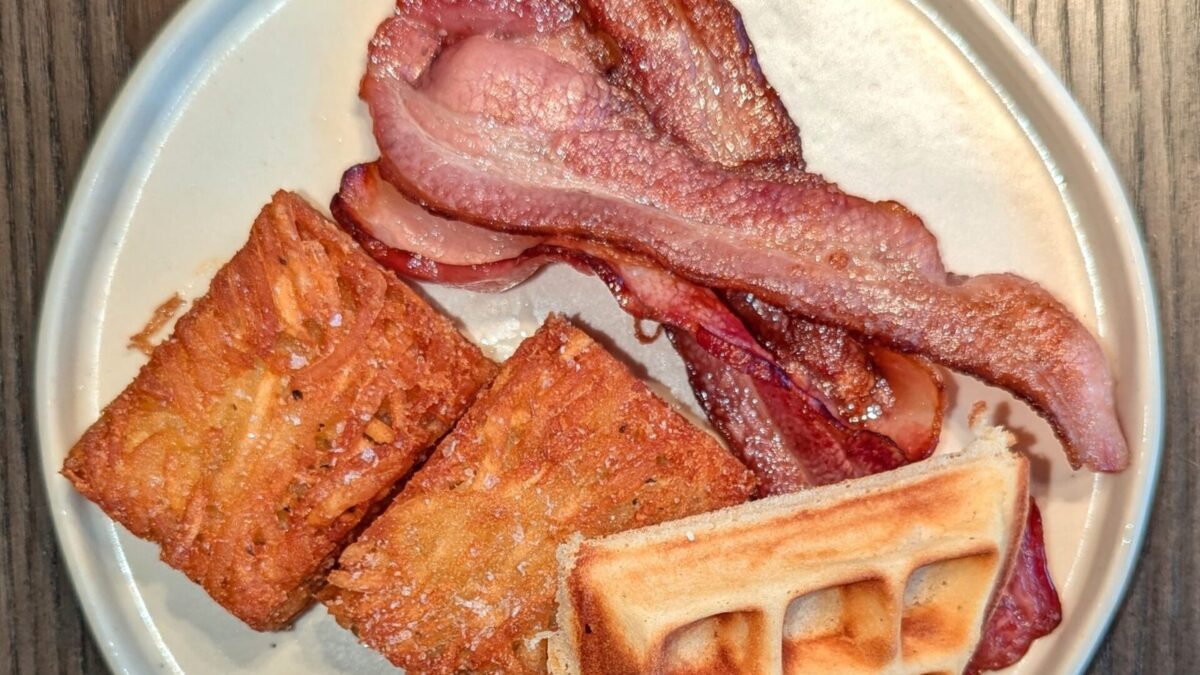
Hash browns fail in about five specific ways, and every one of them is a solved problem. I’ve hit all five, several of them repeatedly, usually before 8am when I had the least patience for diagnosing anything.
So rather than the recipe first, here’s what actually goes wrong and why. The method at the bottom is just these fixes in order.
Soggy Instead of Crisp
Water. Always water. A raw russet is somewhere around 78 to 80 percent water by weight, and while that water is still in the shreds, your potatoes are steaming, not frying. You can’t crisp something that’s boiling itself.
Grated potato has to be wrung out, and wrung out much harder than feels reasonable. Pile the shreds into the centre of a clean tea towel, gather the corners, twist, and lean into it. From two large russets, around 700g, I get somewhere between 1/2 and 3/4 of a cup of liquid out. Then I let the bundle sit for five minutes and twist again, which reliably yields another two tablespoons or so.
If you’re squeezing and getting a tablespoon, you’re being too gentle. It should feel like you might tear the towel.
One bonus from doing this in a bowl: let the drained liquid stand for a couple of minutes and a chalky white layer settles at the bottom. That’s potato starch. Pour off the water, scrape the starch back into your potatoes, and you get better binding and crisper edges for free.
Grey, Or Faintly Pink
Cut potato oxidises. Enzymes in the flesh react with air and the shreds go grey, then a strange pinkish-brown at the edges. It’s harmless and it looks awful.
Grating straight into a bowl of cold water stops it immediately. But the clock is short: I aim to have everything grated, rinsed, drained and squeezed inside ten minutes total. Potatoes left sitting in the grated state, wet or dry, will discolour, and a long soak brings its own problem, which is the next one down.
The other thing that greys them is grating too far ahead. There’s no useful make-ahead here in the fridge — if you want to prep in advance, squeeze the shreds dry, spread them on a tray and freeze them flat. Frozen shreds cook straight from the freezer and stay pale gold.
The Patty Falls Apart When You Flip It
Starch is the glue holding the shreds to each other. So there’s a real tension: rinse too little and excess surface starch turns gummy, rinse too long and you’ve washed away your binder entirely.
Thirty seconds of swishing in cold water is enough. I once left a bowl of shreds soaking while I dealt with the eggs, maybe twelve minutes, and the resulting hash browns broke into confetti the moment the spatula went underneath. Nothing holds them together at that point.
Two other structural fixes:
- A tablespoon of cornstarch tossed through the dried shreds. It’s insurance, and it also gives noticeably crisper edges.
- Press and wait. Press the potatoes into an even layer roughly 1cm thick and then leave them completely alone for 5 to 6 minutes. The crust that forms is the structure. Poking, lifting a corner to check, or stirring in the first four minutes destroys it before it exists.
How do you know it’s ready to turn without looking? Slide the spatula in from the edge. If it goes under in one motion and the sheet moves as a unit, the crust is set. If it drags or catches, it isn’t.
Welded to the Pan
Two causes, and they pull in opposite directions.
The common one is a pan that wasn’t hot enough when the potatoes went in. Cold fat doesn’t seal the surface, so the starch makes direct contact with metal and glues itself there. Get the butter and oil properly hot first — the butter should be foaming and the foam just starting to subside, which is around 160°C, before a single shred goes in.
The other is butter on its own. Butter solids start browning around 150°C and are burnt by 175°C, and you need to sit above that for the crust. Hence 3 tablespoons of butter plus 2 tablespoons of vegetable oil: the oil holds the temperature up while the butter does the flavour and the colour. I tried an all-butter batch once out of stubbornness and got black flecks through the whole thing and a smell that took an hour to clear.
Cast iron works, if it’s genuinely well seasoned. If yours is patchy, use non-stick for this and don’t feel bad. There’s no prize for a stuck breakfast.
Crisp Outside, Raw Ribbons Inside
This one is thickness plus impatience. Shreds much over 1.5cm deep in the pan can’t cook through before the base goes past golden into bitter, and you end up biting into strands that squeak against your teeth.
Keep the layer at about 1cm. In a 26cm skillet, two large russets is roughly the right load — press it edge to edge and it should look thin enough that you doubt it. It’s not. To turn the same skillet into a full breakfast, corned beef hash built on crisp potatoes and a runny egg follows the same crust rule.
If you’ve made it thicker anyway, or you’re cooking a big batch, finish the pan in a 200°C oven for 5 to 7 minutes after the second flip. The dry oven heat gets to the middle without pushing the crust further.
Ingredients
- 2 large russet potatoes (about 700g) — starchy potatoes only; waxy ones won’t crisp
- 1/2 teaspoon salt, plus more at the end
- 1/4 teaspoon black pepper, freshly ground
- 1/4 teaspoon garlic powder, optional
- 1/4 teaspoon onion powder, for the diner flavour
- 3 tablespoons butter
- 2 tablespoons vegetable oil
- 1 tablespoon cornstarch, optional but it earns its place
Note on the salt: season the shreds only just before they hit the pan. Salt pulls water out, and if you salt them and then leave them sitting for ten minutes you’ve undone the squeezing.
Instructions
- Peel the potatoes and grate them on the large holes of a box grater, or with the shredding disc of a food processor. Work fast.
- Drop the shreds into a bowl of cold water and swish for about 30 seconds. No longer — you’re rinsing surface starch, not soaking.
- Drain, then pile the shreds into a clean tea towel, twist the ends and squeeze hard. Rest 5 minutes, squeeze again. You want at least 1/2 cup of liquid out of them.
- If you saved the drained liquid, pour off the water and scrape the settled white starch back in with the potatoes.
- Tip the dry shreds into a bowl and toss with the salt, pepper, garlic powder, onion powder and cornstarch.
- Heat the butter and oil in a 26cm skillet over medium-high until the butter foams and the foam begins to settle down again.
- Add the potatoes and press into an even layer about 1cm thick, right to the edges. Now leave them alone.
- Cook undisturbed for 5 to 6 minutes. Test with the spatula from the edge; when it slides under cleanly and the underside is deep golden, flip — in two or three sections is fine, and easier than one heroic turn.
- Cook the second side 4 to 5 minutes, adding a little more butter around the rim if the pan looks dry.
- Lift onto a wire rack, not paper towel, and salt again immediately while the surface is still hot enough to take it.
The rack matters more than it sounds. Paper towel traps steam against the underside and the crust you spent eleven minutes building goes soft in about ninety seconds. If you’re cooking for several people, keep the finished ones on that rack in a 100°C oven and they’ll hold their crunch for a good twenty minutes — which is the only reliable way I’ve found to get hash browns and eggs onto the table hot at the same time.