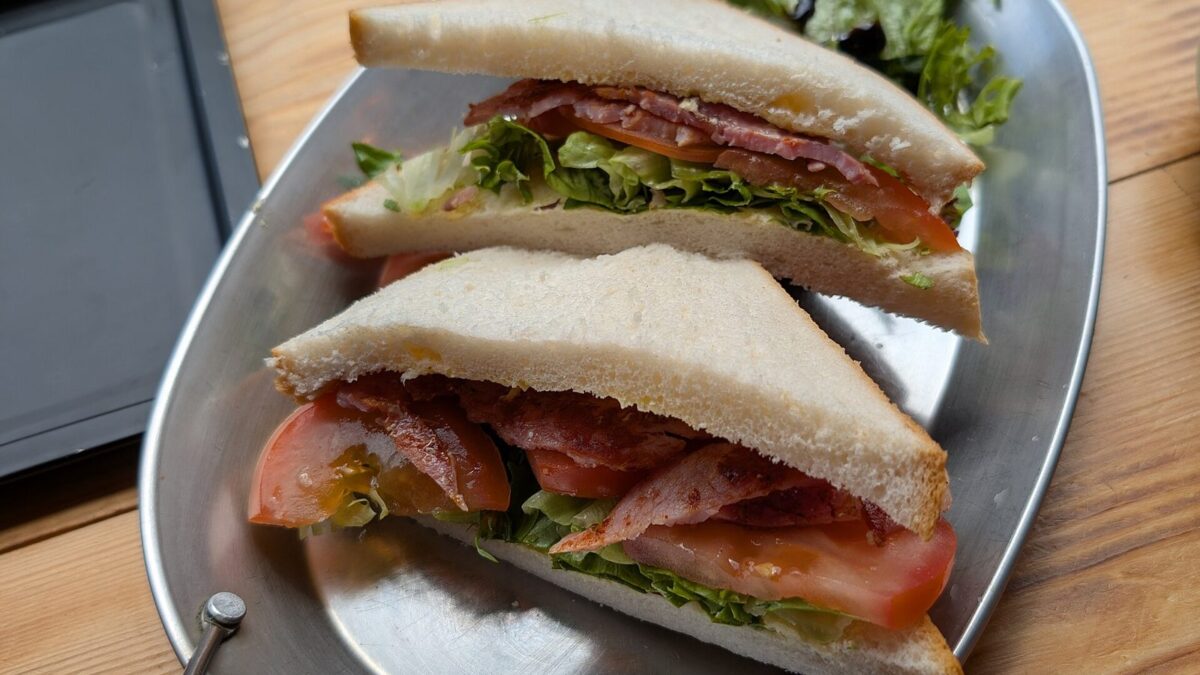
Four decisions separate a good BLT from a limp one, and none of them are about the recipe. How you cook the bacon, whether the bread gets toasted, whether mayo goes on one slice or both, and what you do to the tomato before it goes in. I’ve tested each of these against itself, usually because I was making lunch for one person and had nothing better to do than run a comparison.
Short version, if you want it now: oven for four or more sandwiches, skillet for two, microwave for one. Toast the bread. Mayo on both slices. Salt the tomato and drain it for 10 minutes if you have them.
Prep: 15 mins Cook: 10–20 mins depending on method Makes: 2
Bacon method 1: cold skillet
Bacon into an unheated pan, pan onto medium, then leave it. Starting cold lets the fat render out slowly before the meat seizes, and that’s what gives you a strip that’s crisp but still has some chew. About 10 minutes for standard-cut, 12 to 14 for thick-cut, turning three or four times.
A 10-inch skillet holds four strips flat, six if you curve them. That’s the ceiling, and it’s why this method stops working the moment you’re feeding more than two people. Crowd the pan and the strips steam in their own rendered fat instead of crisping. The payoff is a pan of hot bacon fat; a tablespoon brushed on the bread before toasting beats butter.
Bacon method 2: oven, on a rack
Wire rack set inside a rimmed baking sheet, bacon laid across it without overlapping, 200°C (400°F), 18 to 22 minutes. No turning. The fat drips away, so every strip cooks in dry heat rather than sitting in a puddle, and the result is flatter and more uniformly brittle than skillet bacon.
One tray fits about 12 strips. That’s six sandwiches with two strips each, all finishing at the same moment, and none of them needing your attention while you’re slicing tomatoes.
The catch is honest: without the rack, the underside boils in the fat and you lose most of the advantage. And 20 minutes is a long time to preheat and run an oven for two sandwiches. It’s the right method for a crowd and the wrong one for lunch alone.
Bacon method 3: microwave, between paper towels
Two sheets of paper towel on a plate, bacon on top in a single layer, two more sheets over it. High power, 1 minute per strip as a starting point, then 20-second bursts.
I expected this to be the throwaway option and it isn’t. The paper wicks the fat away as it renders, which is functionally the same thing the wire rack does, and three strips come out crisp in about 3 minutes 30 seconds in my 900W microwave. The texture is drier and snappier than skillet bacon — closer to a crisp than to a rasher — and it shatters rather than bends.
Two real drawbacks. There’s no fat left to cook with, and the timing is unforgiving: the window between done and brittle-burnt is roughly 20 seconds, and every microwave is different, so the first batch is a calibration run. Thick-cut behaves badly here. Standard-cut is what this method is for.
The three methods side by side
| Method | Active time | Best batch size | Texture | Pan fat left |
|---|---|---|---|---|
| Cold skillet | 10–14 min, hands-on | 4–6 strips | Crisp with chew | Yes, plenty |
| Oven on a rack | 2 min, then 20 unattended | Up to 12 strips | Flat, evenly brittle | Yes, in the tray |
| Microwave | 3–4 min, hands-on | 2–3 strips | Dry, shatters | None |
Toasted bread against untoasted
Toasted wins, and it isn’t close. Untoasted white bread starts absorbing tomato liquid on contact and is translucent in patches within four or five minutes. That’s not a texture problem you can eat around.
What toasting does is set the starch on both surfaces into something that resists water for a while. Not indefinitely — a toasted slice still goes soft eventually, it just buys you the twenty minutes you actually need. Go medium-dark rather than pale gold; pale toast has barely changed structurally. Sourdough is the exception, since the crumb is already firm.
If you like your bread with more character than a sandwich loaf gives, a slice cut from rustic rosemary focaccia and pressed flat in a pan is very good here, though the rosemary does start competing with the bacon.
Mayo: one slice or both
Both. Every time.
Mayonnaise is an oil emulsion, and a continuous layer of it is a genuine waterproof barrier — better than lettuce, which people credit for a job it doesn’t really do. Spread on one slice only, and the bare slice is the one that goes soggy, which means half your sandwich fails while the other half is fine.
Coverage matters more than quantity. A thin layer taken right to the crust on both slices beats a thick blob in the middle, because the edges are where the tomato juice runs out. About 1 tablespoon per slice, spread with the back of a spoon rather than a knife, which pushes it further without tearing the toast.
This is the same logic I use on a classic club sandwich, where the middle slice needs mayo on both faces or it turns to mush from two directions at once.
Salting the tomato: drained, or at assembly
Salt the tomato and let it sit, and osmosis pulls water out of the cut cells. That’s water that would otherwise end up in your bread.
Here’s what I measured, because I was curious: two 1cm slices from a large tomato, a quarter teaspoon of fine salt between them, sitting on a rack over a plate. After 10 minutes there was close to a teaspoon and a half of liquid on the plate. The slices were slightly softer, distinctly more tomato-tasting, and much less likely to flood the sandwich.
Salting at assembly is the other option, and it isn’t wrong. The salt hasn’t drawn anything out yet, so the tomato is firmer and the juice is still in it, which some people prefer — that first bite is brighter and wetter. If you’re eating the sandwich standing over the counter within two minutes, do this.
What doesn’t work is the compromise you see everywhere: salt the slices and let them sit “a minute” on the plate. A minute draws out almost nothing, and whatever it does draw out stays on the slice and goes straight into the bread. Either drain properly on a rack for 10 minutes, or salt at the last second. The middle option gets you the downside of both.
Which lettuce, and where it sits
Iceberg over romaine, and I’ll defend it. Romaine has more flavour, but a BLT doesn’t need the lettuce to taste of anything; it needs cold and crunch and a leaf that lies flat. Iceberg’s ribs are shorter and it compresses under a bite instead of sliding out sideways. Tear the leaves smaller than the bread and dry them well, or you undo the tomato draining you just did.
Position: lettuce goes between the tomato and the bacon, not against the bread. The mayo is already handling waterproofing, and putting the lettuce in the middle stops the hot bacon from wilting it while keeping the tomato from sitting directly on crisp strips.
Ingredients
- 6 slices standard-cut bacon (or 4 thick-cut, skillet or oven only)
- 4 slices sandwich bread — white or sourdough
- 1 large ripe tomato, cut into 1cm slices
- 1/4 teaspoon fine salt for the tomato
- 4 tablespoons mayonnaise
- 4 leaves iceberg lettuce, torn and dried
- Black pepper, coarsely ground
Instructions
- Slice the tomato, lay the slices on a rack over a plate, salt both sides and leave 10 minutes. Start the bacon now.
- Cook the bacon by whichever method suits your numbers: cold skillet on medium 10 to 14 minutes, oven on a rack at 200°C for 18 to 22, or microwave between paper towels roughly 1 minute per strip.
- Toast all four slices of bread to medium-dark. If you used the skillet, brush the bread with a little bacon fat first.
- Spread 1 tablespoon of mayonnaise on one face of every slice, edge to edge, using the back of a spoon.
- Blot the drained tomato slices dry and grind pepper over them.
- Build: bottom slice mayo-up, tomato, lettuce, then bacon broken in half so it lies in two layers rather than one thick strip.
- Top slice mayo-down. Press once, firmly but briefly, then cut on the diagonal.
When the tomato isn’t good enough
February tomatoes are the real problem with this sandwich, and no technique rescues a pale one. What I do instead: skip the tomato entirely, add a second layer of bacon and a slice of sharp cheddar, and accept that I’m making something closer to a grilled cheese sandwich with bacon in it. A spoonful of creamy coleslaw in place of the lettuce works too, and gives you back the acidity the tomato was supposed to bring. It’s a different sandwich. It’s better than a bad BLT.