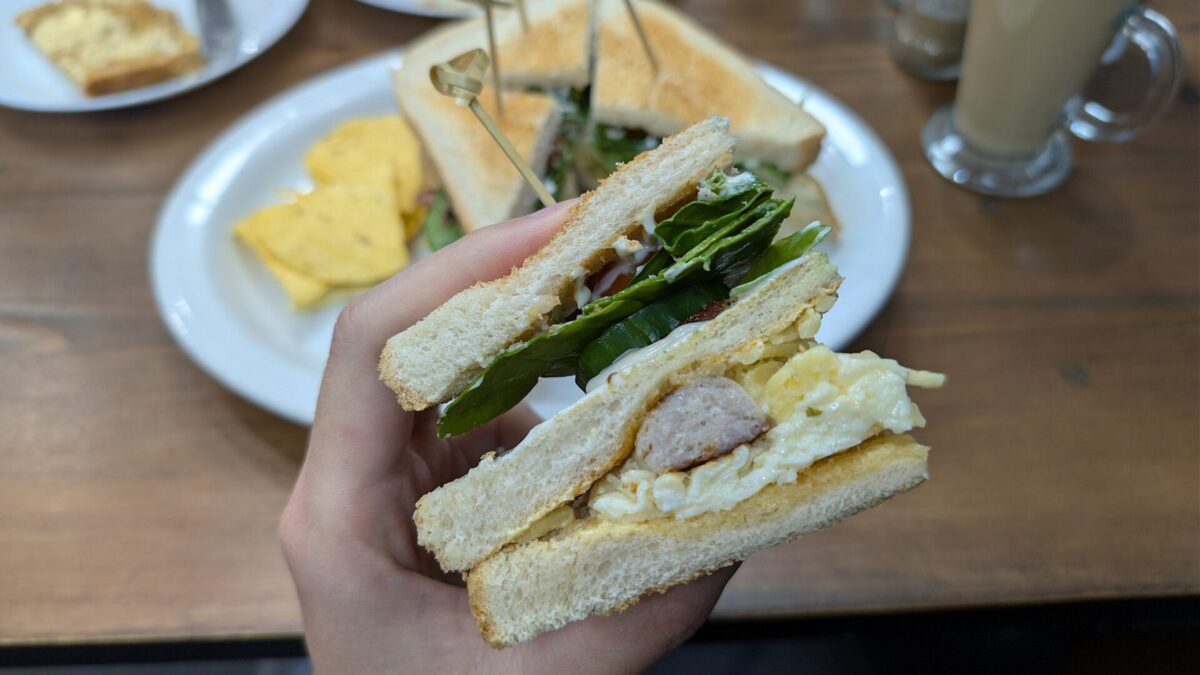
Almost everything repeated about the club sandwich is either half true or plainly wrong, and the wrong bits are exactly why the homemade version slides apart on the plate. Five claims worth arguing with, then the build that comes out of them.
I make these on Sundays when there’s roast meat left over, and I’ve rebuilt my method twice after two lunches ended with the top slice on the floor.
Prep: 15 mins Cook: 8 mins Serves: 2
Claim one: it has to be three slices of bread
The double decker is the standard. Order a club at a diner and you get three slices of toast, two decks of filling, four picks. That’s the shape people picture, and if you’re serving it to guests who ordered the idea as much as the food, build it that way.
But “three slices or it isn’t a club” is a house rule dressed up as a fact. Two-slice clubs were being sold and eaten before anyone started policing the count, and the origin stories you’ll read online contradict each other on dates, places and who stacked what first. I won’t pretend one of them is settled. Nobody has produced a document that closes the argument.
My honest position: three slices gives you the look, two slices gives you the better eating. A double decker on standard 12mm sandwich bread stands roughly 8cm tall before you press it, which is taller than most jaws open comfortably. Drop to two slices and the same filling compresses into something you can actually bite through without the tomato shooting out the back.
Claim two: the middle slice holds the sandwich together
It doesn’t. Nothing about a horizontal slice of toast clamps the layers above and below it. Pull the picks out of a finished club and watch what happens: the whole thing shears sideways, middle slice and all. The picks are the structure. The toast is a passenger.
What it actually does is break up the fillings: a dry, crisp interruption between the turkey half and the bacon-and-tomato half, so the sandwich reads as two mouthfuls rather than one long wet one.
Which points at the fix nobody mentions: mayonnaise goes on both faces of the middle slice, not one. That slice is exposed on two sides, and untreated toast wicks tomato juice like blotting paper. A thin film of fat on each face buys you about ten extra minutes of crispness. Most recipes, including the one that used to sit on this page, only butter one side of it.
Ingredients
- 6 slices sturdy white sandwich bread, toasted
- 6 rashers streaky bacon
- 180g roast turkey breast, cut about 3mm thick (leftover roast chicken works)
- 4 large leaves romaine or iceberg lettuce, dried well
- 1 firm ripe tomato, sliced 5mm and salted
- 5 tablespoons mayonnaise
- 2 slices Swiss or mild cheddar (optional)
- Salt and black pepper
- 4 cocktail picks
Instructions
- Slice the tomato, lay it on kitchen paper, salt lightly and leave it for 10 minutes. Blot the top before use. This is the single step that decides whether the sandwich survives lunch.
- Cook the bacon over medium heat until crisp but still snappable, 6 to 8 minutes, and drain it. Break each rasher in half so the pieces sit flat instead of bridging.
- Toast all six slices until firm and golden right through, not just marked. Soft-centred toast collapses.
- Spread mayonnaise edge to edge: one face on the top and bottom slices, both faces on the middle slice.
- Bottom deck: bread, mayo up, then a lettuce leaf, then the turkey, then cheese if using. Lettuce against the bread, always.
- Set the middle slice on top and press it down gently.
- Top deck: a lettuce leaf first, then the tomato on the lettuce, then the bacon. Grind pepper over the tomato.
- Cap with the last slice, mayo down, and press the whole stack with your palm for about five seconds.
- Push a pick vertically through the centre of each quarter, all the way to the board.
- Cut corner to corner with a serrated knife, two long strokes, no downward pressure. Four triangles, one pick each.
Claim three: turkey means deli slices
Roast breast beats deli turkey, and it isn’t close. Supermarket sliced turkey is brined and pressed, which means a chunk of what you’re stacking is water held in place by salt and phosphate. Under the weight of a double decker, that water leaves. It goes into your toast.
Roast breast carved at about 3mm has grain and chew. It sits in the stack as a layer rather than a paste, and it tastes of roasted meat instead of the ham-adjacent flavour deli turkey drifts towards. If you’ve got the tail end of a herb roast chicken in the fridge, use that. Nobody at my table has ever objected.
The one point for deli slices is thinness. A thick slab of roast breast slips out sideways on the first bite, so cut it thinner than a roast dinner portion and fold each piece once before laying it down.
Claim four: the tomato can sit anywhere in the stack
Tomato against toast is a countdown. I’ve timed it out of stubbornness: an unsalted 5mm slice laid straight on mayonnaised toast leaves a translucent patch you can see from the other side in about four minutes, and by twelve the bread tears when you lift it.
Lettuce is the gasket. A whole leaf, dried properly and folded to the footprint of the bread, holds tomato juice on its own surface long enough for you to finish eating. Romaine beats iceberg here because the rib gives the leaf a spine, though iceberg wins on noise.
Salting first is not optional either. Ten minutes on paper pulls out a genuinely surprising amount of liquid, seasons the slice through instead of just on top, and firms the texture. Same logic as a classic BLT sandwich, where there’s no middle slice to hide behind at all.
Claim five: cutting it into four is presentation
Cut a club in half and each piece carries twice the filling area with the same single anchor near the middle. The outer edge overhangs, the layers fan, and the first bite pushes everything toward the far corner. Quarters fix that by geometry: each triangle is small enough that the pick sits close to the centre of its own weight.
Picks go in before the knife, not after. Push them straight down through the middle of each quadrant so the blade never has to cross one.
Then cut on both diagonals and let the teeth do the work. Pressing down is what squashes a club flat, and a bread knife needs almost no downward force if you use its length.
Serve within about ten minutes of building. If lunch is running late, keep the toasted bread, the drained tomato and the bacon in separate piles and assemble when people sit down, the way you’d hold back the dressing on a creamy coleslaw until the last minute. A club that’s sat wrapped in the fridge for an hour is closer to a tuna melt gone cold than to anything you’d order at a counter.