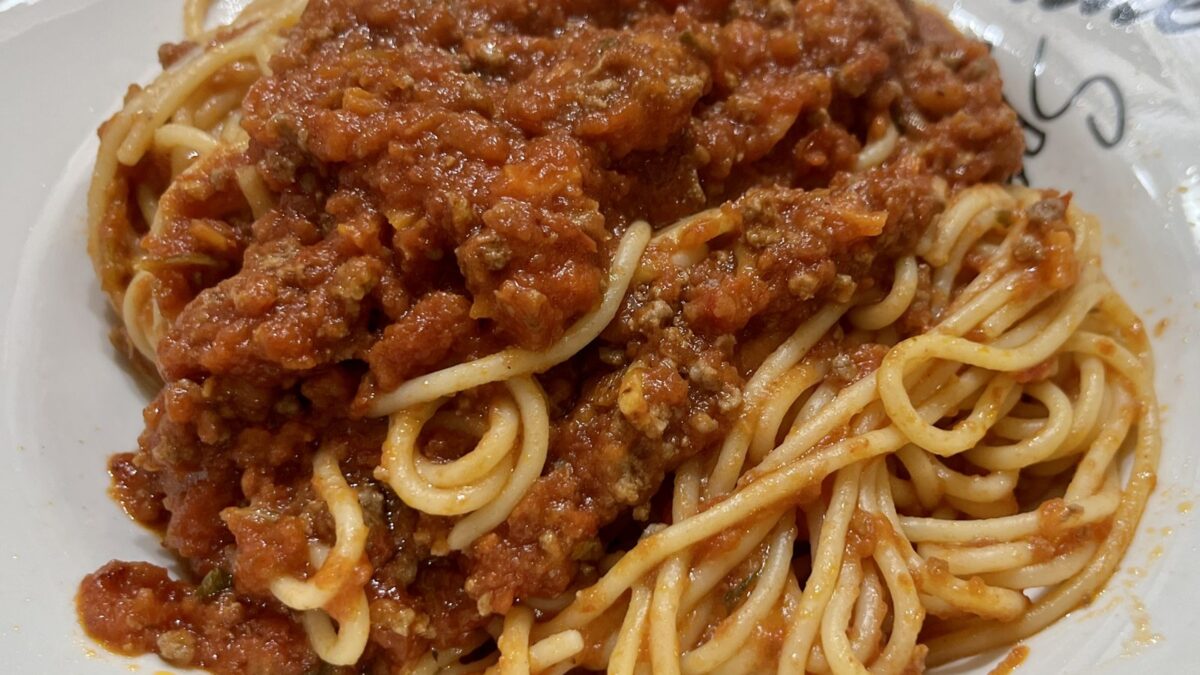
Most of this recipe is waiting. There’s about 35 minutes of actual work in it and then three hours where you do something else entirely. I’d rather say that up front than pretend there’s a shortcut, because the two things that make this ragu good are both about patience with heat.
Brown it hard, and in batches
2.5 lbs of chuck will not fit in one layer in a 26cm Dutch oven. Put it all in anyway and the pot temperature crashes, the meat releases its water, and you spend eight minutes boiling beef in its own juice. It goes grey. There’s no crust, and no crust means no fond — the stuck brown film on the pot bottom that the wine later dissolves into the sauce.
Three batches, roughly eight minutes each, and don’t move the pieces around looking for progress. They release when they’re ready. If a piece is stuck fast it isn’t done browning yet.
Pat the chunks properly dry first. I use two sheets of kitchen paper and press rather than dab.
Ingredients
- 2.5 lbs beef chuck, cut into large 2-inch chunks
- Salt and freshly ground black pepper
- 3 tablespoons olive oil
- 1 large onion, finely diced
- 2 carrots, finely diced
- 2 celery stalks, finely diced
- 4 garlic cloves, minced
- 2 tablespoons tomato paste
- 1 cup dry red wine (such as Chianti or Merlot)
- 1 can (28 oz) crushed tomatoes
- 2 cups beef stock
- 2 bay leaves and a sprig of rosemary
- 1 lb pappardelle pasta
- Parmesan and fresh parsley, to serve
Instructions
- Pat the beef very dry and season generously with salt and pepper.
- Heat the olive oil in a heavy Dutch oven over medium-high. Sear the beef in three batches, without crowding, until deeply browned on all sides — about 8 minutes a batch. Set the meat aside.
- Lower the heat to medium. Add the onion, carrot and celery to the same pot and cook 8 to 10 minutes until soft and golden, scraping up the browned bits as they loosen. Stir in the garlic and tomato paste and cook 2 minutes, until the paste darkens from red to brick.
- Pour in the red wine and let it bubble hard for 3 to 4 minutes, scraping the bottom, until reduced by half and no longer sharp on the nose.
- Return the beef and any juices to the pot. Add the crushed tomatoes, stock, bay leaves and rosemary. The liquid should nearly cover the meat but not drown it.
- Bring to a gentle simmer, cover, and transfer to a 325F (160C) oven — or hold it on the lowest stovetop flame you have. Braise 2.5 to 3 hours, until the beef gives way at the nudge of a fork.
- Lift out the beef and shred it with two forks, discarding the bay and the rosemary stem. Return the meat to the sauce and simmer uncovered 10 to 15 minutes to thicken. Taste and adjust the salt now, not earlier.
- Cook the pappardelle until just short of al dente, reserving a cup of pasta water. Drain and tip it straight into the ragu with a splash of that water. Toss over low heat for a minute until every ribbon is coated. Serve with Parmesan and parsley.
The lowest heat that still moves
A braise should look almost still. One bubble breaking the surface every few seconds is right. If it’s rolling, the collagen in the chuck tightens instead of dissolving and you get shreds that are dry rather than silky — the meat can be falling apart and still taste like cardboard. The same clock runs longer for braised lamb shanks, which are still tough at two hours and right at three and a half.
My stovetop won’t hold that low, so the pot goes in the oven at 160C and I stop thinking about it. Ovens surround the pot with even heat instead of blasting the base, which is why I stopped doing this on the hob altogether. Check once at the 2-hour mark, mostly to make sure the liquid hasn’t dropped below the meat.
Chuck, not stewing steak sold as a mixed pack. You want the shoulder cut with visible seams of fat and connective tissue running through it. That tissue is the entire point — it’s what turns the sauce glossy after three hours.
The pasta water finish is not optional
Draining pappardelle, plating it, and ladling sauce on top gives you two separate things sharing a bowl. The sauce slides off and pools underneath.
Pull the pasta about a minute before the packet says, keep a cup of the cooking water, and finish it in the pot with the ragu. The starch suspended in that water is an emulsifier — it binds the fat in the sauce to the water and makes the whole thing cling. A minute of tossing over low heat is enough. You’ll see it go from loose to coating.
Pappardelle at 1.5-2cm wide is the right shape here because a heavy shredded sauce needs surface area to hold on to. Tagliatelle works. Spaghetti doesn’t, and no amount of pasta water fixes that.
It’s better tomorrow, and it freezes properly
Made on Sunday and eaten Monday, the sauce is noticeably rounder — the fat has had time to disperse and the tomato acidity settles. Cool it uncovered for an hour, then refrigerate up to four days. Any fat that sets on top can be lifted off or stirred back in, your call; I stir it back.
Freeze the ragu alone, never with pasta in it, in portions of about 2 cups. Three months is fine. Thaw in the fridge overnight and reheat gently with a splash of water, because it thickens further in the freezer.
If you’re making it for a crowd, this doubles cleanly in a large pot except for the browning, which still has to happen in batches. That step doesn’t scale, and it’s the one worth the extra 20 minutes. The same principle drives beef bourguignon and a good beef stew — both live or die on how hard you brown the meat before any liquid goes near it. Leftover ragu also makes a shortcut lasagna layer, and a plate of it wants garlic bread alongside for the sauce left in the bowl.