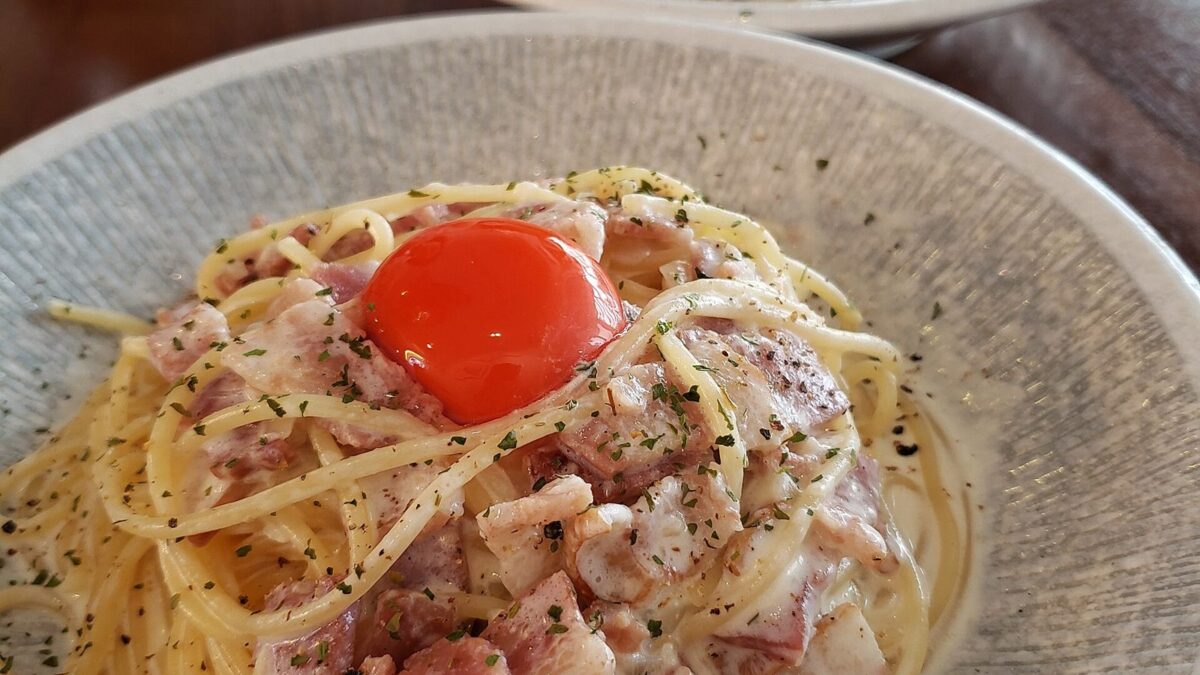
My first six carbonaras were scrambled eggs on spaghetti. Not faintly grainy. Properly scrambled, little yellow curds collecting at the bottom of the bowl while the pasta above them went dry and sticky.
Here is why that happens, and it is worth knowing before you touch a pan. Egg yolk starts thickening at around 65°C and has set firm by about 73°C. Drained spaghetti is close to 100°C. A pan that has been rendering pork fat for eight minutes is somewhere past 120°C. So the sauce has to land inside a window roughly eight degrees wide, using three ingredients that are all far too hot, in about ninety seconds of tossing.
That is the entire dish. Everything else is shopping.
Heat is something you spend, not something you have
Once you stop thinking of carbonara as a sauce you cook and start thinking of it as a fixed budget of stored heat you are spending down, the timing stops feeling like luck.
The budget comes from three places: the pasta itself, the rendered fat in the pan, and the pan’s own metal. You want to spend enough of it to thicken the eggs and not one degree more. So you deliberately throw some away before the eggs go anywhere near it.
Three things I do every time, in this order. Kill the heat under the guanciale the moment it is crisp and let the pan sit for a full 60 seconds. Lift the pasta straight from the water with tongs instead of dumping it into a colander, which lets a bit of steam escape on the way. Then add the pasta to the pan and toss it in the fat for another 30 seconds before the egg mixture comes anywhere near.
People rush that last 30 seconds because the pasta looks lonely sitting in fat. Don’t. It is doing real work.
Cast iron is the wrong pan here
This is the one piece of equipment advice I would argue about. A 28cm stainless or thin carbon steel pan is better for carbonara than cast iron, and it is not close. Cast iron holds so much heat that it keeps cooking for four or five minutes after you turn the burner off, which is exactly the thing you are trying to prevent. My 26cm cast iron skillet scrambled two batches before I worked out that the pan, not me, was the problem.
If cast iron is all you own, tip the guanciale and its fat into a warmed mixing bowl and finish the dish there. Sounds fussy. Works.
The cheese paste, and why it should look wrong
Whisk the eggs, the extra yolk and the grated cheese together and you should end up with something closer to wet sand than to a liquid. Thick, stiff, barely pourable. If it slides around the bowl like a beaten egg for an omelette, you have not used enough cheese or you have grated it too coarsely.
That thickness matters because the cheese proteins physically get in the way of the egg proteins trying to bond with each other. Loose egg sets fast and in lumps. Egg carrying 100g of finely grated cheese per four portions sets slowly and smoothly. It is buffering, in the same way a custard with cornflour in it is much harder to split than one without.
Use the smallest holes on the grater, or a microplane. Pre-grated cheese from a bag has anti-caking starch on it and clumps into stubborn little pellets that never dissolve. I have tried. They sit there in the finished plate like gravel.
Grind the pepper into the egg mixture, not over the finished plate. It has 30 seconds in the warm fat to soften and bloom, and that is where the peppery backbone actually comes from.
Pasta water is starch, and you need it concentrated
The water that emulsifies the sauce needs to be genuinely starchy, which means cooking 400g of spaghetti in around 3 litres rather than the 5 or 6 most of us reach for out of habit. Less water, more dissolved starch, better sauce. Salt it, but at about half your usual rate, roughly 5g per litre, because pecorino and cured pork are both already salty.
Scoop out a full mug before draining. Not a splash. A mug. You will use maybe a third of it and be very glad of the rest the one time the sauce seizes.
Prep: 10 mins. Cook: 15 mins. Serves: 4.
Ingredients
- 400g spaghetti — rigatoni if you want a chewier bite
- 150g guanciale, cut into batons roughly 1cm thick — pancetta is the usual stand-in
- 3 large eggs plus 1 extra yolk, at room temperature
- 75g Pecorino Romano, finely grated
- 25g Parmesan, finely grated
- Freshly ground black pepper, about 1 teaspoon, coarsely ground
- Fine sea salt for the pasta water, about 5g per litre
- A mugful of reserved pasta water
- A drizzle of olive oil, only if your guanciale is unusually lean
Instructions
- Bring about 3 litres of water to a rolling boil in a tall pot and salt it lightly. Add the spaghetti and cook it 1 minute short of the packet’s al dente time.
- While it cooks, put the guanciale into a cold 28cm pan and set it over medium heat. Starting cold renders the fat out gradually instead of searing the outside and leaving the middle rubbery.
- Render for 6 to 8 minutes, until the edges are deep gold and the pieces have shrunk by roughly a third. You should hear the sizzle drop in pitch as the water cooks out. Turn off the heat and leave every drop of fat in the pan.
- Whisk the whole eggs, the yolk, both cheeses and all the pepper in a bowl until it forms a thick, sandy paste that holds a mark from the whisk.
- Scoop out a mugful of pasta water. Lift the spaghetti straight into the pan with tongs and toss for 30 seconds so every strand picks up fat. The pan should now be warm to a hovering hand, not fierce.
- Off the heat, pour the egg paste in all at once and toss hard and continuously for 45 to 60 seconds. Keep the pasta moving. Any strand sitting still against hot metal is where the scramble starts.
- Add pasta water 2 tablespoons at a time, tossing after each, until the sauce turns glossy and slides rather than clings. It should coat the back of a spoon and hold a line when you drag a finger through it.
- Taste, add pepper, and serve straight into bowls you have warmed under the hot tap and dried. Cold ceramic stiffens the sauce within about 20 seconds.
Reading the sauce while it happens
Three stages, and they go past fast.
For the first 15 seconds or so it looks thin and slightly translucent, and nothing appears to be happening. Then it turns opaque and pale yellow and starts pulling together, which is the point at which it is genuinely working. If you keep going past that it goes matte, slightly stiff, and starts leaving a film on the pan. That film is your last warning. Add pasta water immediately.
The tell I trust most is sound. A working carbonara makes a soft slapping noise as the pasta folds over itself. A splitting one goes quiet, because the sauce has stopped flowing.
When it splits anyway
It is usually recoverable if you catch it in the first few seconds. Get the pan onto a cold trivet or a damp tea towel, add a good splash of the reserved water, and stir rather than toss so you are not whipping air into it. Cooling the base is the part that matters, not the liquid.
Fully curdled is a different situation and I would rather tell you the truth than pretend. Once the eggs have set into visible curds there is no unscrambling them. Add a knob of butter, call it a pasta with egg and pecorino, eat it, and try again tomorrow when you are not hungry and rushed. Almost every carbonara disaster I have had came from cooking it at 9pm on an empty stomach.
The bowl trick, if you want a guaranteed result
Anyone who has scrambled it twice and lost confidence should try this once. Set a heatproof mixing bowl over the pasta pot for the last minute of cooking, tip in the guanciale and its fat, then drain the pasta and build the whole dish in that bowl off the heat entirely. You are working with residual warmth only, which means the sauce takes closer to 2 minutes to thicken instead of 60 seconds, and it will not split on you. It is a slower, safer version of the same physics, and it is how I would teach it to someone standing next to me.