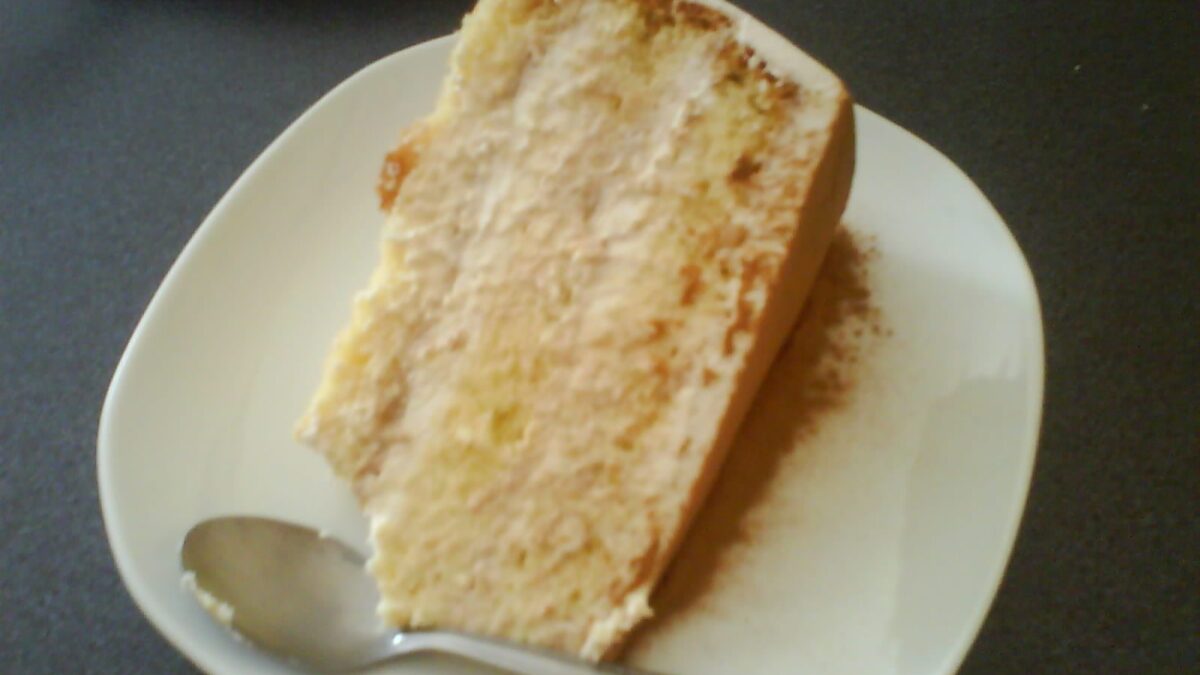
Tres leches cake is talked about like it’s fragile. It isn’t. The version that slumps into a beige puddle on the plate almost always failed at the sponge stage, hours before a drop of milk went near it.
I’ve made this in the same 9×13 dish since a neighbour served it at a Diwali potluck and refused to give me the recipe until I’d guessed the milks. Three pieces of advice get repeated about this cake, and all three are wrong in ways that change what you do at the counter.
What The Milk Is Actually Doing In There
The soak is not a sauce sitting on top of a cake. It moves into the crumb and stays there, held by the walls of thousands of little air pockets.
A sponge raised on whipped egg whites has a fine, elastic, slightly rubbery structure. Those cell walls hold liquid the way a kitchen sponge does, which is where the dessert gets its texture. A cake raised on creamed butter has softer, fattier walls that dissolve on contact. Same milk, completely different result. Everything below follows from that one fact.
Myth One: Soak It Too Long And It Turns To Mush
Overnight is not too long. It’s better than three hours.
The failure people blame on time is nearly always a temperature problem. Pour warm milk over a cake that hasn’t fully cooled and the crumb collapses on contact, leaving a wet layer at the bottom with dry cake floating above it. I’ve done it, in a hurry, for a birthday. It was edible. It was not tres leches.
Cool the cake completely, a good 90 minutes on a wire rack, and pour the milk cold and slowly. Then leave it. At 12 hours in the fridge the cake is denser and more evenly saturated than at 3 hours, and it slices cleanly instead of tearing. The real ceiling is about two days, and that’s a flavour question: the cinnamon and cream start tasting tired.
Myth Two: Any Sponge Will Take The Milk
This is the one that actually ruins cakes. A boxed vanilla mix, a butter pound cake, a leftover birthday layer, none of them work, and the reason is fat.
Fat coats the crumb and repels liquid. Butter-heavy cakes shed most of the soak into the bottom of the dish, which is why people end up ladling milk back over the top and wondering why it never disappears. The recipe below uses 5 separated eggs and only 1/3 cup of milk in the batter, with no butter or oil at all. That’s the reason 20 oz of dairy vanishes into a cake that looked too small for it.
Beat the whites to stiff, glossy peaks, the kind where you can tip the bowl past 45 degrees and nothing moves. Fold in three additions with a spatula, cutting down through the middle and sweeping up the side. If the finished batter looks like thick pancake batter rather than mousse, the air’s gone and the cake will drink about half what it should. A strawberry shortcake sponge gets the same treatment for the opposite reason: there the air is for lift, here it’s for storage.
Myth Three: It Needs Equal Parts Of All Three Milks
Three milks, three different jobs, three different amounts. Equal parts would be far too sweet and far too thin.
- Evaporated milk (12 oz) is the volume. It’s milk with about 60 percent of the water removed, so it carries flavour without watering the crumb down.
- Sweetened condensed milk (14 oz) is the sugar and the body. It’s thick and sticky, and it’s what gives the soaked crumb that faintly custardy weight instead of a soggy one.
- Heavy cream (1/2 cup) is the smallest share on purpose. Fat slows absorption, so more cream in the soak means less soak in the cake.
People who find tres leches sickly are usually eating a version where someone increased the condensed milk. If you want it less sweet, swap 1/4 cup of the evaporated milk for whole milk and leave the condensed alone. And a splash of dark rum in the soak, about a tablespoon, is traditional in plenty of households and cuts the sweetness more effectively than anything else I’ve tried.
Ingredients
- 1 1/2 cups all-purpose flour, spooned into the cup and levelled
- 1 1/2 teaspoons baking powder
- 1/4 teaspoon salt
- 5 large eggs, separated, at room temperature
- 1 cup granulated sugar, divided in half
- 1/3 cup whole milk
- 1 teaspoon vanilla extract
- 1 can (12 oz) evaporated milk
- 1 can (14 oz) sweetened condensed milk
- 1/2 cup heavy cream, for the soak
- 1 1/2 cups heavy cream, cold, for the topping
- 3 tablespoons powdered sugar
- Ground cinnamon, for dusting
Instructions
- Heat the oven to 350°F (175°C) and grease a 9×13-inch baking dish.
- Whisk the flour, baking powder and salt together. In a large bowl, beat the egg yolks with half the sugar until pale and thick, then mix in the 1/3 cup milk and the vanilla.
- In a clean, dry bowl, beat the egg whites until foamy, add the remaining sugar in a slow stream, and beat to stiff glossy peaks. Take your time here; this is the cake’s whole structure.
- Fold the dry ingredients into the yolk mixture, then fold in the whites in three additions, keeping as much air in the batter as you can.
- Pour into the dish and bake 30 to 35 minutes, until golden and a toothpick comes out clean. Cool completely, at least 90 minutes.
- Whisk the evaporated milk, sweetened condensed milk and 1/2 cup heavy cream together.
- Poke the cooled cake all over with a fork, right down to the base, then pour the milk over in three or four stages so it soaks in rather than pooling at the edges.
- Cover and refrigerate at least 3 hours. Overnight is better.
- Just before serving, whip the cold heavy cream with the powdered sugar to soft peaks, spread it over the cake, dust with cinnamon and slice.
How To Tell The Soak Has Gone Far Enough
Push a fork into the middle and lift straight up. If the tines come out with wet crumb clinging to them and the hole fills with milk within a second or two, it’s done. If the hole stays dry-walled, it needs longer.
The other tell is weight. A fully soaked 9×13 tres leches is genuinely heavy, and you feel it lifting the dish out of the fridge. Mine usually has a film of milk still in the corners after 12 hours. That’s fine; it gets spooned over the slices.
One thing nobody mentions: poke the holes with a fork, not a skewer. Fork tines make short slits that close up and hold milk in the crumb. Skewer holes are round channels that let it run straight to the bottom.
Cutting It, Keeping It, And What Goes Alongside
Cut with a thin knife wiped clean between slices and lift with a wide spatula. Sixteen squares out of a 9×13 is about right; the cake is rich enough that bigger portions get left half-eaten.
It keeps covered in the fridge for 3 days, but only add the whipped cream on the day. Cream sitting on a wet cake overnight weeps, and you’ll find a watery ring around the edge by morning. It does not freeze: the milk separates on thawing and the crumb goes grainy.
Sliced strawberries or mango on top cut the sweetness better than any sauce. On a dessert table, put it beside something with a firm set rather than another soft one, so tiramisu cups are a poor neighbour but a vanilla bean panna cotta or a slice of chocolate cake gives people somewhere else to go. Cold coffee alongside, always. The bitterness does more for it than tea ever has.