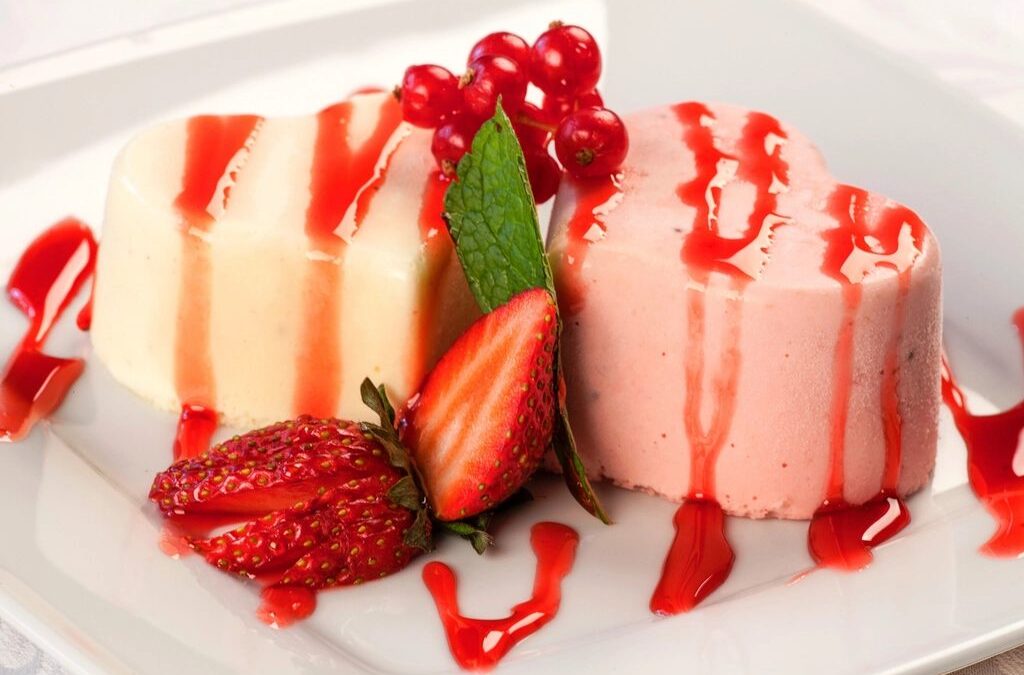
Most people arrive here for one number, so here it is: about 5 to 6 grams of powdered gelatine per 500ml of cream and milk if you want to turn the panna cotta out onto a plate, and 3 to 4 grams per 500ml if you’re serving it in the glass. Nearly every panna cotta problem is a variation on getting that number wrong.
The recipe below makes six, sets soft enough to wobble and firm enough to unmould, and needs four hours in the fridge. Everything after the method is a question I’ve either been asked or got wrong myself.
How much gelatine do I need per 500ml of cream?
This recipe uses 2 1/2 teaspoons of powdered gelatine, roughly 7.5g, for 3 cups of liquid (about 710ml). Around 5.3g per 500ml, right at the bottom of the unmould range.
The number matters more than the recipe because gelatine is sold in formats of different strengths, so measuring by envelope or sheet count is where people go wrong. A standard US envelope holds 7g, about 2 1/4 teaspoons. If your packet disagrees, trust the grams.
Below 3g per 500ml you get thickened cream that never really sets: fine in a glass, useless on a plate. Above about 8g you’ve made jelly. No fat adjustment is needed either, since gelatine sets the water and not the fat. If you want a set dessert with no gelatine at all, crème brûlée gets there on egg yolk and an oven.
Ingredients
- 2 1/2 cups heavy cream
- 1/2 cup whole milk
- 1/3 cup granulated sugar
- 1 vanilla bean, split and seeds scraped (or 2 teaspoons vanilla bean paste)
- 2 1/2 teaspoons powdered gelatine (about 7.5g)
- 3 tablespoons cold water, to bloom the gelatine
- A pinch of salt
- For the compote: 2 cups mixed berries, fresh or frozen
- 3 tablespoons sugar
- 1 tablespoon lemon juice
- 1 teaspoon cornstarch mixed with 1 tablespoon water, optional
Instructions
- Sprinkle the gelatine evenly over the cold water in a small bowl and leave it 5 minutes to bloom. It should go spongy and swollen right through, with no dry powder left on top.
- Combine the cream, milk, sugar, salt, vanilla seeds and the scraped pod in a saucepan. Warm over medium heat, stirring, until it steams and small bubbles gather at the edge. Don’t let it boil.
- Off the heat, lift out the pod. Add the bloomed gelatine and whisk gently for about a minute until it dissolves completely. Rub a drop between finger and thumb to check for granules.
- Pour the mixture through a fine sieve into a jug, then divide between six ramekins or glasses. Leave to cool on the counter for 15 minutes.
- Cover and refrigerate at least 4 hours, ideally overnight, until softly set. It should wobble in the centre when nudged, not stand rigid.
- For the compote, simmer the berries, sugar and lemon juice in a small pan over medium heat for 5 to 7 minutes, until the fruit breaks down and releases its juice. Stir in the cornstarch slurry and cook 1 minute more if you want it thicker.
- Cool the compote completely. Spoon it over the panna cotta in its glass, or unmould first and crown each one after.
Why is mine rubbery instead of wobbly?
Too much gelatine, almost every time, usually from rounding up or tipping in a whole 7g envelope where the recipe wanted less.
Second cause: boiling the cream. A hard boil drives off water and concentrates everything left, so a mixture reduced by even 10 percent is now over-gelled. Stop at steaming with bubbles at the edge, around 80C (176F).
Third, easily fixed. Gelatine firms as it chills, so a panna cotta straight from a 4C fridge tastes tighter than the same one after 10 minutes on the counter. Take them out before you make the coffee. A batch that’s already rubbery can be melted gently, loosened with another 100ml of warm cream and re-chilled; less silky, better than the bin.
Why didn’t it set at all?
Four culprits, in the order I’d check them.
Undissolved gelatine is the usual one. Bloomed gelatine dissolves in warm liquid, not cold, so if the cream had dropped below about 50C (122F) it just sat there. Whisk a full minute, then do the finger test.
Boiled gelatine is the opposite fault: prolonged high heat weakens its setting power.
Then there’s time. Four hours is the honest minimum for six ramekins, 6 to 8 for one large mould. And the odd one, certain fresh fruits, which is a question of its own further down.
Sheet gelatine or powdered — does it matter?
Not to the dessert. It matters to the measuring. Sheets come in grades, bronze through platinum, each setting differently per sheet, and bronze weighs around 3.3g against platinum’s 1.7g. “Four sheets” means genuinely different things in different countries.
So weigh instead. Same weight as the powder called for, 7.5g here, soaked in cold water 5 minutes, then lifted and squeezed firmly before it goes into the warm cream. Skip the squeeze and you’ve added a few tablespoons of plain water. Sheets do have one real advantage: they melt on contact, so they’re much harder to leave half-dissolved.
Can I unmould it without wrecking it?
Yes, and at 5.3g per 500ml this one is firm enough. Oil the ramekins before pouring: a drop of neutral oil wiped round with kitchen paper until it looks almost dry. You won’t taste it, and it comes out in one piece instead of two.
Then dip each ramekin in warm, not hot, water for 8 to 10 seconds, up to just below the rim. Hot water melts the outer few millimetres and the sides slump. Run a thin knife round the top edge to break the seal, set the plate on top, and invert with a small sideways jerk rather than a shake.
Wet the plate with a few drops of water first. It’ll land off-centre, and then you can slide it into place instead of prying at it.
Can I make it vegetarian with agar?
You can, as long as you know what changes. Agar comes from seaweed, sets firmer and more brittle, and gives a clean snap rather than a wobble. It also doesn’t melt on the tongue, and that melt is a lot of what people like here.
Practically: agar must be boiled about 2 minutes to activate, where gelatine must never boil. It sets around 40C (104F), so it starts gelling on the counter and you pour fast. It’s far stronger by weight too. Start at 1.5g per 500ml for the softest set you can manage.
Worth knowing either way: a lot of powdered gelatine is porcine and the packet rarely says so on the front. For a vegetarian chilled dessert needing no setting agent at all, rice pudding runs on starch alone.
Why are there gritty bits at the bottom?
Undissolved granules, which sink. It happens when the powder went into water that wasn’t cold, or landed in a heap so the outside swelled and sealed a dry centre inside.
Sprinkle it across the surface of cold water in a wide shallow bowl and leave it the full 5 minutes. Properly bloomed gelatine looks like wet sand right through, no chalky patches.
The sieve in step 4 is the safety net, and it catches the skin off the warmed cream and stray bits of pod as well. Pour slowly, don’t push anything through with a spoon.
Which fruit will stop it setting?
Fresh pineapple, kiwi, papaya, mango, figs and fresh ginger all contain protease enzymes that break down gelatine’s protein chains. Fold any of them in raw and you’ll open the fridge to soup.
Heat destroys those enzymes, so the same fruits behave once cooked, and tinned pineapple is fine because it was heat-treated in the can.
Berries aren’t on the list, which is part of why they’re the standard partner. Frozen ones work as well as fresh and often better, collapsing faster and giving more juice: use them straight from frozen and add a minute to the simmer. Berries you want raw and glossy belong on a fruit tart instead.
How long does it keep, and can I freeze it?
Three to four days covered in the fridge, tightening a little each day as the network keeps knitting. Day one is the best texture, day four noticeably firmer and still good. Cover them properly: cream picks up onion and garlic off an open fridge faster than almost anything in there. The compote keeps a week in a jar.
Freezing is the one thing I’d tell you not to do. Ice crystals rupture the gelatine network, and what thaws is grainy cream sitting in a puddle of its own water, with no way back. If you want a chilled dessert that genuinely survives a fortnight in the freezer, chocolate mousse takes it far better.