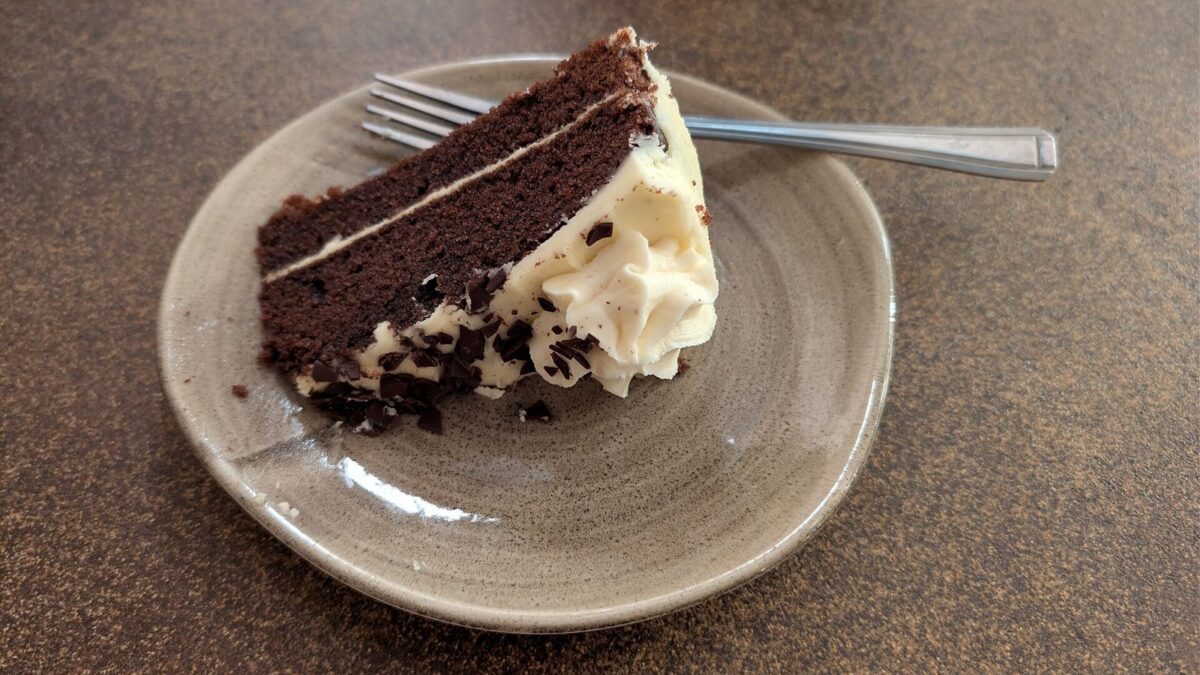
Three questions come up about chocolate cake more than everything else combined, and all three have real answers rather than opinions. I’ve put them first, before the recipe, because if you understand them the recipe more or less bakes itself.
Why Is There Coffee In It?
Because cocoa is full of bitter, roasted, faintly fruity compounds that overlap with the ones in coffee, and the two together make the chocolate read as deeper without adding any chocolate. You don’t taste coffee at 240ml across two 20cm layers. I’ve served this to people who don’t drink coffee and nobody has picked it out.
The heat matters as much as the coffee. Hot liquid poured over cocoa blooms it — the fat in the cocoa particles softens and releases flavour that stays locked up in a cold batter. Plain boiling water does most of this job. Coffee just does it slightly better.
So: use hot coffee if you have it, hot water if you don’t, and don’t use cold either way. The difference between hot and room-temperature liquid here is bigger than the difference between water and coffee.
Why Did Mine Come Out Dry?
Three culprits, in the order they actually cause the problem.
Overbaking, by a long way. Chocolate cake goes from moist to dry in about four minutes, and the usual advice to bake until a skewer comes out clean is what does the damage — by then it’s already gone too far. Pull it when the skewer has a few moist crumbs clinging to it. Carryover heat finishes the job in the tin. Start checking at 28 minutes, not 35.
Second, measuring the flour by scooping the cup straight into the bag, which can pack in 20 to 30 percent more flour than intended. That’s the entire reason this recipe is written in grams. 200g of plain flour, on a scale, and the problem disappears.
Third, and this catches people who did everything else right: overmixing after the flour is wet. Whisk until smooth and then stop. Another 30 seconds of enthusiastic beating builds gluten and gives you a tighter, tougher crumb that reads as dry even when it isn’t.
One more, if all three check out: an oven that runs hot. Mine was 15C over the dial, which I’d been blaming on recipes for a year.
Oil or Butter?
Oil, for this cake, and it isn’t close.
Butter is about 80 percent fat and 15 percent water, and solid at room temperature, so a butter cake firms as it cools and tastes drier from the fridge. Oil is 100 percent fat and stays liquid at any temperature you’d eat cake at, which is why an oil-based chocolate cake is still soft on day three.
What you give up is flavour. Butter tastes of butter, and in a vanilla sponge that’s the whole point. Here, cocoa and coffee do the flavour work anyway, so butter contributes nothing except a texture penalty. Oil in the cake, butter in the buttercream, which is what’s written below.
Ingredients
- 200g plain flour — the structure of your cake.
- 75g cocoa powder — good-quality unsweetened cocoa for deep color and flavor.
- 350g caster sugar — for sweetness and moisture.
- 2 teaspoons baking soda — plus 1 teaspoon baking powder to help it rise.
- 1 teaspoon salt — to balance and sharpen the chocolate.
- 2 large eggs — at room temperature.
- 240ml buttermilk — for tang and a tender crumb.
- 120ml vegetable oil — the key to a lasting, moist texture.
- 240ml hot coffee — freshly brewed; it intensifies the cocoa without tasting of coffee.
- 2 teaspoons vanilla extract — for warmth and depth.
- For the frosting: 250g butter, 400g icing sugar, 75g cocoa, and a splash of milk.
Instructions
- Preheat your oven to 175°C. Grease two 20cm round cake tins and line the bases with parchment paper so the layers release cleanly.
- In a large bowl, whisk together the flour, cocoa, sugar, baking soda, baking powder, and salt until evenly combined and free of lumps.
- Add the eggs, buttermilk, oil, and vanilla to the dry ingredients. Whisk until the batter is smooth and thick, scraping the bottom of the bowl.
- Carefully pour in the hot coffee and stir gently. The batter will become quite thin and pourable; this is exactly what you want for a moist cake.
- Divide the batter evenly between the two prepared tins. Tap each tin gently on the counter to release any large air bubbles.
- Bake for 30 to 35 minutes, until a skewer inserted into the center comes out with just a few moist crumbs. Avoid overbaking, which dries out the crumb.
- Let the cakes cool in their tins for 10 minutes, then turn them out onto a wire rack to cool completely before frosting.
- For the buttercream, beat the softened butter until pale, then gradually add the icing sugar and cocoa. Add a splash of milk and beat until light, fluffy, and spreadable.
- Place one cooled layer on a plate, spread with frosting, top with the second layer, and cover the whole cake in the remaining buttercream. Swirl decoratively and serve.
The Batter Looks Far Too Runny. Is That Right?
Yes. After the coffee goes in it pours like thick single cream, and the first time I made it I was convinced I’d misread a quantity and stood there second-guessing the scale.
That thinness is deliberate. All that liquid becomes steam in the oven, which is a leavening force in its own right, and it’s a large part of why the crumb comes out open and soft rather than close and heavy. A thick chocolate batter gives you a denser cake — good for brownies, wrong for this.
It does mean lined tins aren’t optional, and carry them to the oven one at a time. Weigh the two tins as you fill them: within about 20g of each other gives flat layers that stack without shimming.
Can I Bake It as One Cake, or as Cupcakes?
One 23cm round tin: yes, but fill it no more than two-thirds and bake for 45 to 55 minutes, tenting foil over the top at the 35-minute mark if it’s browning fast. Deep single layers are harder to judge; a skewer near the centre is your only reliable read.
A 23x33cm rectangular tin: 30 to 35 minutes, and this is the easiest version because it needs no layering and no crumb coat. Frost it in the tin and cut squares.
Cupcakes: this makes about 24. Line the tins, fill each case two-thirds, and bake at 175C for 18 to 20 minutes. The batter is thin enough that a jug is easier than a spoon. For a version built for cupcakes from the start, with quantities that don’t leave you with an awkward half-tray, the chocolate cupcakes recipe is the better starting point.
Do not try to bake all of this in one 20cm tin. It will dome, crack down the middle, and stay raw in the centre while the edges dry out.
My Buttercream Tastes Gritty and Sugary. How Do I Fix It?
Sift the icing sugar and the cocoa together before they go anywhere near the butter. Icing sugar clumps in the bag and those clumps never fully dissolve, which is where the grit comes from. Two minutes with a sieve.
For the sweetness, add 1/2 teaspoon of salt and a teaspoon of vanilla to the finished frosting. Salt in buttercream is the fix almost nobody applies, and it cuts the sugar hit dramatically without making anything taste salty.
Beat the butter alone 4 to 5 minutes, until visibly paler, before any sugar goes in. Add the milk a teaspoon at a time at the end: buttercream goes from stiff to slack in about two teaspoons and there’s no undoing it without more icing sugar.
If you’d rather skip buttercream entirely, a bowl of chocolate mousse spooned between the layers works, though it needs eating the same day.
How Long Does It Keep, and Does It Go in the Fridge?
Frosted and under a cake dome at room temperature: 3 days, and day two is better than day one. The oil keeps it soft and the buttercream seals the cut faces.
The fridge makes it firm and mutes the chocolate, so I only refrigerate in genuinely hot weather or if the frosting is starting to slump. If you do, take slices out 45 minutes before eating. Cold chocolate cake tastes like a lesser cake, and people blame the recipe.
Unfrosted layers freeze well for 3 months: cool completely, wrap each layer twice in cling film, then foil. Thaw wrapped, on the counter, for about 3 hours — unwrapping a frozen layer makes condensation land directly on the crumb.
The scraps from levelling the domes are the best part of the whole exercise. Crumble them into a glass with a spoonful of leftover buttercream, and that’s the baker’s share. If you want that texture as the actual dessert rather than an offcut, fudgy brownies or molten lava cakes get you there with far less washing up.