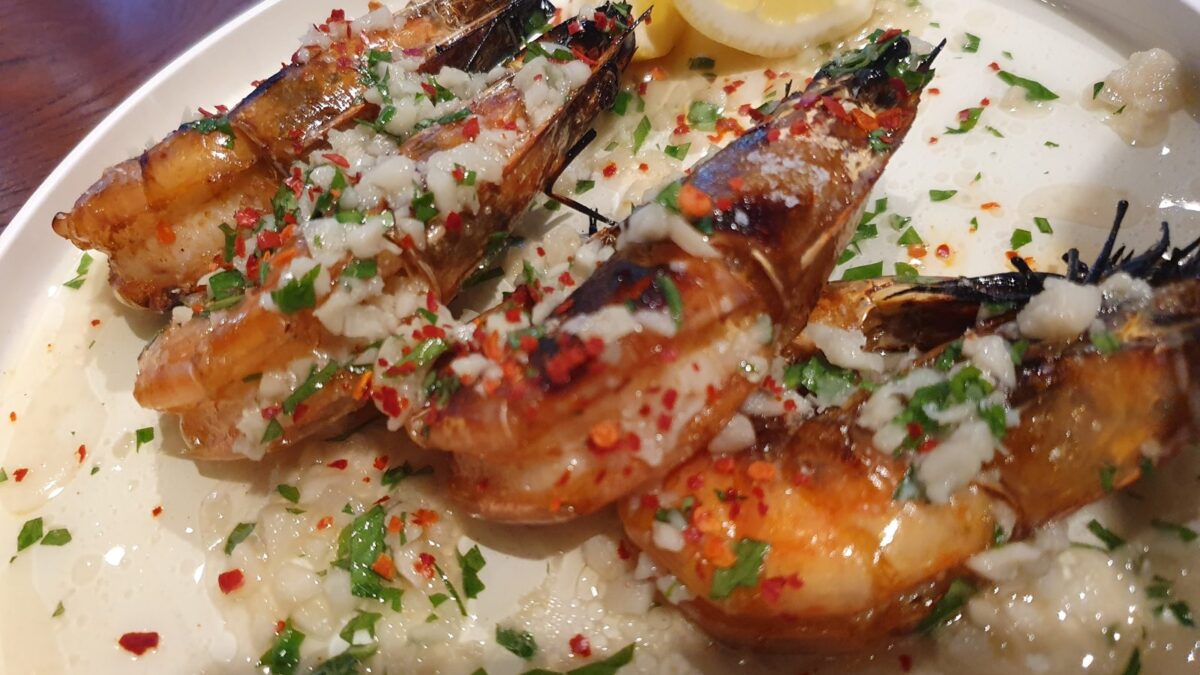
Ten minutes is honest here, but only if the shrimp are already thawed and dry before the pan gets hot. The cooking really is about two minutes a side plus a three-minute sauce. Everything that goes wrong with this dish goes wrong before that, at the freezer or the fish counter.
So this guide spends most of its time on shrimp, not on the sauce. Butter, garlic, stock, lemon, cream — you can learn that in one read. Buying the right shrimp and pulling them out of the pan at the right second is the part that takes a few tries.
Prep: 5 mins Cook: 10 mins Serves: 4 over pasta, or 2 to 3 as a plate on its own
What 16/20 and 21/25 actually mean on the bag
Those numbers are a count, not a size code. 16/20 means somewhere between 16 and 20 shrimp make up one pound, so each one weighs roughly 23 to 28 grams. 21/25 gives you slightly smaller shrimp, around 18 to 21 grams each. The smaller the numbers, the bigger the shrimp. “Jumbo”, “large” and “extra large” on the front of the pack mean whatever the packer wants them to mean, and I’ve bought two bags labelled large from different shops in the same month that were visibly different animals. The count is the only part of the label doing real work.
For this dish I buy 21/25. Big enough to sear and stay juicy, small enough that four or five of them fit on a forkful of linguine without anyone having to cut. 16/20 also works and looks more impressive on the plate, but they need closer to two and a half minutes a side and they’re easier to undercook in the middle while the outside is already tight.
Skip anything numbered 41/50 or higher for this. They cook through in about 45 seconds and there’s no window between raw and rubbery. Save those for a fried rice, where they get tossed with everything else and a few seconds either way disappears — our 15-minute shrimp fried rice is exactly that kind of forgiving.
The shrimp size and timing table
| Count per pound | Shrimp per 500g | Sear, first side | Sear, second side |
|---|---|---|---|
| 16/20 (extra large) | 18 to 22 | 2 min | 1 min 30 sec |
| 21/25 (large) | 23 to 28 | 1 min 30 sec | 1 min |
| 26/30 (medium large) | 29 to 33 | 1 min 15 sec | 45 sec |
| 31/40 (medium) | 34 to 44 | 1 min | 30 sec |
Those times assume a hot pan, a single layer, and shrimp from the fridge rather than straight off ice. Add about fifteen seconds a side for nonstick, which runs cooler than bare stainless at the same burner setting. The shrimp also go back into the hot sauce for a final minute, so the sear stops deliberately short.
Nearly all “fresh” shrimp was frozen first
The shrimp lying on ice at the counter, unless you live within an hour of a working shrimp boat, was frozen at sea and thawed by the shop that morning. That isn’t a scandal, it’s just how the supply chain works — freezing on the boat is what keeps the texture good. The catch is that once the shop thaws it, the clock starts, and you have no idea whether it was thawed today or on Saturday.
Which is why I buy the frozen bag. I control the thaw, I know the date, and I can cook two portions on Tuesday and leave the rest solid. The one time the counter genuinely wins is if the shop tells you it’s day-boat fresh and never frozen, and that shrimp is worth cooking plainly, not drowned in cream.
Two things worth checking on the bag. Avoid added sodium tripolyphosphate if you can; phosphate-treated shrimp hold extra water and release it into your pan, turning a sear into a poach. And individually quick frozen, loose in the bag rather than one solid block, is far easier to portion.
Thawing: cold water, never hot, never the counter
Overnight in the fridge is the best method and needs no supervision. Put the shrimp in a bowl, not straight on a shelf, because thawing shrimp leak.
The fast method: seal them in a bag or a bowl, sit that under a thin stream of cold running water, and 500g will be loose and flexible in about twelve minutes. Cold tap water, somewhere around 15°C. Hot water is the mistake I see most often and it does two bad things at once — the outer few millimetres of each shrimp start to cook and go opaque and chalky while the centre is still frozen, and the temperature sits in the range where bacteria are happy for as long as the thaw takes.
Don’t leave a bag of shrimp on the counter for two hours either. The outside is at room temperature long before the middle has given up.
Patting dry is not an optional nicety
Thawed shrimp carry a surprising amount of surface water. Drop them in wet and the pan’s energy goes into boiling that water off instead of browning the shrimp, so they turn grey-pink and slightly bouncy without ever taking colour. I lay them out on a double layer of kitchen paper, press another sheet on top, and give it maybe twenty seconds. Sometimes I leave them spread on the paper in the fridge while I mince the garlic, which dries the surface further.
You’ll know by the sound. Dry shrimp hitting hot butter make a sharp continuous hiss. Wet ones sputter, and the pan goes quiet within seconds as the temperature crashes.
Ingredients
- 500g large shrimp (21/25 count), peeled and deveined, patted very dry
- 3 tablespoons butter, divided
- 1 tablespoon olive oil
- 5 cloves garlic, finely minced
- 1/2 teaspoon red pepper flakes, optional
- Zest and juice of 1 large lemon (about 3 tablespoons juice)
- 1/2 cup chicken or vegetable stock
- 2/3 cup heavy cream, at room temperature
- 1/4 cup parmesan, grated from a block
- Salt and freshly ground black pepper
- 2 tablespoons fresh parsley, chopped
Instructions
- Take the cream out of the fridge before you do anything else. Twenty minutes on the counter is plenty and it makes the sauce noticeably more stable.
- Pat the shrimp dry and season with salt and pepper. Set the lemon juice, stock and cream within arm’s reach of the stove — once the pan is going there’s no time to open a fridge.
- Heat a large skillet over medium-high. Add the olive oil and one tablespoon of butter. When the foam subsides, lay the shrimp in a single layer with space between them and cook 90 seconds, then flip and cook 60 more. Work in two batches if your pan is smaller than about 28cm. Move them to a plate while still slightly underdone.
- Drop the heat to medium and add the remaining butter. Stir in the garlic and pepper flakes for 30 seconds, no longer, until it smells sweet rather than sharp.
- Pour in the stock and lemon juice and scrape the bottom of the pan with a wooden spoon until nothing is stuck. Let it bubble and reduce by roughly half, 1 to 2 minutes.
- Turn the heat to low. Stir in the cream and the lemon zest and let it simmer gently, never at a rolling boil, until it coats the back of a spoon, about 2 minutes.
- Pull the pan off the heat entirely, then stir in the parmesan. It melts into the residual heat in about 20 seconds and stays smooth.
- Return the shrimp with any juices from the plate, set the pan back on low, and toss for 60 seconds. Finish with parsley and a squeeze more lemon if it needs lift, and serve straight away.
The C and the O: reading doneness by shape
A raw shrimp lies almost straight. As the proteins tighten it curls, and how far it curls tells you exactly where you are. A relaxed C, where you could still slide a finger through the gap, is done. A tight O, tail tucked against the head end so the circle has closed, is overcooked — that’s when the texture goes from tender to squeaky.
This beats judging by colour, because pink arrives before the centre is set and stays pink long after it’s gone too far. Pull them at a loose C. The minute back in the hot sauce closes that curl slightly and they land right.
The window between the two shapes is roughly thirty seconds at this heat. That’s the whole game.
Why the cream splits when the lemon hits it
Cream is fat suspended in water, held there by proteins. Acid makes those proteins clump together, and heat makes them clump faster. Lemon juice sits around pH 2.2, which is aggressive enough to curdle cream on contact if the pan is hot and the cream is thin.
The recipe dodges this in three ways, and it’s worth knowing which is doing the work. First, the lemon juice goes in with the stock and gets reduced before the cream, so by the time the cream arrives the acid is diluted through a larger, already-simmering base. Second, the cream is full-fat and at room temperature — 35% fat cream resists curdling far better than single cream or half-and-half, and cold cream hitting a hot pan shocks the proteins. Third, the heat goes to low and stays there. A rolling boil will break this sauce even without lemon.
I split a batch once by being impatient and pouring cold cream straight from the fridge into a pan still on medium-high. It went grainy in about four seconds and no amount of stirring brought it back. If yours does split, take it off the heat and whisk in a tablespoon of cold cream or a splash of stock; sometimes it comes back together, often it doesn’t. The same logic governs the sauce in our creamy Tuscan salmon, where sun-dried tomatoes bring their own acidity.
Garlic has a thirty-second window
Minced garlic in hot butter goes from raw to fragrant at about twenty seconds and from fragrant to bitter at about sixty. The finer you mince it, the faster it burns, and a garlic press produces something close to a paste that scorches almost immediately. I use a knife and aim for pieces about the size of coarse salt.
The safety valve is the liquid. If it’s browning faster than you like, get the stock and lemon in early; the temperature drops instantly and the garlic stops where it is. Nothing rescues garlic already gone dark and acrid. Wipe the pan and start over.
Scraping the pan after the liquid goes in matters more than people expect. Those stuck brown flecks are browned shrimp proteins and milk solids, and they carry most of the savoury depth the sauce has. A silicone spatula won’t shift them — use wood or metal until the bottom is clean.
What to put underneath it
Linguine is the default for a reason: long strands hold a thin cream sauce better than short shapes, which let it slide to the bottom of the bowl. Cook it a minute short and finish it in the pan with the shrimp, adding a splash of pasta water. If you want the fuller version of that idea, the technique overlaps with our creamy chicken alfredo.
Mashed potato is my own preference and I’ll defend it. The sauce pools in the well instead of coating, so you get concentrated mouthfuls rather than an even film, and the lemon cuts the butter in the potato.
Rice is a mistake here, honestly. Plain grains absorb the sauce and give you back nothing, and the dish loses its glossiness within a minute.
Bread on the side is not optional in my house. Something with an open crumb that mops properly — a torn corner of rosemary focaccia does the job better than a soft sandwich loaf, which just goes to paste.
One last thing about the lemon. Zest the fruit before you juice it, always, because zesting a squeezed half is miserable work. And add the zest with the cream rather than at the end — it needs a minute of warmth to release its oils, and thrown on raw at the table it tastes sharp and slightly soapy.