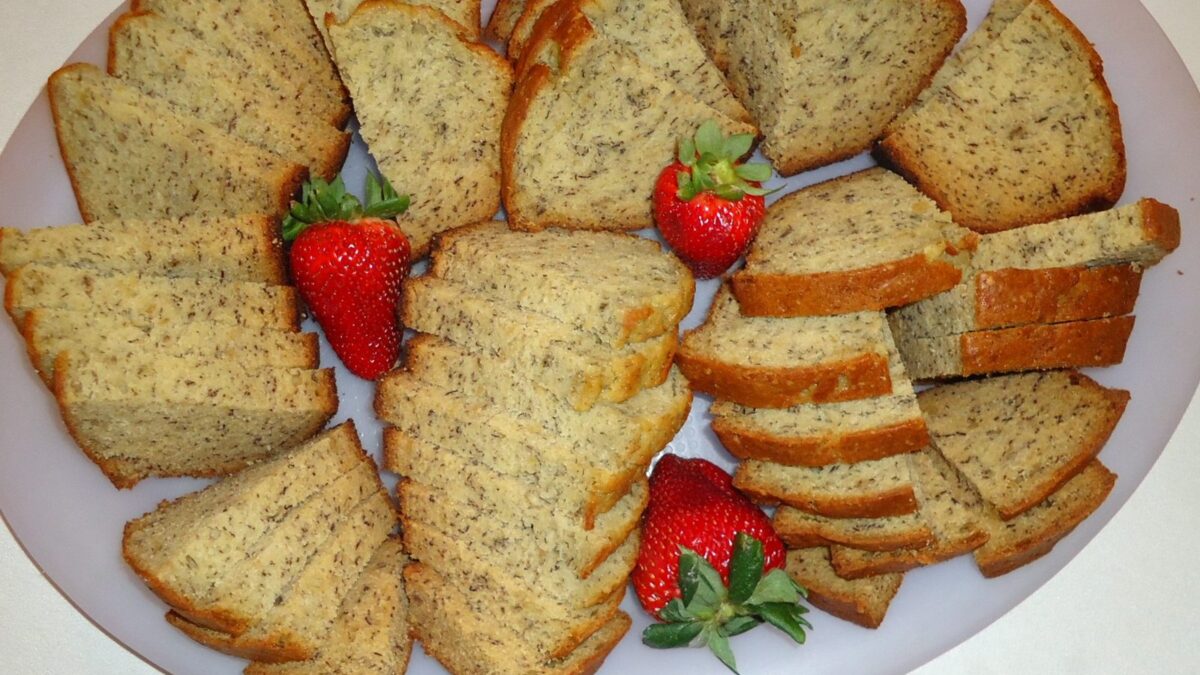
Two questions come up about this loaf more than every other question put together, and they’re both about things going wrong in the middle of the tin where you can’t see them happening. So let’s start there rather than with the recipe.
Why Does the Cinnamon Swirl Sink to the Bottom?
Because cinnamon sugar is heavier than batter, and because it stops being a solid about eight minutes into the bake.
The sequence goes like this. You lay a band of sugar across the middle, add the top half of the batter, and slide it into a 350F oven. The batter stays liquid for the first fifteen minutes or so. The sugar melts to syrup, syrup is denser than the batter around it, and it does what dense things do in a liquid. By the time the crumb sets around minute 25, the swirl has migrated an inch down and turned into a dark, slightly wet stripe near the base.
Three things stop it. Keep the swirl dry and coarse — the 1/3 cup granulated sugar with 1 tablespoon cinnamon is deliberately not a paste, and adding melted butter to it, which plenty of recipes suggest, guarantees a sink. Use two-thirds in the middle and the last third on top, so there’s a dark line at the surface regardless of what happens below. And marble in three or four figure-eights, no more; every extra pass drags sugar downward and thins the ribbon to a smear.
Thicker batter holds the swirl better, which is part of why the half cup of yogurt earns its place beyond tenderness. Swap it for milk and the batter loosens and the swirl sinks further.
Why Is the Middle Gummy When the Top Looks Done?
Nearly always one of three culprits, and the loaf tin shape makes all three worse than they’d be in a muffin tin.
Overmixing is the first. Once flour meets liquid gluten starts forming, and a banana batter beaten smooth for even 45 seconds develops enough to go dense and rubbery at the centre. Fold with a spatula, stop when the last dry streak goes, and let the batter look slightly lumpy. I count roughly 20 folds and put the spatula down.
Underbaking is the second, and it hides well. A 9×5 loaf at 350F needs 55 to 65 minutes, and the top goes deep golden at about 45 — exactly when it’s tempting to take it out. Skewer the true centre. A few moist crumbs are right; wet batter means at least eight minutes more, and nothing fixes it once it’s out of the oven. Browning fast? Tent with foil at 40 minutes and keep going.
Too much banana is the third, and this one surprises people. Three large bananas give about 1.5 cups mashed. Four very large ones push closer to 2 cups, and that extra half cup of wet purée has nowhere to go — the crumb turns heavy and damp however long you bake it. Measure the mash, don’t count the bananas.
Cutting it hot does something similar. Starch is still setting for the first half hour out of the tin, and slicing at ten minutes drags the crumb into a compressed, gluey band along the knife.
Ingredients
- 3 large very ripe bananas, well mashed (about 1.5 cups) — the spottier the better
- 2 large eggs, at room temperature
- 1/3 cup neutral oil, such as sunflower or light olive oil
- 3/4 cup light brown sugar, packed
- 1 teaspoon pure vanilla extract
- 1/2 cup plain yogurt or sour cream
- 1 3/4 cups all-purpose flour
- 1 teaspoon baking soda
- 1/2 teaspoon fine salt
- For the swirl: 1/3 cup granulated sugar mixed with 1 tablespoon ground cinnamon
Instructions
- Heat the oven to 350F and line a 9×5-inch loaf tin with parchment, leaving an overhang on the long sides. Mix the swirl sugar and cinnamon in a small bowl and set aside.
- Mash the bananas in a large bowl until only a few small lumps remain. Whisk in the eggs, oil, brown sugar, vanilla, and yogurt until smooth and glossy, about a minute of steady whisking.
- Sprinkle the flour, baking soda, and salt over the wet mixture. Switch to a spatula and fold just until no dry streaks remain, around 20 folds. Stop there.
- Spoon about half the batter into the tin and level it. Scatter roughly two-thirds of the cinnamon sugar across the surface, right to the edges.
- Add the rest of the batter and spread gently to cover. Sprinkle the remaining cinnamon sugar over the top, then drag a knife through in three or four figure-eights to marble it.
- Bake 55 to 65 minutes, until deeply golden, springy at the centre, and a skewer comes out with a few moist crumbs. Tent with foil at 40 minutes if the top is darkening fast.
- Cool in the tin 15 minutes, lift out by the parchment, and cool at least 30 minutes more before slicing.
My Bananas Aren’t Ripe Enough. Can I Speed Them Up?
Yes, partly. Bake unpeeled bananas on a lined tray at 300F for 15 to 20 minutes until the skins go black and shiny, then cool and squeeze them out.
The honest caveat: it softens and sweetens them without producing the deep, almost boozy flavour a genuinely overripe banana has. That comes from days of enzymes converting starch to sugar on the counter, and twenty minutes of heat only does part of the job. Oven-ripened bananas make a good loaf. Counter-ripened ones, skins more black than yellow, make a better one.
The freezer is the real answer. Whenever three bananas go past the point of anyone eating them, peel and freeze them in a bag. Thawed, they release a slick of dark liquid — pour it in, it’s concentrated flavour.
Can I Use Butter Instead of Oil?
You can, and the loaf will taste better on day one and be drier by day three.
Swap in 1/3 cup melted unsalted butter for the oil, one for one, and cool it a little before it meets the eggs. Butter is around 15 percent water, so you lose some of the fat that keeps the crumb soft, and butter firms as it cools while oil stays liquid at room temperature. That’s the whole difference. Eating it the same afternoon, use butter. Wanting it to last the week in a tin, keep the oil.
For butter flavour without the trade, brown 3 tablespoons of butter and add 2 tablespoons of oil alongside. That choice behaves differently without wheat flour, which I tested against four flours in a gluten-free banana loaf.
Why Did My Loaf Split Down the Middle?
It’s meant to. That crack is the sign of a good quick bread, not a fault.
The outside sets first in a deep, narrow tin. The middle keeps rising underneath and the crust gives way along its weakest line. Every well-risen loaf does it. A flat, smooth top means the batter was too loose or the baking soda too old — soda more than about six months open loses lift, and half a teaspoon dropped into vinegar should fizz hard.
The crack does mean the middle bakes slower than the edges, which is why the skewer goes into the centre and not two inches off to the side. Muffins dodge the problem entirely, since nothing sits more than an inch and a half from the tin wall — one reason banana nut muffins bake in 20 minutes and are much harder to underbake.
How Long Does It Actually Keep?
Three days at room temperature, wrapped once it’s fully cool, in a tin rather than plastic. It’s better on day two than day one — the cinnamon works its way outward into the crumb overnight.
Don’t refrigerate it. Cold speeds up the staling of starch in a way room temperature doesn’t, and a fridge loaf goes firm and dull by the second day. Freeze it instead: whole or in slices, wrapped tight, up to three months. Frozen slices toast straight from the freezer, and a swirl slice in a toaster is genuinely better than fresh, because the cinnamon sugar at the ribbon caramelises against the heat.
If you find yourself making this fortnightly, the same tin, temperature, and 55 to 65 minute window carry over to zucchini bread and pumpkin bread, so the timing you learn here transfers. The one that doesn’t transfer is cinnamon coffee cake — a wide shallow pan changes the bake entirely, and the swirl behaves itself much better with only two inches of batter to fall through.