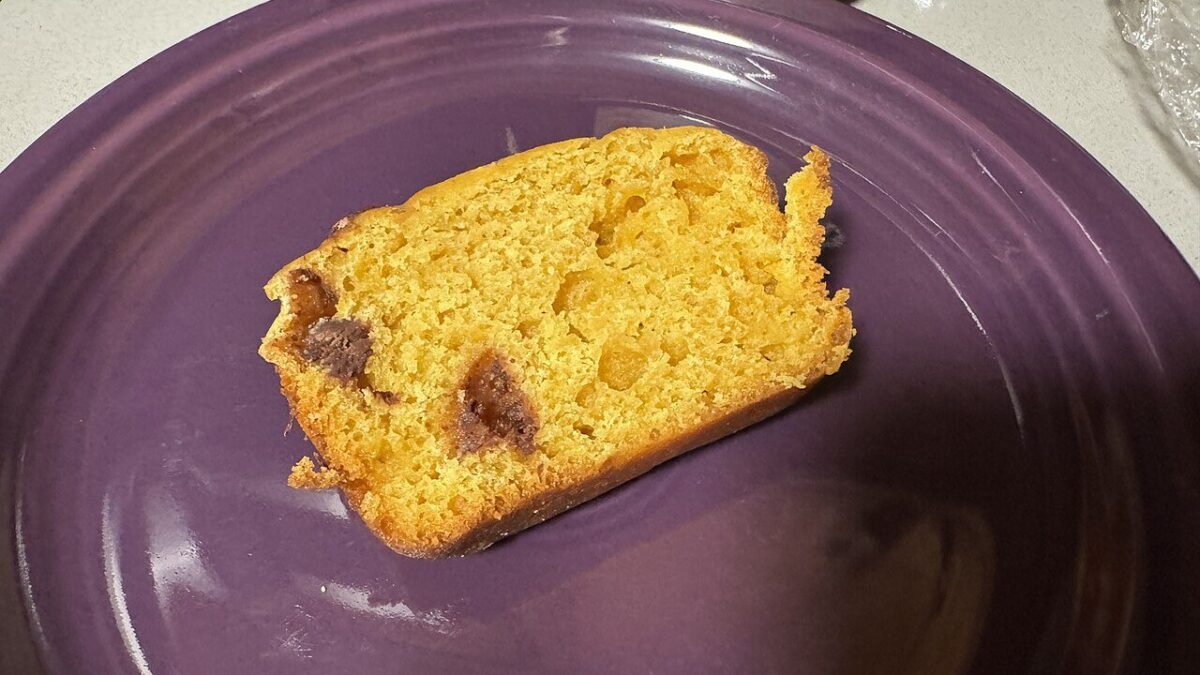
Pumpkin Puree Is Mostly Water, and That Decides Everything
The reason pumpkin bread goes gummy is not your oven and not your flour. It is that a cup of pumpkin puree is roughly 90 percent water by weight, and you are pouring all of it into a batter that has no idea it is supposed to compensate.
Think about what that cup is actually doing. It is behaving like a cup of thin, orange, faintly sweet liquid with some fibre suspended in it. Every recipe treats it as a solid ingredient, listed alongside flour and sugar, and then you wonder why a loaf with 1 and 3/4 cups of flour comes out with a wet stripe down the middle.
Once I started thinking of the puree as a liquid, the loaf stopped failing.
How Much Water We Are Actually Talking About
I did the boring thing and weighed it. A cup of tinned puree came to about 245g. I spread it on a double layer of paper towel, left it forty minutes, scraped it back into the cup and weighed again: about 205g. Forty grams of water had walked out of a single cup, on the counter, with no effort at all.
Forty grams is roughly three tablespoons. In a loaf built on 1 and 3/4 cups of flour, three extra tablespoons of water is the difference between a crumb that springs back and a crumb that stays dented when you press it.
That is one brand of tinned puree on one afternoon in one kitchen, so treat the number as a ballpark rather than a law. The direction is what matters, and the direction is always the same: there is more water in there than you think.
Tinned Versus Homemade Puree
Tinned puree is the drier of the two, and by a wide margin. It has been cooked down under heat before it ever went in the can, and the good brands are dense enough that a spoon will nearly stand up in them.
Homemade puree is a different animal. If you roast a squash, scoop it and blend it, you get something looser and paler that carries a lot more free water. I made a loaf with homemade puree once without adjusting anything, and it took 78 minutes to bake instead of 60, sank about a centimetre in the centre as it cooled, and had a band of dense, almost custardy crumb across the bottom third.
If you are using homemade, drain it. Not optional. If you are using tinned, draining is a judgement call and I will get to it.
The spoon test
Drop a heaped spoonful of puree onto a plate and wait thirty seconds. If a ring of watery orange liquid seeps out around the base, it needs draining. If the mound just sits there holding its shape, you are fine to carry on.
How To Drain It Without Losing the Flavour
Two methods, and they are not equal.
The paper towel method: spread the puree in a thin layer, maybe 1cm deep, on a doubled sheet of paper towel. Lay another sheet on top and press gently. Leave it 30 to 45 minutes. Scrape it up with a bench scraper or the back of a knife. You lose a little puree to the towel, which is irritating but survivable.
The sieve method: line a fine sieve with a coffee filter, tip the puree in, set it over a bowl and refrigerate for two hours or overnight. Slower, cleaner, and you can see exactly how much liquid came out sitting in the bowl underneath. This is what I do if I am baking the next morning anyway.
Do not squeeze it in a cloth like grated courgette. Pumpkin puree is fine enough that it pushes straight through the weave and you end up wringing half the loaf into the sink.
What Draining Does To the Spice
Here is the part nobody mentions. Drained puree tastes noticeably more of pumpkin, because you have concentrated it, and that shifts the spice balance.
With undrained puree the 1 and 1/2 teaspoons of cinnamon in this recipe sit right on the edge of dominating. With drained puree, the same amount reads as balanced and the squash flavour actually comes through underneath. If you drain, I would leave the spices exactly as written and let the pumpkin do more of the talking. If you do not drain, you can push the cinnamon to a rounded 1 and 3/4 teaspoons without it going overboard.
The cloves are the one to be careful with either way. A quarter teaspoon is genuinely the ceiling. I went to half once and the loaf tasted like a scented candle for three days.
Ingredients
- 1 and 3/4 cups all-purpose flour — spoon it into the cup and level it so you do not pack in too much.
- 1 teaspoon baking soda — the main lift for this loaf.
- 1/2 teaspoon baking powder — a little extra insurance for a good rise.
- 1 teaspoon fine salt — balances all that sweetness.
- 1 and 1/2 teaspoons ground cinnamon — the backbone of the flavour.
- 1/2 teaspoon ground nutmeg — freshly grated if you have it.
- 1/4 teaspoon ground cloves — a little goes a long way, so do not overdo it.
- 1 cup pumpkin puree — pure pumpkin, not pre-sweetened pie filling.
- 1/2 cup neutral oil — canola, vegetable, or light olive oil all work.
- 1 cup granulated sugar — or swap half for brown sugar for a deeper, caramel note.
- 2 large eggs — at room temperature so they blend smoothly.
- 1 teaspoon vanilla extract — rounds out the spices.
Instructions
- Heat the oven to 350F (175C) and grease a 9×5 inch loaf pan, then line it with a strip of parchment hanging over the two long sides. That paper sling makes lifting the loaf out effortless later.
- In a medium bowl, whisk the flour, baking soda, baking powder, salt, cinnamon, nutmeg and cloves together. Set it aside so the leavening and spices are evenly distributed before they meet the batter.
- In a large bowl, whisk the pumpkin puree, oil and sugar until smooth and glossy. Add the eggs and vanilla and whisk for about thirty seconds more, until the mixture looks uniform and slightly lightened.
- Add the dry ingredients to the wet in two additions, folding gently with a spatula. Stop the moment you no longer see dry flour. A few small lumps are fine and much better than an overmixed, tough loaf.
- Scrape the batter into the prepared pan and smooth the top. If you like, scatter a tablespoon of coarse sugar over the surface for a bit of crackle.
- Bake for 55 to 65 minutes. The loaf is ready when the top is domed and cracked and a skewer pushed into the centre comes out with a few moist crumbs, not wet batter.
- Cool the bread in the pan for 15 minutes, then use the parchment sling to lift it onto a wire rack. Give it at least another 30 minutes before slicing so the crumb has time to set.
Reading the Crack Down the Middle
Every good loaf splits along the top. That crack is the crust setting before the middle has finished rising, and the batter tearing its way out. It is a feature, and it also happens to be a gauge.
A crack that opens wide and stays visibly wet-looking in the seam means the centre is still raw. A crack whose edges have gone matte and the same colour as the rest of the crust means you are close. I start testing at 55 minutes and I test in the crack itself, not beside it, because the crack is the last part to cook.
Why Oil and Not Butter
Oil is liquid at room temperature and butter is not, which is the entire reason this loaf is still soft on day three while a butter-based cake has gone firm in the fridge. Butter would give you more flavour and a shorter shelf life.
The other reason: the spice mix here is fairly assertive, and butter’s flavour has nowhere to go against cloves and nutmeg. It gets buried. Save the butter for something that will actually let you taste it.
The same argument applies to zucchini bread, which has an even worse water problem than pumpkin does, and to cinnamon swirl banana bread, where the fruit brings its own moisture.
If It Sinks Anyway
Assuming you drained, three other culprits. Opening the oven before the 40-minute mark, which drops the temperature enough that a half-set crumb collapses. Overmixing after the flour goes in, which builds gluten that stretches high and then falls. Or an oven that runs cool, in which case a 350F setting might genuinely be 325F and the loaf never sets in time. A cheap oven thermometer settles that last one for the price of a coffee.
A sunken loaf is still edible, by the way. Slice it, toast the slices in a dry pan for a minute a side, and nobody will know.
Day Two Is Better Than Day One
Pumpkin bread improves overnight and it is not close. The spices bloom, the crumb evens out, and the slightly rubbery quality a very fresh loaf can have disappears entirely. I now bake it the day before I want it, which felt like cheating the first time and now just feels like planning.
Wrap it in foil once completely cool, not cling film, and leave it on the counter. Cling film traps condensation against the crust and turns the top sticky by morning. Foil breathes just enough. It keeps four days that way, and the last slice is honestly as good as the second.
If you want the same spice profile in a different form, the filling in classic pumpkin pie uses a near-identical blend, and banana nut muffins bake in 20 minutes when you cannot wait an hour for a loaf.