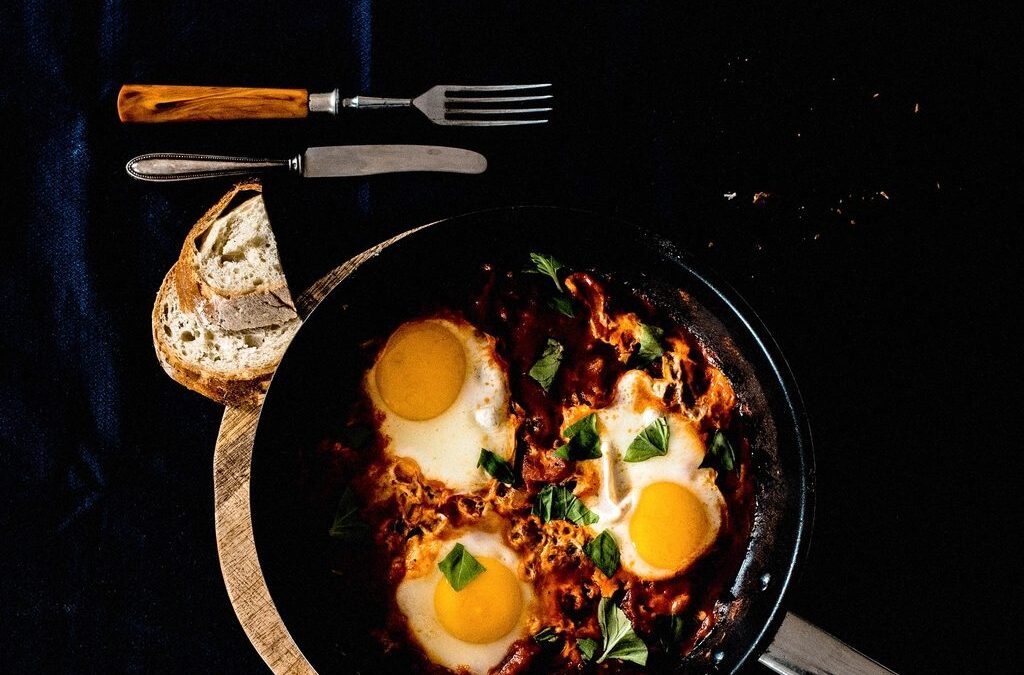
Baked eggs go wrong in about five specific ways, and I’ve done all of them. Below is each failure, why it happens and what fixes it, before the recipe — because the recipe is the easy part and the failures are what actually costs you a breakfast.
Problem 1: The Sauce Is Watery And The Eggs Slide Around
You spoon a well, crack the egg, and it drifts. Two eggs merge. The sauce goes pink where the whites have thinned into it.
Cause: the tomatoes still hold too much free water. Crushed canned tomatoes come out of the tin at roughly the consistency of thin yoghurt, and eight minutes over medium heat doesn’t move enough of it.
Fix: reduce uncovered, and test rather than time. Drag a spoon through the centre; the channel should stay open a full second. Mine takes 12 to 14 minutes at a proper bubble, and I’ve had watery tins that took 20. Frying the tomato paste for a minute first helps too.
Problem 2: The Yolks Set Before You Notice
Cause: almost always oven heat plus carryover. Whites need about 82C to set; yolks start firming around 65C. In an oven the yolks are being heated from above by radiant heat as well as through the sauce, so the gap between “whites just done” and “yolks chalky” can be under two minutes at 200C.
Fix: drop the oven to 190C and pull the pan while the whites still look faintly glossy. Cast iron carries them another 15 to 20 seconds after they leave the oven. If your yolks look perfect in the pan and turn out hard on the plate, that’s carryover, not overbaking.
Problem 3: Whites Cook Unevenly, Some Raw And Some Rubbery
One egg is done, its neighbour has a slick of clear jelly around the yolk, and the one nearest the handle is squeaky.
Cause: fridge-cold eggs start 15C behind, and eggs placed too close pool into one connected sheet that cooks from its edges inward.
Fix: sit the eggs in warm tap water for five minutes, and space them — six eggs need a 28cm pan minimum. Crack each into a cup first and pour it in.
Ovens have hot spots too. Mine runs hot at the back left, so I rotate the pan 180 degrees at the halfway point. Two seconds, and it fixed something I’d blamed on my eggs for a year.
Problem 4: It Tastes Flat Despite Good Tomatoes
Cause: under-salting for the eggs that are coming, and raw spices. Six eggs are bland protein and they dilute everything around them. A sauce seasoned to taste right on its own will taste like nothing once they’re in.
Fix: season until it tastes slightly aggressive on the spoon, and bloom the spices — smoked paprika and cumin need 45 to 60 seconds in hot oil before any liquid arrives. Paprika’s colour and smoke are fat-soluble; they come out into oil, not into tomato juice. The oil turning deep orange is your signal. If it’s still flat after that, a teaspoon of red wine vinegar before the eggs go in usually does more than more salt.
Problem 5: The Base Catches And The Whole Pan Tastes Burnt
Cause: a thin pan, too much heat, and sugars in the tomato sticking to the base while the top looks fine.
Fix: use a heavy pan — cast iron or a thick-based stainless skillet — and stir the sauce right to the corners every couple of minutes during the reduction. If you smell caramel turning to coffee, get the sauce into a clean pan immediately and don’t scrape the bottom. Burnt tomato does not blend back in; it takes over.
How This Differs From Shakshuka
They look alike in the pan and they’re genuinely not the same dish to eat. Shakshuka leans on sweet paprika, cumin and fresh peppers, stays on the stovetop under a lid, and gives you soft jammy yolks in a brighter sauce. This one is built around smoked paprika and tomato paste, goes into the oven, and comes out deeper, drier and a little savoury-sweet.
Practically: the oven sets whites more evenly and lets you fill a pan without babysitting, so I make this for five or six and shakshuka for two. The reasoning behind building the tomato base itself is in the shakshuka post rather than repeated here.
Ingredients
- 2 tbsp olive oil
- 1 medium yellow onion, finely diced
- 1 red bell pepper, thinly sliced
- 3 garlic cloves, minced
- 1 1/2 tsp smoked paprika
- 1 tsp ground cumin
- A pinch of red pepper flakes
- 1 tbsp tomato paste
- 1 can (28 oz / 800g) crushed tomatoes
- 1 tsp red wine vinegar
- 6 large eggs, at room temperature
- 1/2 cup crumbled feta
- A handful of cilantro or parsley, chopped
- Salt and black pepper
Instructions
- Heat the oil in a 28cm oven-safe skillet over medium. Cook the onion and pepper 6 to 8 minutes until soft with a little colour at the edges.
- Add the garlic, smoked paprika, cumin and pepper flakes. Stir hard for 45 to 60 seconds, until the oil around the vegetables has gone deep orange and the pan smells toasted.
- Add the tomato paste and fry it for another minute, stirring, until it darkens from bright red to brick.
- Pour in the tomatoes, season with salt and pepper, and bring to a steady bubble. Reduce uncovered for 12 to 15 minutes, stirring into the corners every couple of minutes. Stop when a spoon-drag leaves a channel that holds for a second.
- Heat the oven to 190C (375F). Stir in the vinegar and taste. Season until it’s slightly too bold.
- Make six shallow wells with the back of a spoon, well spaced. Crack each egg into a cup and pour it into its well.
- Scatter the feta over the sauce, not over the yolks — cheese on a yolk insulates it and that egg will lag behind the others.
- Bake 8 to 12 minutes, rotating the pan at the halfway point. Pull it when the whites are opaque but still faintly glossy and the yolks wobble as one soft dome when you shake the handle.
- Rest the pan on a trivet for two minutes, scatter the herbs, and serve straight from the skillet with bread.
Doneness Windows I Actually Use
At 190C, cast iron, room-temperature eggs: 8 minutes gives runny yolks with a little slack left in the whites. 10 is my default — set whites, yolks that break and flow. 12 gives jammy yolks, which is what I make for people who don’t like runny eggs. Past 14 you have hard-cooked eggs in tomato sauce and there’s no rescue.
If You’re Cooking For More Than Four
Don’t scale up in one pan. Nine eggs in a 30cm skillet cook worse than six in a 28cm one — the sauce sits deeper and the outer eggs finish long before the middle. Make the sauce in a big pot and split it between two skillets before the eggs go in. It keeps four days in the fridge, so making it the night before is the shortcut worth having.
The Pan Question
Cast iron holds heat, which is mostly good and occasionally the reason your yolks overshoot. Enamelled cast iron behaves the same and is easier on acidic tomato over long simmers. A thin non-stick pan is the worst option — it can’t hold a steady reduction and most aren’t rated for a 190C oven with a plastic handle.
If your only oven-safe pan is small, cook the eggs on the stovetop under a lid instead and accept slightly less even whites. And if you want the starchy side that makes this a proper meal, crispy hash browns hold up next to a wet sauce better than toast does. For a lighter route, the garlic-rubbed bread from tomato bruschetta is the right texture for dragging through the pan, and if the eggs themselves are the part you want more practice with, a plain cheese omelette teaches heat control faster than anything with a sauce in it.