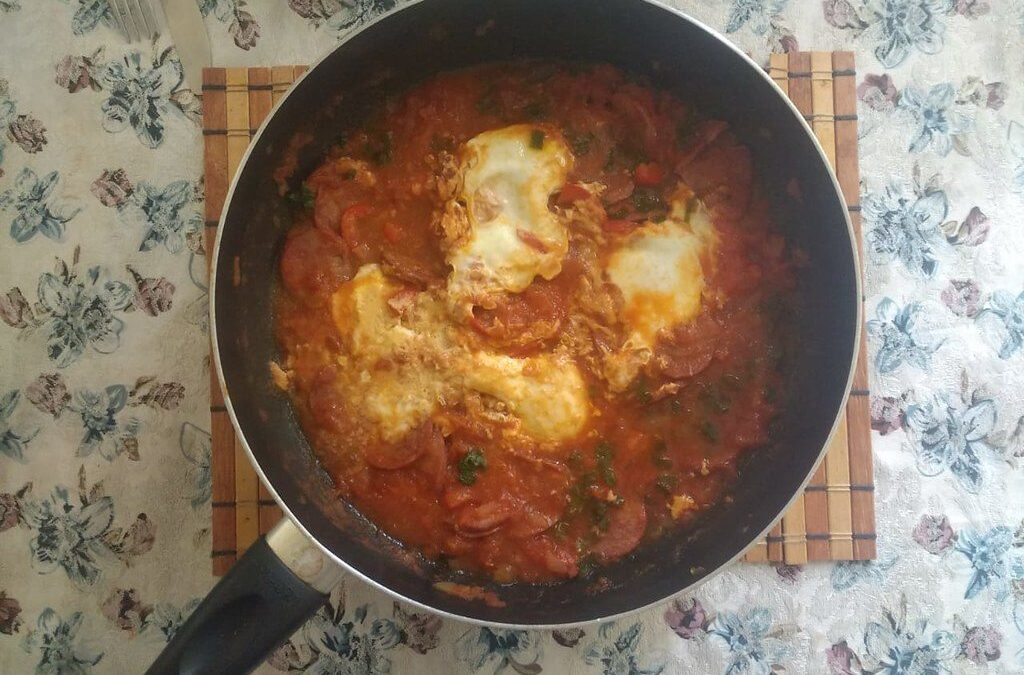
The first shakshuka I was actually proud of came after three bad ones in a row, and the thing that fixed it had nothing to do with spices.
It was a Sunday in March. I’d made shakshuka for four people, and by the time it reached the table the sauce had gone thin and grey-red at the edges, the eggs had slid into one corner of the pan, and two of the yolks were hard. Somebody said it was nice. It wasn’t nice. I ate mine standing at the counter and worked out what I’d done.
The Sunday I Nearly Gave Up On It
Here’s what went wrong, and it’s embarrassingly simple. I’d been cracking the eggs into the sauce far too early — around the eight-minute mark, when the tomatoes were still loose and sloshing. A loose sauce won’t hold a well. The egg spreads, the white thins out across the whole pan, and then you’re cooking a tomato omelette with no structure at all.
The other half of the problem was the pan. I was using a 24cm skillet with tall straight sides because it was the one I could reach. Six eggs in a 24cm pan means they touch, and eggs that touch cook as one sheet: the outer edges go rubbery a full two minutes before the middle yolks are ready. I now use a 28cm skillet for five eggs and I don’t crowd it. If I want to feed more people I make two pans rather than one heroic one.
Third thing, which I only noticed the fourth time: I was seasoning at the end, once the eggs were in and I couldn’t stir. Salt the sauce before the eggs go in, and taste it. It should read slightly too bold on the spoon, because five unseasoned eggs are about to dilute it.
Once I reduced the sauce until a spoon dragged through the middle left a track that stayed open for a second or two — that’s the whole test, no thermometer needed — the eggs sat where I put them and cooked at the same rate. Everything else in this recipe is flavour. That one thing is the difference between shakshuka and tomato soup with eggs floating in it.
Ingredients
- 2 tbsp olive oil
- 1 large onion, finely diced
- 1 red bell pepper, diced
- 3 garlic cloves, minced
- 1 tsp ground cumin
- 1 tsp sweet paprika
- 1/2 tsp smoked paprika, plus a pinch of chili flakes
- 1 can (28 oz / 800g) crushed or whole peeled tomatoes
- 1/2 tsp salt, plus more to taste
- 5 large eggs
- 1/2 cup crumbled feta
- Fresh parsley or cilantro, chopped, to finish
- Warm bread, for eating it with
On the tomatoes: whole peeled ones crushed by hand in the pan give a better texture than pre-crushed, which often carries added puree and tastes flatter. It costs you thirty seconds and a messy hand.
Instructions
- Heat the olive oil in a 28cm skillet over medium heat. Add the onion and bell pepper and cook for 8 to 10 minutes, stirring now and then, until soft and just starting to colour at the edges. Don’t rush this on high heat — you want sweetness, not browning.
- Add the garlic, cumin, both paprikas and the chili flakes. Stir constantly for 60 seconds, until the pan smells toasted rather than raw. If the spices look dry, add another teaspoon of oil.
- Tip in the tomatoes, crushing whole ones against the side of the pan with a spoon. Add the salt and bring to a gentle simmer.
- Simmer uncovered for 12 to 15 minutes. You’re waiting for one specific thing: drag a spoon across the middle of the pan and the track should stay open for a beat before the sauce closes back over it. If it fills in instantly, keep going.
- Taste now, and season harder than feels right. Once the eggs are in you can’t fix it.
- Make five shallow wells with the back of a spoon, spaced so no two eggs will touch. Crack an egg into each.
- Season the eggs lightly, cover the pan, and cook 6 to 10 minutes over low heat. Start checking at six. Nudge the pan: the whites should be opaque with no clear jelly left, and the yolks should still move as one soft mass.
- Scatter the feta over the sauce in the last two minutes so it warms without melting into the tomato.
- Off the heat, add the herbs and take the pan straight to the table.
What I Do Differently Now
I keep the lid on and the heat low for the egg stage, and I lift the lid every 90 seconds or so. Steam is doing the work on top of the yolks — too much heat under the pan and the base of the whites turns to leather before the top has set at all. Low and covered gives you maybe a two-minute window where the eggs are right, which is generous compared to the thirty seconds you get on high.
I also stopped putting the feta on top of the yolks. It insulates them, and you end up with one egg that’s still raw under a cheese blanket. It goes on the sauce, around the eggs.
The bread matters more than people admit. Shakshuka has no starch in it — the pan is sauce and protein — so whatever you’re dipping is a real part of the meal, not a side. A torn-up slab of cheesy garlic bread is the version my nephew requests, and I’ve stopped arguing with him about it.
If the eggs are the part you find fussy, it’s worth practising them somewhere lower-stakes. The control you need here is close to what soft scrambled eggs teach you: pull the pan before your eyes say it’s done, because carryover heat finishes the job.
The One Change I’m Still Arguing With Myself About
Some weeks I finish shakshuka in a 190C oven instead of under a lid, which is what I do for smoky tomato baked eggs — a close cousin built around smoked paprika and a hotter, deeper sauce. The oven sets whites more evenly, no question. Every white gets the same heat from above and the edges don’t outrun the middle.
But I lose something. On the stovetop I can see the eggs the whole time, and shakshuka is a dish where twenty seconds changes the answer. In the oven I’m guessing through a glass door, and at 190C a batch goes from jammy to chalky between one check and the next. I’ve overcooked far more oven batches than lid batches.
So the lid stays, for me, on any morning where I care about the yolks. Feeding six across two pans, the oven wins on logistics and I accept slightly firmer eggs.
One last thing that took me too long to learn: leftovers. Shakshuka does not reheat, because the eggs go to rubber. What does work is scooping out the eggs, keeping the sauce in the fridge for up to four days, and cracking fresh eggs into a reheated portion the next morning. Two minutes to warm the sauce in a small pan, five under a lid, and it’s a better breakfast than most things you’d make from scratch at that hour. If you’d rather take the sauce somewhere else entirely, spoon it over fried tortillas and you’re most of the way to huevos rancheros.