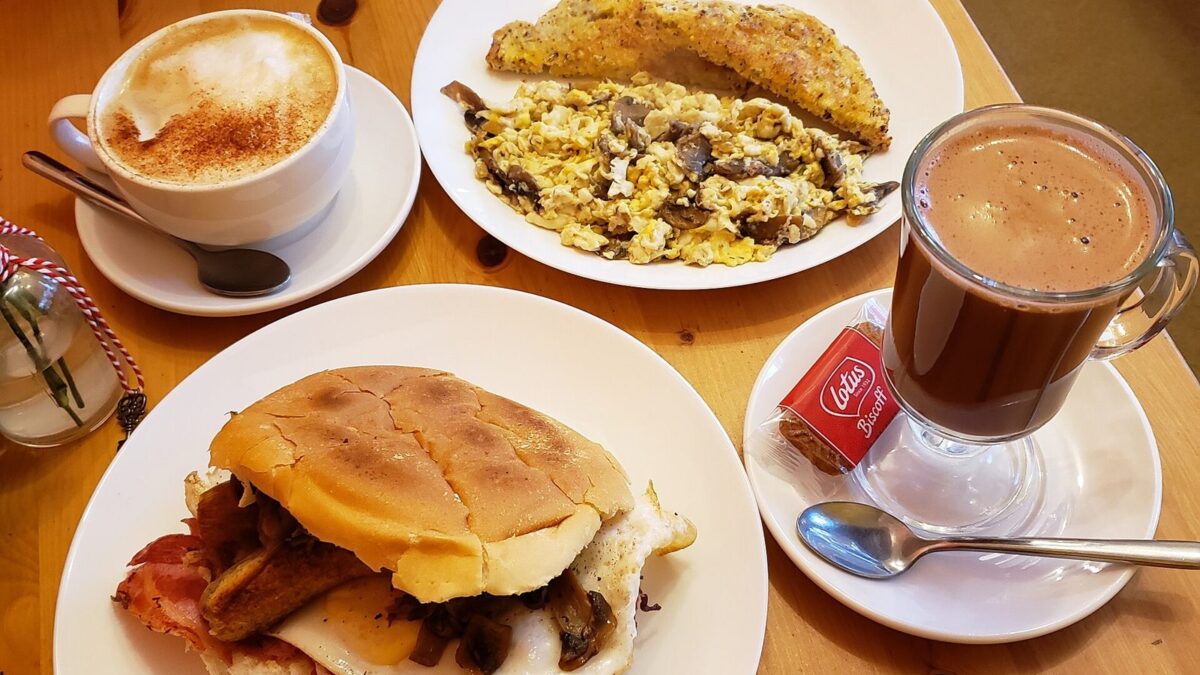
Should You Put Milk in Scrambled Eggs?
A little, yes — around 1/2 tablespoon per egg, and no more. That’s the question everyone actually types into a search box, and the answers split into two camps that both overstate their case.
What milk does is dilute the protein. Egg proteins set into a network as they heat, and that network is what squeezes moisture out and turns eggs rubbery. Adding liquid puts distance between the proteins, so the network forms more loosely and later, which buys you a wider window between soft and overcooked. Two tablespoons across four eggs is enough to notice.
Go past about 1 tablespoon per egg and you’ve diluted it too far. The proteins can no longer hold that much water, the mixture sets and then weeps, and you get a puddle on the plate. That’s where the “never add milk” camp is coming from, and they’re right about the outcome, wrong about the cause.
Cream behaves better than milk at higher volumes because the fat holds onto the water. Whole milk is what I use, mostly because it’s what’s in the fridge door at 7am.
Ingredients
- 4 large eggs
- 2 tablespoons whole milk or cream
- 1/4 teaspoon salt
- Pinch of black pepper
- 1 tablespoon unsalted butter
- 1 tablespoon chopped fresh chives (optional)
- 2 tablespoons grated cheese (optional)
- Extra butter or flaky salt for finishing
- Buttered toast, for serving
Instructions
- Crack the eggs into a bowl, add the milk, salt, and pepper, and whisk thoroughly until the mixture is uniform and slightly frothy with no streaks of white remaining.
- Place a nonstick skillet over low heat and add the butter, letting it melt gently without browning.
- Pour in the whisked eggs and let them sit undisturbed for a few seconds until the very edges begin to set.
- Using a spatula, slowly push the eggs from the edges toward the centre, forming soft, loose folds as you go.
- Keep stirring gently and patiently on low heat, so the eggs form large, creamy curds rather than small dry ones.
- When the eggs are mostly set but still look slightly wet and glossy, take the pan off the heat.
- Stir in any cheese or chives. Residual heat will finish cooking the eggs the rest of the way.
- Slide them onto plates immediately, finish with a little butter or flaky salt, and serve with toast.
How Low Is Low Heat, Really?
Lower than you think, and the test takes two seconds: drop the butter in, and if it sizzles at all, the pan is too hot. It should melt into a pool and sit there without foaming hard.
On my gas hob that’s the second-smallest flame setting. On the induction hob at my sister’s place it’s 3 out of 9. Either way, four eggs should take 5 to 7 minutes from pour to plate. If yours are done in 90 seconds, that’s the whole problem — the curds set faster than you can fold them, and small tight curds are the dry-eggs texture. A microwave forces that speed on you, so eggs scrambled in a mug need their own timings to stay soft.
Give it a minute before you pour. A pan that’s still warming while the eggs cook gives you a hot ring at the edge and a raw pool in the middle.
There’s a second reason to stay this low, beyond texture. Butter starts browning somewhere around 150°C, and browned butter is delicious with a lot of things but it tints scrambled eggs a dull beige and adds a nuttiness that fights the eggs. If the butter has gone past pale yellow before the eggs go in, tip it out and start again — thirty seconds lost, and the alternative is eggs that look like they’ve been sitting under a warmer.
When Should You Salt Them?
In the bowl, before cooking, and ideally a couple of minutes before the pan.
Salt breaks up some of the protein bonds before heat gets a chance to tighten them, which is the same effect the milk is having by a different route. Fifteen minutes of salted resting time gives a measurably softer set, though I’ll admit I rarely plan breakfast that far ahead.
Salting at the end isn’t wrong, it just doesn’t do this. It seasons the surface. If you’re using a salty cheese, hold back the 1/4 teaspoon and season on the plate instead.
Pepper I’d add at the end rather than in the bowl. Ground pepper sitting in a wet mix for fifteen minutes goes slightly bitter, and against eggs this mild you can taste the difference. It’s a small thing, and it’s the kind of small thing that’s free to fix.
Why Do They Go Watery on the Plate?
Because they were overcooked, not undercooked. This one catches people out constantly.
The liquid pooling around your eggs was inside them. Heat contracts the protein network, it squeezes water out, and the tighter the network gets the more it releases. So the fix is counterintuitive: take them off the heat earlier, while they still look slightly too wet in the pan.
The other cause is holding them. Eggs kept warm for even four minutes will weep, because the residual heat keeps working. I learned this hosting a brunch for six — I scrambled a big pan at 10:40 for an 11:00 sit-down and served grey eggs in a puddle. Scramble to order in two batches, or serve them cold-ish. Both beat holding.
Can You Get Fluffy Eggs Without a Nonstick Pan?
Yes, and stainless is genuinely better for flavour if you can manage it, because you can use enough butter without the coating limiting your heat.
The technique changes slightly. Heat the empty stainless pan for 60 seconds on low, add double the butter (2 tablespoons for four eggs), swirl to coat the sides as well as the base, and only then pour. Use a silicone spatula and scrape rather than push. Some sticking is normal and it comes away with the fold if the pan is properly buttered.
Cast iron I’d skip for scrambled eggs unless the seasoning on yours is excellent. Mine isn’t, and I’ve scraped enough egg out of it to stop trying.
When Do Add-Ins Go In?
Off the heat, at the end, for anything that melts or wilts fast: cheese, chives, soft herbs. In the pan first, cooked and drained, for anything wet: mushrooms, tomatoes, spinach.
Wet vegetables stirred in raw release their water directly into the eggs, and you get the plate puddle again from a different direction. Spinach in particular — a handful holds a surprising amount of water. Wilt it in the pan first, tip it onto a plate, wipe the pan out, then cook the eggs and fold the spinach back in at the end.
Cheese is worth being fussy about. Grated cheddar folded in off the heat melts in about 20 seconds into ribbons. The same cheese added at the start goes stringy and pulls the curds tight around it.