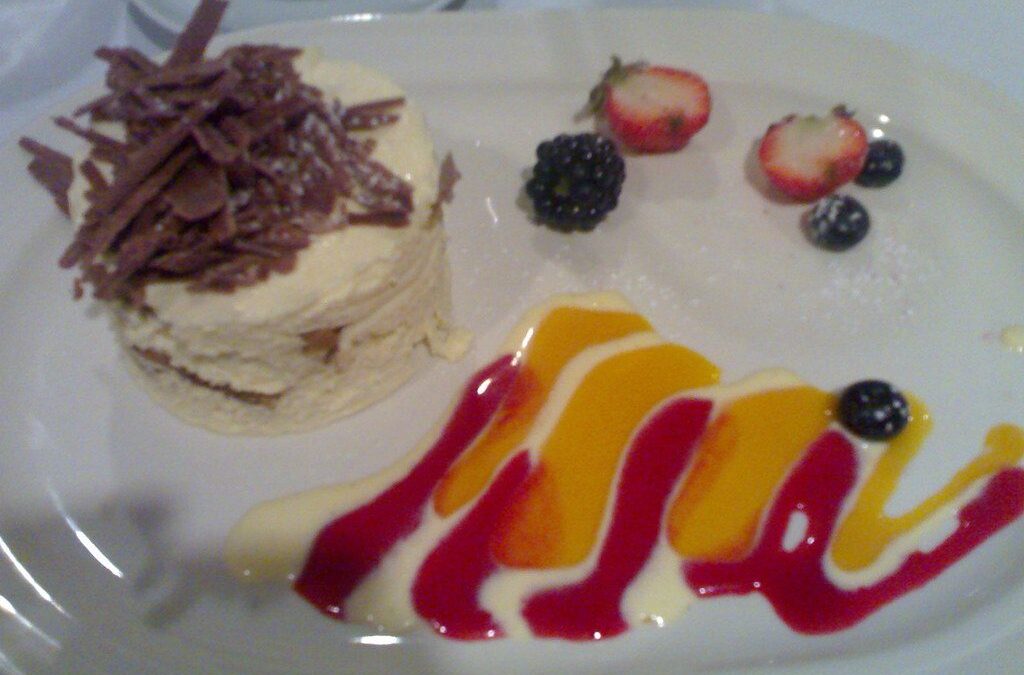
No-bake tiramisu is a tray dessert: coffee-dipped savoiardi, mascarpone cream, six hours in the fridge, cocoa dusted on at the last second. Nothing goes near an oven. What it does have is a stack of rules passed around so often that nobody checks them any more, and four of the loudest ones are wrong.
I’ve made this in an 8 by 8-inch dish more times than anything else in my kitchen, mostly because it’s the dessert I can start at nine at night and then forget about. If you want the individual glasses instead, same cream but assembled upright and chilled faster, that’s my tiramisu cups recipe. This page is the tray, and the tray fails in its own particular ways.
The raw-egg rule that isn’t a rule
Myth one: real tiramisu uses raw yolks, and warming them makes it inauthentic.
The yolks are there to thicken and enrich, and both jobs happen whether the yolk is raw or gently cooked. Whisking yolks and sugar over barely simmering water for 6 to 8 minutes, until it turns pale, falls in ribbons and feels properly warm against your knuckle, is a zabaglione base. Old Italian technique, not a modern safety fudge, and it makes a thicker, more stable cream. Mine still cuts a clean edge on day two; the raw version I used to make would slump onto the plate by then.
The safety part, stated plainly: raw and lightly cooked eggs can carry salmonella, and food safety agencies advise pregnant people, young children, older adults and anyone immunocompromised to avoid them. If you skip the warming step, use pasteurised eggs. Cooking the yolks over water removes the question altogether, which is why the method below does it.
The texture cost? I can’t taste one. The real cost is four extra minutes of whisking and one more bowl.
Mascarpone isn’t whipped cream, so stop whipping it
Second myth: beat the mascarpone until light and fluffy.
Don’t. Mascarpone runs around 40 to 45 percent fat and arrives thick from the tub. Beating it hard does roughly what beating cream past stiff peaks does: the fat clumps, water squeezes out, and you get a grainy cream that weeps at the edges. Folding won’t bring it back. I split a tub exactly once with a stand mixer on medium, and once was enough to make this a by-hand step forever.
Use it cold, straight from the fridge, and whisk it into the cooled yolk base just until smooth. Fifteen seconds is usually the whole job. If it starts looking shiny and separated, stop immediately and fold through a spoonful of the whipped cream, which sometimes rescues it.
The lightness comes from the separately whipped cream folded in afterwards, in two additions, with the same gentle cut-and-turn motion you’d use for a chocolate mousse. Stir it and you knock out the air you just spent three minutes putting in.
Cream cheese is not a swap, and here’s what it does instead
Third myth, and the substitution I get asked about most: can I just use cream cheese?
You can, but call the result something else. Cream cheese sits near 33 percent fat, it’s cultured so it tastes tangy, and most supermarket blocks carry stabilising gums that set it firmer. Mascarpone is barely cultured, sweeter and much softer. Swap one straight across and you get a dessert that tastes faintly of cheesecake and slices like one.
If cream cheese is genuinely all you have, bring it fully to room temperature, beat in 2 tablespoons of heavy cream per 8 oz to loosen it, and cut the chilling short by an hour because it firms up faster. And if a cheesecake-leaning dessert was what you wanted anyway, make the real thing rather than a hybrid that satisfies neither.
Ingredients
- 1 1/2 cups strong brewed espresso or very strong coffee, cooled
- 2 tbsp coffee liqueur or dark rum (optional)
- 4 large egg yolks
- 1/2 cup granulated sugar
- 16 oz mascarpone cheese, cold
- 1 cup heavy cream, cold
- 1 tsp vanilla extract
- 1 package (about 24) Italian ladyfingers (savoiardi)
- 2 tbsp unsweetened cocoa powder, for dusting
- Dark chocolate shavings, for garnish (optional)
- A pinch of salt
Instructions
- Brew the espresso and let it cool completely, then stir in the liqueur if you’re using it. Pour it into a shallow dish wide enough to lay a whole ladyfinger flat.
- Set a heatproof bowl over a pot of gently simmering water, the base not touching the water. Whisk the yolks, sugar and a pinch of salt for 6 to 8 minutes, until pale, thick and warm to the touch. This is the step that cooks the yolks.
- Take the bowl off the heat and let it cool for a few minutes. Add the cold mascarpone and whisk by hand just until smooth, about fifteen seconds. Stop the moment there are no lumps.
- In a separate bowl, whip the cream with the vanilla to stiff peaks. Fold it into the mascarpone mixture in two additions.
- Dip each ladyfinger into the coffee, one second per side, and lay it straight into the dish. It should still feel firm in the middle.
- Arrange a single layer of dipped ladyfingers across the bottom of an 8 by 8-inch dish, snapping them to fit the gaps. Spread half the cream over the top.
- Repeat with a second layer of dipped ladyfingers, then spread the remaining cream smooth.
- Cover and refrigerate at least 6 hours, ideally overnight. Dust with cocoa through a fine sieve immediately before serving, and add chocolate shavings if you like.
Weak coffee is why tray tiramisu turns to paste
Fourth myth: any coffee will do, just dip a little longer to make up for it.
This is where the tray version dies. Savoiardi are dry, porous sponge fingers engineered to drink liquid, and what matters isn’t which coffee you used but how much water ends up inside them. Weak coffee makes you dip longer chasing flavour. More water, softer base, and by morning the bottom layer is paste.
Espresso, or coffee brewed at roughly double normal strength, lets you get the flavour in with a one-second dip per side. I count it out loud, one on each side, and the finger goes into the dish still stiff through the middle. It keeps softening for the next six hours whether you want it to or not.
Instant works if you make it strong, around 2 tablespoons of granules to 1 1/2 cups of hot water. Not as good, but better than weak filter coffee, which is the worst of the three options.
Six hours, not twenty-four
Last myth: it needs a full day.
It doesn’t. The fridge time is doing two things, letting the savoiardi pull moisture from the cream until they turn cake-soft, and letting the cream firm enough to hold a slice. Six hours does both. I cut into a tray at five once and it tasted right but the edges sagged when I lifted the first piece out.
Overnight is better, mainly because the coffee and cocoa settle into each other. Past about 36 hours it goes the other way and the bottom layer turns genuinely wet. Make it the night before, not two nights before. For a fridge-set tray dessert that actually improves on day two, banana pudding is the one.
The cocoa is the one part that can’t be done ahead under any circumstances. Sieve it over at the table if you can. Cocoa dusted even two hours early pulls moisture out of the cream and turns from powdery to damp and blotchy, which is the difference between a dessert that looks homemade and one that looks like you meant it.