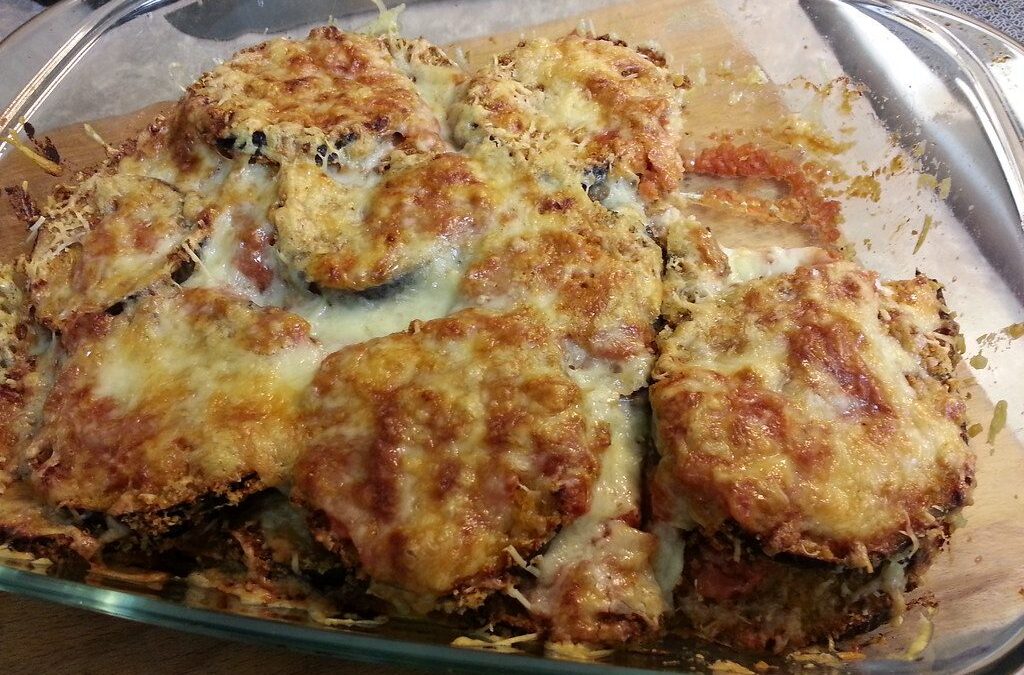
Every problem with baked eggplant parmesan is a water problem. Not the sauce, not the cheese ratio, not the oven temperature. Water, coming out of the aubergine at the wrong moment, into a dish that has nowhere to put it.
A medium aubergine is somewhere north of 90 percent water by weight. When I salted and drained 1.4 kg of sliced aubergine on a tray last summer and squeezed the paper towels out over a measuring jug, I got a bit over 60 ml. That’s a quarter of a cup of liquid that would otherwise have ended up under my bottom layer. And salting alone doesn’t get all of it out, which is the part most recipes skip past.
Prep: 30 mins Cook: 45 mins Serves: 6
The Water Problem, Measured
Here’s the sequence that actually happens in the oven. The aubergine slices sit in sauce. Heat drives the remaining moisture out of them. The sauce, already 80-odd percent water itself, can’t absorb any more, so the excess runs downhill and collects at the bottom of the dish. Your bottom layer sits in it, the breading (if you used any) dissolves into it, and when you cut a square the whole thing slumps sideways onto the plate.
The fix isn’t one thing. It’s removing water in two separate passes, because salting and roasting take out different water in different ways.
Salting and Roasting Do Different Jobs
Salting is osmotic. You put salt on the cut surface, the salt draws free water out of the cells, and it beads on the surface where you can blot it away. Twenty minutes with about 1 teaspoon of salt spread over 3 lbs of slices gets you most of what salting is going to give you; I’ve left them 45 minutes and got maybe another 10 ml for the trouble, plus slices that needed rinsing because they’d gone too salty.
Roasting is evaporative, and it does something salting can’t: it collapses the spongy cell structure. Raw aubergine is full of air pockets. That’s why a raw slice dropped in a pan of oil will drink an alarming amount of it. Roast the slices at 425F and those pockets deflate, the flesh goes from white and squeaky to translucent and silky, and what’s left won’t take on much more of anything.
Do both. Salt for 20 minutes and blot properly, then roast for 20 to 25 minutes. Skipping the salt and just roasting gives you a decent dish that weeps a little. Skipping the roast and just salting gives you a soupy one.
One caveat: modern aubergines are bred far less bitter than they were. Salt for the water, not the bitterness.
Why Breading Drinks Oil
The traditional version dredges each slice in flour, egg and breadcrumb, then fries it. It’s delicious and I’m not going to pretend otherwise. But the breading is doing two things at once and they fight each other.
Breadcrumb is dry and porous, so in hot oil it crisps beautifully. Underneath it, though, is raw aubergine still full of air pockets and water. As the slice cooks, the water inside turns to steam and pushes outward through the crust, and oil moves inward to take its place. That’s the swap that makes fried aubergine heavy: it isn’t absorbing oil through the surface so much as trading water for it.
Then the coated slice goes into sauce for half an hour and the crust you just built goes soft anyway. You’ve paid the oil cost and lost the crunch.
So the crunch goes on top instead, where it stays dry: panko tossed with a spoonful of olive oil and a little parmesan, scattered over the final layer and baked uncovered.
Ingredients
- 3 medium eggplants (about 3 lbs / 1.4 kg), sliced into 1/2-inch rounds
- 3 tbsp olive oil, for roasting
- 1 tsp salt, plus more for drawing out moisture
- 3 cups marinara sauce, good jarred or homemade
- 2 cups shredded low-moisture mozzarella
- 1 cup grated parmesan, divided
- 1 cup whole-milk ricotta (optional, for creaminess)
- 3 garlic cloves, minced
- 1/2 tsp dried oregano and a pinch of red pepper flakes
- 1 cup fresh basil leaves, torn
- 1/2 cup panko breadcrumbs, for the topping
Instructions
- Lay the slices in one layer on a tray or two, sprinkle with salt on both sides, and leave 20 minutes. You’ll see beads form within about 8 minutes. Blot each slice firmly with paper towel; press, don’t wipe.
- Heat the oven to 425F. Brush both sides with the olive oil, spread across two sheets without overlapping, and roast 20 to 25 minutes, flipping at the halfway mark, until the slices are floppy, translucent at the edges and browned in patches. Pale slices mean they aren’t done.
- While they roast, warm the marinara with the garlic, oregano and red pepper flakes over low heat for 10 minutes. It should be thick enough that a spoon dragged through leaves a track for a second.
- Drop the oven to 375F. Spread a thin layer of sauce over the base of a 9 by 13-inch dish, no more than about 1/2 cup, just enough to stop sticking.
- Lay half the roasted aubergine over the sauce, overlapping slightly. Spoon over more marinara, dot with ricotta if you’re using it, then scatter mozzarella, parmesan and torn basil.
- Repeat with the remaining aubergine, sauce and cheese. Toss the panko with a spoonful of olive oil and a little parmesan and scatter it evenly over the top.
- Bake uncovered for 25 to 30 minutes, until the sauce bubbles slowly at the edges and the top is deep golden.
- Rest 10 to 15 minutes before cutting. This is not optional if you want clean squares.
Layer Order, Bottom to Top
The bottom layer is the one that has to be built differently, and it took me three tries to work out why.
Sauce goes down first, but only a thin film. My instinct used to be a generous layer so nothing stuck, and that layer is exactly where the weeping liquid pools. Half a cup across a 9 by 13 dish is plenty. Aubergine on top, slices overlapping like roof tiles rather than laid flat with gaps, so the layer holds together when you cut it.
Cheese goes between the layers and on top, never on the bottom, where its own melted moisture has nowhere to evaporate to.
The dry topping goes on last and uncovered, always. Cover this dish with foil and you’ve built a steam chamber: every bit of water you spent an hour removing condenses and drips straight back in. The only time I cover it is when it’s coming out of the freezer and the top is browning faster than the middle is heating.
The same tile-and-thin-sauce logic applies to any layered bake. It’s the reason a good beef lasagna holds its edge on the plate while a rushed one spreads.
Reading the Dish While It Bakes
At about 20 minutes, look at the edges rather than the middle. You want slow, thick bubbles breaking every second or two. Fast thin bubbling means the sauce is loose, and it will still be loose on the plate.
If that’s what you see, pull the dish, tilt it carefully over the sink with a spatula holding the top in place, and pour off what runs to the corner. I’ve done this more than once and nobody has ever noticed. Then return it uncovered for the remaining time.
Panko goes from pale to properly coloured in the last 6 or 7 minutes. I’ve burnt it exactly once, by walking away.
Cheeses That Put Water Back In
Fresh mozzarella in a ball of brine is roughly 55 to 60 percent water. Low-moisture shredded mozzarella sits nearer 45. Across two cups, that difference is real, and it lands in your dish.
Use low-moisture for the body of the bake. If you love the stretch of fresh mozzarella, tear it, spread it on paper towel for 15 minutes, and use it only on the top layer where it can lose water to the air.
Ricotta is optional and I go back and forth. Straight from the tub it’s often sitting in its own whey; tip that off, or give it 15 minutes in a fine sieve. Dot it, don’t spread it, so it stays as pockets. Parmesan adds no water at all and a lot of savour, and it’s the one I’d increase rather than cut.
If Yours Still Pooled
Work backwards through four things, in this order: was the aubergine actually browned, or just cooked? Was the dish covered? Was the bottom sauce layer thin? Was the mozzarella fresh rather than low-moisture? In my kitchen, ninety percent of the time it’s the first one. Under-roasted aubergine is the usual culprit and it’s easy to do, because the slices look done at 15 minutes and aren’t.
Rescue at the table: lift each portion out with a fish slice and hold it over the dish for a count of three so the liquid drains back. Then serve bread that can do some work. Cheesy garlic bread or a slab of rosemary focaccia turns the problem into a feature. And if you’d rather skip the water management entirely, mushroom and spinach risotto gets you the same savoury comfort in one pan with nothing to drain.