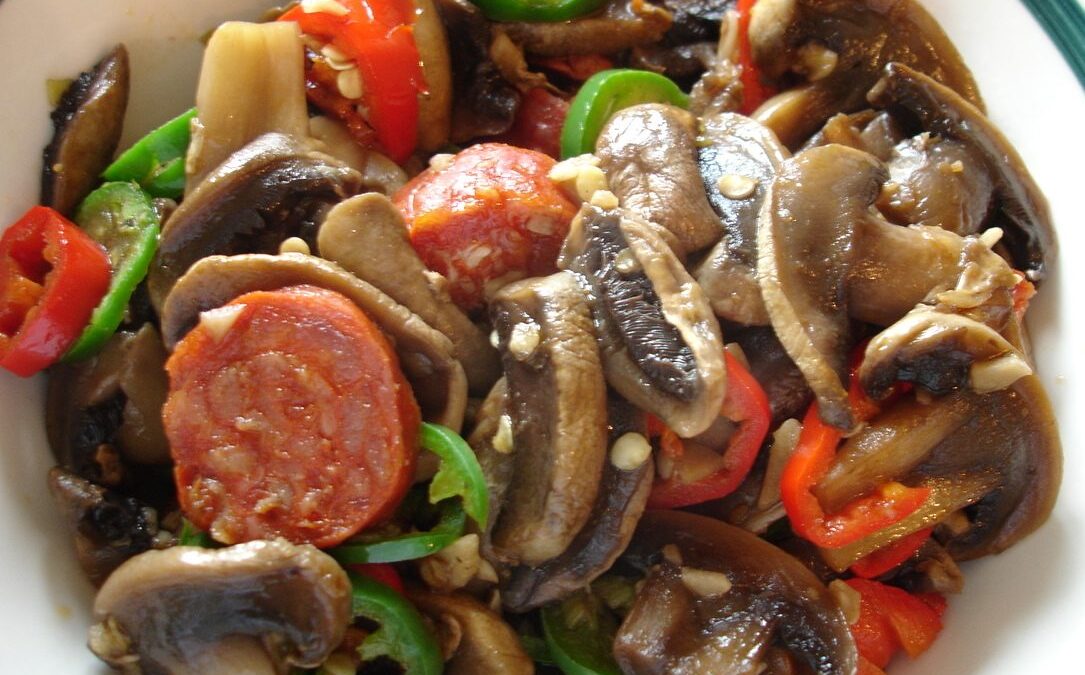
The first tray I was proud of came out of the oven looking like it had been rained on. Six sausages, split down their sides and grey where they weren’t beige. Two red peppers I’d chopped into neat little squares, now sitting in a puddle of their own liquid about as deep as a fingernail. Everything cooked. Nothing browned.
I’d pricked the sausages. I’d diced the peppers small so they’d cook evenly. I’d put the tray in a cold oven with everything already on it. Every single one of those decisions felt sensible at the time and every one of them was the reason for the puddle.
It took me about four more trays to work out what was actually happening, and the fix turned out to be less about the recipe and more about where the moisture and the fat go. Once I understood that, this became the thing I make on a Tuesday when I’ve got no plan and forty minutes.
The puddle problem, explained
Peppers are roughly 92% water. When you cut them into small dice, you create an enormous amount of cut surface for their size, and every one of those cut faces is a place for water to come out. The pieces sit close together in the tray, the water pools, and the tray temperature drops to whatever boiling water sits at. Nothing above 100C means nothing browns. You’ve made steamed peppers in a roasting tin.
The pricked sausages made it worse in a way I hadn’t expected. A sausage skin is a container, and the fat inside it renders slowly and comes out through the ends and through wherever the casing gives. Prick it in eight places and the fat leaves early and fast, before the tray is hot enough to use it. What you want is that fat arriving on a hot tray, meeting pepper skins, and doing the browning for you. Pricked sausages give you the fat at the wrong time and dry meat as a bonus.
So: don’t prick them. I know the instruction is on half the packets I’ve bought. Ignore it. A sausage that bursts in the oven has usually been cooked too fast at the start, not because you failed to vent it.
Cutting for contact, not for tidiness
Cut each pepper into flat strips about 3cm wide. Not batons, not dice — wide flat pieces, cut so they can lie down on the metal. A strip that lies flat has one whole face pressed against a hot tray, and that face is where the colour comes from. Diced pepper touches the tray at a corner.
Onions I now cut into wedges through the root, six per medium onion, thick enough that each wedge is about 2cm across at its widest. Thinner than that and they collapse into strands and burn at the edges while the sausages are still pink inside. The root end holding the layers together is doing real structural work here, so cut through it rather than around it.
Same instinct I use for a roasted vegetable medley: bigger pieces, more space, hotter tray. Denser vegetables shift the timing, which is why sausages roasted with parsnips and carrots want a staggered start.
Ingredients
- 6 pork sausages (about 400g), the coarser and fattier the better
- 3 bell peppers (I use 2 red, 1 yellow), cut into flat strips about 3cm wide
- 2 medium onions, cut through the root into 6 wedges each
- 3 tbsp olive oil
- 1 tsp fennel seeds, lightly crushed under the flat of a knife
- 1 tsp dried oregano
- 1 tsp flaky salt, plus a pinch at the end
- Black pepper
- 1 tbsp red wine vinegar (sherry vinegar also works, cider vinegar is a bit sweet for this)
Instructions
- Put your largest metal roasting tray into the oven and set it to 220C fan-off (200C fan). Let the tray heat for a full 15 minutes after the oven says it’s ready. This is the step people skip and it’s the one that matters most.
- While it heats, toss the peppers and onion wedges in 2 tbsp of the oil with the fennel seeds, oregano, salt and a good grind of pepper. Rub the remaining 1 tbsp over the sausages.
- Pull the hot tray out. It should hiss when the first pepper lands. Lay the vegetables out in a single layer with a bit of breathing room, then tuck the sausages in between them, seam side down, not touching each other.
- Roast 15 minutes without opening the door.
- Turn the sausages, shuffle the peppers so any pale faces meet metal, and roast another 12 to 15 minutes.
- Check a sausage at its thickest point with a probe. You want 71C / 160F. If the peppers need more colour and the sausages are done, lift the sausages onto a plate and give the tray another 5 minutes alone.
- Take the tray out, move the sausages to a plate, and pour the vinegar straight onto the hot metal where the brown sticky patches are. It’ll spit. Scrape those patches loose with a wooden spoon and toss the vegetables through the liquid until the tray looks clean.
- Sausages back in, a last pinch of flaky salt, and serve straight from the tray.
Why the vinegar goes in last
Those dark patches welded to the tray are the best-tasting thing in the whole dish and most of the time they go into the sink. A tablespoon of vinegar hitting metal at that temperature loosens them in about four seconds, and the peppers soak it up like they were built for it.
Add the vinegar earlier and you’ve just added liquid to a tray you spent forty minutes trying to keep dry. Timing is the entire trick.
I once tried lemon juice instead. Fine, but it goes soft and vague after a minute or two, where vinegar keeps a sharp edge that cuts the sausage fat. Red wine vinegar is my default.
Things I got wrong for longer than I’d like
I used a glass dish for about a year. Glass is slow to heat and it never gave me that hiss, so the vegetables started steaming before they started roasting. Switching to a plain steel tray changed more than any ingredient swap I tried.
I also used to line everything with parchment. It keeps the tray clean and it also keeps the fond off the tray, which means there’s nothing to deglaze. Wash the tray. It’s worth it.
And I salted the peppers half an hour ahead once, thinking I was being organised. Salt pulls water out. They went into the oven already wet. Salt them as they go in, not before. If the difference between salt types is bugging you, I wrote up what actually changes between kosher, table and flaky salt.
What I’d change next time
More onion. Every time I make this I wish I’d done three onions instead of two, because the wedges that catch at the edges go sweet and slightly jammy and they’re gone off the tray before anything else.
I’d also stop making it for four people on one tray. Two trays, swapped between shelves halfway, beats one crowded tray every time — crowding is just the puddle problem wearing a different hat.
If you want something on the side, a sharp creamy coleslaw works better than a starch here, or cheesy garlic bread if you’re feeding teenagers. And if the 71C number is the part you’re least sure about, keep a plain chart of meat thermometer temperatures somewhere near the oven. I check every sausage. Every time. Cheap insurance against the grey tray.