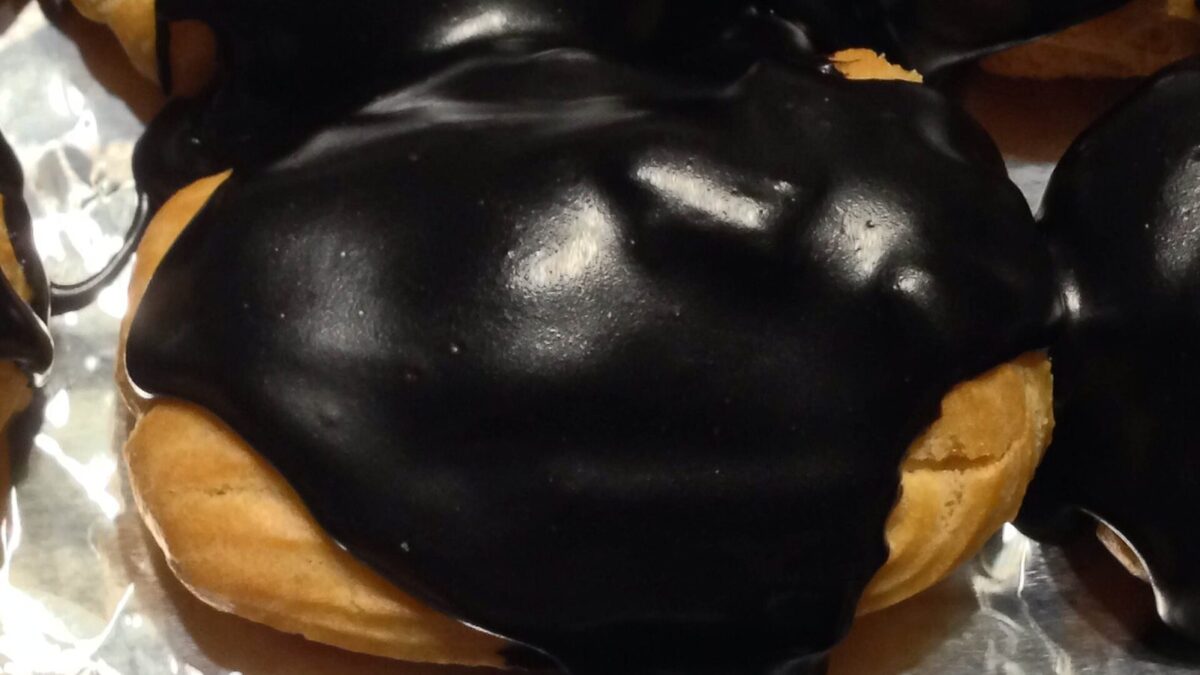
My first tray of eclairs came out of the oven looking like tongue depressors. Flat, matte, barely browned, and when I broke one open there was no hollow at all — just a damp, custardy crumb filling the space where the pastry cream was supposed to go. I had followed a recipe. I had weighed things. And I still had twelve useless fingers of pastry cooling on a rack at half past eleven at night.
The thing I had skipped was about ninety seconds of stirring.
Choux is one of the few doughs in a home kitchen that tells you when it is ready, and you have to be willing to stop counting eggs and actually look at it. Every recipe hands you a number — four eggs, usually. The dough does not know about the number. Some days it wants three and a half.
Prep runs about 40 minutes, the bake is 30, and the custard needs two hours in the fridge before anything gets assembled. Makes 12 eclairs roughly five inches long.
Three bad trays, and what each one was actually telling me
The flat tray was a wet paste problem. I had brought the water and butter to a boil, dumped the flour in, stirred until it looked like a ball, and stopped there because it looked done. It was not done. That ball still holds a lot of water, and water you leave in the paste is water that cannot turn into steam and lift the shell. You have to keep the pan on the heat and keep stirring for another minute or two until a thin film of dried dough starts to grey the bottom of the pan. That film is the whole tell. No film, no hollow.
The second tray puffed beautifully and then sank. I had opened the oven at the 18-minute mark to rotate the sheet, felt very pleased with the tall golden logs I saw, closed the door, and came back to twelve deflated slippers. Choux inflates on steam pressure and the walls are still soft protein and starch until quite late in the bake. Let the pressure out early and the walls fold in. I do not open the door before 25 minutes now, however much I want to.
The third tray spread sideways into blobs. Too much egg. I had added the fourth one out of obedience to the recipe, the paste went from thick and glossy to slack, and slack paste flows before it sets. I now break the fourth egg into a cup, beat it, and add it a spoonful at a time.
Ingredients
- 1 cup water
- 1/2 cup unsalted butter, cubed
- 1 cup all-purpose flour
- 1/4 teaspoon salt
- 4 large eggs, at room temperature
- 2 cups whole milk
- 1/2 cup granulated sugar
- 4 large egg yolks
- 1/4 cup cornstarch
- 2 teaspoons vanilla extract
- 4 ounces semisweet chocolate, chopped
- 1/2 cup heavy cream
- 1 tablespoon light corn syrup (optional, for shine)
Instructions
- Start with the custard so it has time to chill. Heat the milk in a saucepan until it steams and you see the first small bubbles at the edge, around 180°F. Meanwhile whisk the sugar, egg yolks and cornstarch in a bowl until pale and smooth with no dry pockets of starch.
- Pour about a third of the hot milk into the yolk mixture in a slow stream, whisking hard, then tip the lot back into the pan.
- Cook over medium heat, whisking constantly and getting into the corners of the pan, until it thickens to a pudding and you see two or three lazy bubbles break the surface. Cornstarch needs that boil to reach full thickness, so do not pull it off at the first sign of body.
- Stir in the vanilla, scrape into a bowl, press cling film flat onto the surface so no skin forms, and refrigerate at least 2 hours.
- For the pastry, bring the water, butter and salt to a full rolling boil in a medium saucepan. Take it off the heat, add all the flour at once, and stir hard with a wooden spoon until it comes together in one lump.
- Put the pan back on medium heat and keep stirring and smearing the dough against the base for 1 to 2 minutes, until a thin dry film greys the bottom of the pan and the dough smells faintly like a fresh chapati. This is the drying step. It is the difference between a hollow shell and a solid one.
- Tip the dough into a bowl and let it cool for 5 minutes, stirring occasionally, until it is warm rather than hot. Too hot and the next egg scrambles.
- Beat in three eggs one at a time, letting each one disappear completely before the next goes in. Beat the fourth egg in a cup and add it a spoonful at a time. Stop when the dough is glossy and falls off the spoon in a thick ribbon that slowly folds back into itself, and when a spoon dragged through leaves a valley whose walls sag but do not close. If you have not used all the egg, that is fine.
- Pipe five-inch logs onto a lined baking sheet with a half-inch plain or star tip, leaving two inches between them. Flatten any peaks with a wet fingertip, because a peak is the first thing to scorch.
- Bake at 400°F for 25 to 30 minutes, without opening the door, until they are deeply golden and feel firm and light when you tap one. Pale shells are wet shells.
- Pierce each shell once at the end with the tip of a knife, turn the oven off, and leave them inside with the door propped ajar on a wooden spoon for 10 minutes. This vents the steam that would otherwise soften them on the rack.
- Cool completely. Poke a hole at each end and pipe in the chilled custard, whisked smooth first, until the shell feels heavy and custard begins to push back at the hole.
- Warm the cream to just below a simmer, pour it over the chopped chocolate, wait a minute, then stir from the middle outwards until glossy. Add the corn syrup for shine. Let it cool to lukewarm, then dip each eclair top and set them aside for 20 minutes to firm.
The two steps everything actually hinges on
Drying the paste, and adding the last egg by eye. Nothing else in this recipe is difficult.
On the drying: you are evaporating water and gelatinising starch at once. I go by the pan film, but the paste also changes in the hand — it stops being sticky and comes away from the spoon in one clean mass. Two minutes on a medium flame is right in my kitchen with a heavy-bottomed pan. On a thin pan it happens faster and scorches, so keep it moving.
On the egg: stiff dough gives short, cracked shells that hollow poorly. Loose dough spreads and bakes into a flat oval. The window between them is maybe half an egg wide, which is exactly why the recipe number fails so often. Flour absorbs different amounts of water depending on how it was measured and how humid the day is. In July I have needed three eggs. In January I have used all four and wanted a splash more.
The ribbon test is the reliable one. Lift the spoon. The dough should hang, stretch, and drop off in a thick V after two or three seconds. If it slides off straight away you have gone too far, and the only fix is a small extra batch of paste with no egg beaten back in.
What I would change if I made these tomorrow
Make the custard the day before, not the same morning. Two hours is the minimum, but overnight gives a firmer cream that stays put inside the shell instead of leaking back out of the piping holes twenty minutes later. Whisk it smooth first; it sets solid and looks broken until you beat it, which alarmed me the first time.
Use a star tip rather than a plain one. The ridges give the shell somewhere to expand along, and my star-piped eclairs crack far less on top. Small thing, consistently true in my oven.
And fill them later than feels comfortable. Filled eclairs hold about four hours before the shell goes leathery from the inside. If you are taking them somewhere, carry shells and custard separately and fill on arrival — five minutes of work, and the difference in that first crackle is not subtle. Unfilled shells keep a day in a paper bag or a month in the freezer; five minutes at 300°F brings them back.
If choux has put you off, the same custard is the base for a fresh fruit tart, which asks nothing beyond a pastry case, and silky chocolate mousse or a set-and-forget crème brûlée gets you to the same place with a fraction of the standing. What I would not do is attempt eclairs for the first time on the morning of a party. Try them on a quiet Tuesday, ruin a tray, learn the pan film.