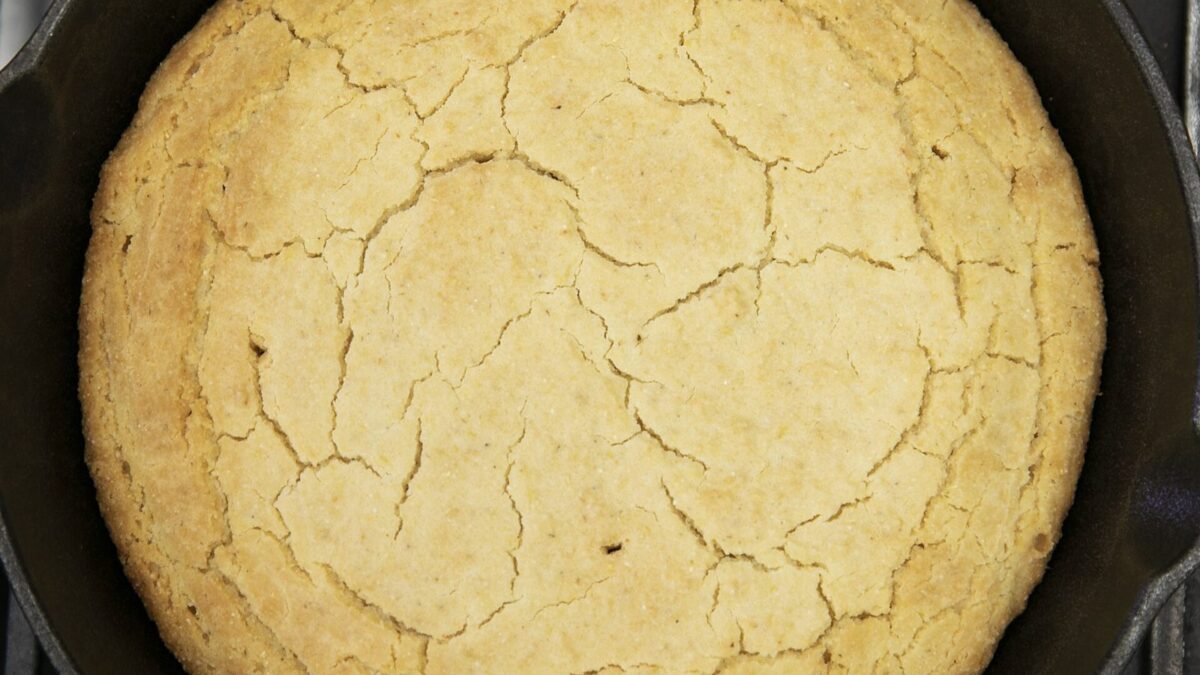
Cornbread starts more arguments than anything else I bake. Put sugar in it and somebody tells you it’s cake. Bake it in a glass dish and somebody tells you it doesn’t count. I’ve made this recipe in a 10-inch skillet, in an 8-inch square aluminium pan, and once in a loaf tin because everything else was in the sink, and the loaf tin version was fine. Slightly pale on the sides. Still gone by dinner.
Three claims get repeated harder than the rest. Two of them are wrong about how the bake actually works. The third isn’t wrong at all, it’s a preference dressed up as a rule, and pretending otherwise does nobody any favours.
The Sugar Argument Is Regional, Not Right-Versus-Wrong
Traditional Southern cornbread is unsweetened. White cornmeal, buttermilk, often bacon fat instead of butter, sometimes no flour at all, baked in a screaming-hot skillet and served as a savoury bread next to beans and greens. Sugar in that context genuinely does taste out of place, the way sugar in naan would.
Northern-style cornbread came out of a different tradition and a different pantry: more wheat flour, yellow cornmeal, a couple of spoons of sugar, closer to a tender quick bread. Both are old. Neither one is a corruption of the other.
What sugar actually does here is worth knowing, because it decides how much you can cut. It’s hygroscopic, so it holds onto water and keeps the crumb soft on day two. It also browns: the top of a sweetened cornbread goes deep gold several minutes earlier than an unsweetened one at the same 400F. At the quarter-cup in this recipe, spread across a 9-inch round, sugar is not doing structural work. You can drop it to 1 tablespoon and skip the honey and nothing collapses. Bake it about 2 minutes less, because without the sugar the top browns slower and you’ll be tempted to leave it in too long.
I went through a stretch of making the low-sugar version every week to eat with a pot of beef chili, and honestly, next to chili it is better. Next to butter and honey at breakfast, the sweeter one wins. That’s the whole argument. It’s about what’s on the plate beside it.
Cast Iron Isn’t Magic, Preheating Is
The skillet doesn’t season the bread. What it gives you is a hot, fat-slicked metal surface, so the outer millimetre of batter fries on contact instead of slowly steaming. That crust is the entire reason people love skillet cornbread, and it comes from heat capacity plus preheating, not from iron itself.
So you can get most of the way there in other pans. An 8-inch square aluminium cake pan, preheated 10 minutes with a tablespoon of butter dropped in just before the batter, gives a genuinely good crust. Not identical: cast iron holds close to 400F when cold batter lands on it, so the sizzle runs 30 seconds or more, while thin aluminium drops fast and the sizzle stops almost at once.
The sizzle is your test. Pour, listen. No sound, no crust.
Glass and ceramic are a different case. Do not preheat them empty and then pour cold batter in — thermal shock is a real risk with tempered glass, and manufacturers say so. Grease them cold, accept a paler, softer edge, and add 3 to 5 minutes to the bake because glass conducts heat lazily. Nonstick, meanwhile, shouldn’t be run empty in a hot oven at all; grease it cold and take the softer crust.
Cornmeal Is Not One Ingredient
This is the myth that actually costs people a good bake, and nobody argues about it because most don’t know there’s anything to argue about.
Grind size changes the crumb more than any substitution in the recipe. Fine cornmeal hydrates almost instantly and gives a tight, close, slightly cakey texture. Medium grind is what these quantities assume and what most bags labelled simply “cornmeal” in the US contain. Coarse or stone-ground needs help: whisk it into the buttermilk on its own and let it sit for 20 minutes before you add anything else, or the hull stays hard and the finished bread reads as gritty rather than tender.
Then processing. Degerminated cornmeal, the supermarket default, has had the germ removed, which is why a bag lasts a year in the cupboard. Whole-grain stone-ground keeps the germ, tastes far more of corn, and goes rancid — I keep mine in the freezer in a zip bag and use it inside three months. If a bag smells faintly like old paint, it’s gone, and no amount of honey covers that.
Two things sold near cornmeal that aren’t cornmeal: masa harina is nixtamalised, treated with lime, and tastes emphatically of tortillas. And British cornflour means cornstarch, a white thickener with no corn flavour and no structure — a straight swap on that name gives you a gummy, sunken tray. US corn flour is just very finely milled cornmeal and does work, one for one, for a dense cakey result. Polenta is usually coarse cornmeal in a smarter bag; give it the 20-minute soak.
Ingredients
- 1 cup yellow cornmeal, medium grind
- 1 cup all-purpose flour
- 1/4 cup granulated sugar
- 1 tablespoon baking powder
- 1/2 teaspoon baking soda
- 3/4 teaspoon salt
- 1 cup buttermilk
- 2 large eggs
- 1/3 cup melted butter, plus extra for the pan
- 2 tablespoons honey
Instructions
- Preheat your oven to 400 degrees F. If using a cast-iron skillet, place it in the oven to heat while you mix.
- In a large bowl, whisk together the cornmeal, flour, sugar, baking powder, baking soda, and salt.
- In a separate bowl or measuring cup, whisk the buttermilk, eggs, melted butter, and honey until smooth.
- Pour the wet ingredients into the dry and stir just until combined. A few small lumps are fine; do not overmix.
- Carefully remove the hot skillet from the oven and add a pat of butter, swirling to coat the bottom and sides. If using a baking dish, simply grease it well.
- Pour the batter into the pan, spreading it evenly. It should sizzle if the skillet is hot.
- Bake for 20 to 25 minutes, until the top is golden and a toothpick inserted in the center comes out clean.
- Let the cornbread rest in the pan for 10 minutes before slicing, so it sets up and holds together.
Two Things That Wreck It, Neither of Which Anyone Argues About
Letting the batter stand around. The baking soda meets the buttermilk’s acid and starts fizzing the second they touch, and that lift doesn’t wait for you. Have the pan hot and the oven at temperature before the wet hits the dry, then get it in within five minutes. The baking powder is double-acting and will hold some in reserve, but the soda’s contribution is spent by then.
The other one is stirring. Cornbread has a full cup of wheat flour in it, which means it can absolutely develop gluten and turn rubbery. Twelve to fifteen strokes with a spatula, stop while you can still see streaks of dry flour and a few lumps the size of peas. It looks underdone in the bowl. It isn’t.
If your bread has risen barely at all and tastes slightly soapy, your baking powder is dead. Drop a teaspoon into a splash of hot water: it should foam up immediately and vigorously, not just bubble politely.
What I Actually Eat It With
Chili, obviously. But the pairing I’d defend harder is split pea soup — the soup is soft and salty all the way through, and the crust gives it the texture it’s missing. Cut the sugar to a tablespoon for that one.
Leftovers get better treatment than they deserve here: split a wedge, butter both faces, press it in a dry pan over medium heat about 90 seconds a side until the cut edges crisp. Day-three cornbread comes back nicely that way.
If you like this style of quick, no-yeast bread, buttermilk biscuits use the same buttermilk-and-soda logic with cold fat instead of melted, and honey oat bread is where I go when I want something that keeps past the second day.