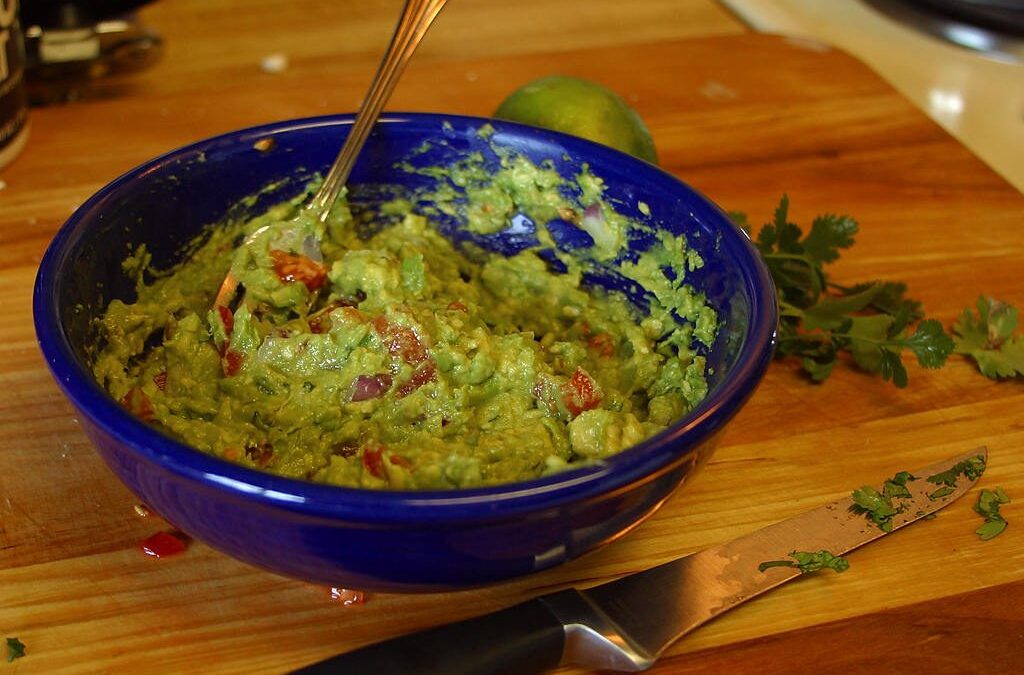
Good guacamole is ripe avocado, lime, salt and restraint. Nearly everything else you have been told about it, including the pit that supposedly stops it browning and the food processor that supposedly makes it better, is either wrong or wildly oversold.
I make this three or four times a month, usually for people who have turned up to watch cricket and will eat a bowl of it in eleven minutes. The batches that vanish fastest are never the elaborate ones. They are the ones where I mashed too little and salted slightly too much.
Prep: 15 mins Cook: none Serves: 4 to 6
The pit trick doesn’t work, and here’s what it actually does
Browning is an enzyme reaction. Polyphenol oxidase in the flesh meets oxygen in the air and turns pale green into grey-brown. There is nothing magical in the stone.
What the stone does is block air from the patch directly underneath it. I have tested this in my own fridge, because I kept being told I was wrong: leave the pit in for three hours, lift it out, and you get one green disc the diameter of the pit surrounded by a dull grey-brown lid. A coaster would do the same job.
Cling film pressed flat onto the surface, out to where the guacamole meets the bowl with no air trapped under it, actually works. Made at 7pm, still green at breakfast.
The other method is water. Smooth the top flat, pour on about a centimetre of cold water, cover, refrigerate up to a day, then tip it off and stir once. The first time I tried it I was sure I would end up with soup. The mash is dense enough that the water just sits there.
Lime juice gets too much credit
Acid slows the enzyme by dropping the pH. It does not switch it off. In an open bowl on my counter with a whole lime already stirred through, the edges start greying at about the forty minute mark. Under pressed cling film with no lime at all, it holds for hours.
Treat lime as flavour that buys you a little time, not as a preservative. One juicy lime, around two tablespoons, for three avocados. Add half, mash, taste, then decide, because an over-limed bowl can only be fixed by adding another avocado.
One thing I’ll be stubborn about: bottled lime juice tastes metallic in something this plain. There is nowhere for it to hide. A fresh lemon beats it.
Tomato and onion don’t belong in every bowl
Guacamole comes from the Nahuatl ahuacamolli, avocado sauce, and plenty of versions in Mexico are avocado, salt, lime, chilli and coriander with nothing else. Tomato is common, not compulsory, and it is usually what wrecks the texture.
A tomato is over ninety percent water. Dice a ripe one in and within twenty minutes there is a puddle at the bottom and the mash has gone loose. If you want it, use a firm plum or Roma, quarter it, scrape out the seeds and jelly with your thumb, and dice only the fleshy walls. One small tomato for three avocados.
My mild heresy: if the avocados are genuinely perfect, skip the tomato. It dilutes the one flavour you paid for. I add it when the avocados are merely fine.
Raw red onion has the opposite problem. Not watery, just harsh, and it gets harsher as the bowl sits. Soak the diced quarter-onion in cold water for five minutes, then drain and pat dry. That removes most of the sulphur burn and keeps the crunch.
How to tell an avocado is ready without bruising it
Stop squeezing them in the shop. Every squeeze bruises the flesh, and those bruises are the black patches you find two days later. It is why the fruit at the front of the display is usually the worst.
Use the stem test. Flick off the small dried nub at the top with your thumbnail and look at the circle underneath:
- Bright green — ripe today.
- Pale yellow-green — a day or two away. Right if you shop Thursday and cook Saturday.
- Brown or streaked — past it. The flesh will have dark threads through it.
- Won’t budge at all — three or four days off.
Backup cue: a ripe Hass feels heavy for its size and its pebbly skin has gone nearly black. That colour rule only applies to Hass. Smooth-skinned varieties like Fuerte stay green when perfectly ripe.
To hurry one along, paper bag with a banana, 24 hours. The fridge halts ripening almost completely. And if only two of your three are ready, make a smaller batch. One firm avocado leaves waxy lumps that never mash in, and you feel every one.
Ingredients
- 3 ripe avocados — Hass for preference, stem test passed
- 1 lime, juiced (about 2 tablespoons), added in two stages
- 1/4 small red onion, finely diced and soaked 5 minutes in cold water
- 1 small plum tomato, seeds and jelly scraped out, flesh diced — optional
- 1 small jalapeno, finely chopped, seeds removed for less heat
- 2 tablespoons fresh coriander, chopped, stalks included
- 1 clove garlic, grated on a microplane so there are no raw chunks
- 1/2 teaspoon salt, plus more to taste
- 1/4 teaspoon ground cumin — not traditional, but I like the warmth underneath and will argue about it
- A pinch of black pepper, freshly ground
Instructions
- Do the onion first. Dice, cover with cold water, leave it while you deal with everything else. Drain and pat dry before it goes in.
- Chop the rest of the aromatics. Tomato, jalapeno, coriander, garlic. All of it before you cut a single avocado.
- Halve and scoop. Knife around each avocado lengthways, twist apart, scoop into a wide bowl. Wide matters; you need room to mash against the side.
- Salt and half the lime, immediately. As soon as the flesh hits the bowl, about a tablespoon of juice.
- Mash with a fork, and stop early. Press against the side, roughly 20 to 30 strokes. Leave a third of it in visible lumps.
- Fold in the aromatics. Fold rather than stir, so the pieces stay separate instead of smearing into the mash.
- Taste, then adjust. The step that decides the bowl. Salt for depth, the rest of the lime for brightness, jalapeno for heat. Taste on a chip, not a spoon, because the salt in the chip changes the answer.
- Rest 5 minutes, then serve. Going in the fridge? Cling film pressed flat, or the centimetre of cold water on top.
Put the food processor down
A processor blade shears the cells open and whips air through the flesh. What comes out is pale, uniform and faintly frothy, and it tastes flatter than the fork version made from the same fruit. Nothing left to chew, and chewing is where you notice the onion and the coriander separately instead of as one beige note.
If you own a molcajete, the order reverses: grind the onion, chilli, coriander and salt into a rough paste first, then press the avocado in with a few turns of the pestle. That wrecks the aromatics on purpose and leaves the avocado alone, which is exactly backwards from what a blender does.
Serve it next to smoky black bean and sweet potato tacos, or spoon it over loaded beef nachos after they leave the oven rather than before. Leftovers go onto toast, which is roughly how caprese avocado toast happens in my kitchen. Building a spread, put a bowl of creamy homemade hummus beside it; the two do different jobs.