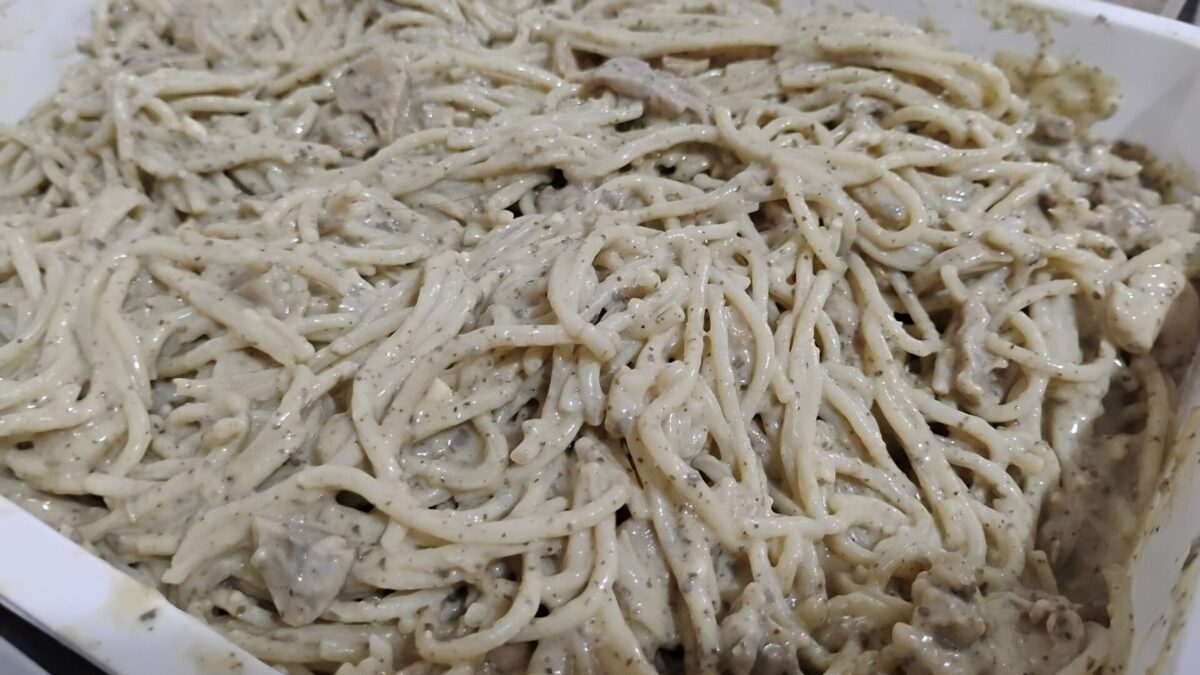
Creamy pesto pasta goes wrong in five predictable ways, and four of them happen in the last ninety seconds. The sauce breaks into oil slicks. The green fades to olive-drab. The sauce pools at the bottom of the bowl instead of coating anything. It tastes of nothing. It feels sandy on the tongue.
I’ve done all five, some of them in the same week. So this runs backwards from the usual order: the failures first, each with the real cause, then the method that avoids them. The recipe is at the bottom and takes about 20 minutes.
Prep: 5 mins Cook: 15 mins Serves: 4
Failure One: The Sauce Breaks Into Oil and Curds
It looks fine for ten seconds, then a slick of green oil separates out and the dairy goes slightly grainy underneath. That’s a broken emulsion, and only two things cause it here.
Cause one: the cream boiled. Double cream at around 48% fat is stable up to a simmer and unhappy above it. Hard boiling drives water off fast, the fat coalesces, the proteins tighten. Keep the pan at a lazy bubble at most, the sort where you see movement at the edges and nothing in the middle.
Cause two, the bigger one: you cooked the pesto. Pesto is roughly half olive oil held in suspension by ground basil, nuts and cheese. Heat it in a pan and that suspension collapses; the oil leaves and floats. The rule I follow without exception now: pesto goes in off the heat. Pan off the burner, count to five, then the pesto. Every time I’ve cheated on that because I was in a hurry, I got the oil slick.
Already split? Off the heat, add two tablespoons of cold pasta water and whisk hard for fifteen seconds. It comes back together roughly three times out of four. The same trick rescues a spaghetti carbonara that’s on the edge of scrambling.
Failure Two: The Green Goes Brown and Dull
Fresh pesto is bright, almost fluorescent. Twenty minutes later it can look like something scraped off a garden path.
Bruising is the first cause. Chopping basil with a dull knife, or running a food processor until the bowl warms up, ruptures the cells and lets an enzyme (polyphenol oxidase, the one that browns a cut apple) get to work. Making your own? Pulse instead of running the motor, and stop while there’s still visible leaf texture.
Heat is the second, and it’s faster. Basil holds its colour maybe a minute in a hot pan.
Two fixes, and you need only one. Either blanch the leaves for 10 seconds in boiling water and drop them into iced water before blending, which kills the enzyme and keeps the sauce green for days. Or never cook the pesto at all, which you’re already doing to dodge failure one. I take the second route on weeknights and only blanch when I’m making a big jar to keep.
Worth knowing: blanched pesto is greener but tastes softer, less peppery. My mother-in-law prefers it. I don’t.
Failure Three: The Sauce Won’t Cling
Did you tip the pasta into a colander, shake it dry, then let it sit for two minutes while you dealt with the pan? That’s the whole problem.
Starch is the first half of it. The cloudy water your pasta cooked in carries dissolved amylose, and a ladleful acts as a binder between fat and dairy. Plain tap water does nothing of the kind, and I’ve tested that side by side out of stubbornness.
Surface moisture is the second. Pasta drained too thoroughly dries at the surface and the starch there sets into a slick skin. Sauce slides straight off it.
So: reserve 250ml of the cooking water before draining, drain for about five seconds only, and move the pasta into the sauce while it’s still dripping. Add the reserved water 60ml at a time and toss hard for a full 30 seconds. Tossing matters more than most recipes admit; that agitation is what turns wet into glossy. The same finish carries noodles tossed in nothing but garlic and butter, where there is no cream to hide behind.
Failure Four: It Tastes Flat and You Can’t Say Why
Almost always the pasta water. Pasta absorbs salt only while it’s boiling. Salt added afterwards sits on the outside and reads as sharp rather than seasoned, and the bowl tastes like cream with a herby edge.
The old line, “salt it until it tastes like the sea,” is wrong and expensive. Seawater runs about 35g per litre. Use 10g of salt per litre, roughly two level teaspoons of fine salt. For 400g of pasta in 4 litres, that’s 40g. It sounds like a lot. Most of it goes down the drain.
The other flatness culprit is missing acid. Pesto, cream and Parmesan are all rounded, savoury, low-acid things stacked on each other. A teaspoon of lemon juice across four servings sharpens the bowl without tasting lemony. Halved cherry tomatoes do a similar job with more texture, which is why they’re in the recipe below. Roasting sharpens them further, the way tomatoes burst over a tray of gnocchi in a hot oven.
Failure Five: A Sandy, Gritty Mouthfeel
Cheese, twice over.
Bagged pre-grated Parmesan is dusted with potato starch or cellulose so it doesn’t clump in the packet. That coating won’t dissolve into a warm sauce; it stays as fine grit. Buy a wedge and grate it on the fine side of a box grater. A 200g wedge lasts me about a month, wrapped in greaseproof paper rather than cling film so it doesn’t sweat.
The other cause is temperature. Parmesan protein tightens and squeezes out its fat in a boiling pan, leaving rubbery specks. Add the cheese with the pan off the heat, same moment as the pesto, and stir until it disappears. Cold kitchen? Warm the serving bowls under the hot tap first. It buys you a minute of working time.
Ingredients
- 400g pasta, penne or fusilli (ridges and spirals hold this sauce better than spaghetti)
- 40g salt for the pasta water, based on 4 litres
- 150g basil pesto, jarred or homemade
- 150ml double cream
- 50g Parmesan, grated from a wedge, plus more to serve
- 1 tbsp olive oil
- 2 garlic cloves, finely sliced
- 150g cherry tomatoes, halved
- 250ml reserved pasta cooking water
- 1 tsp lemon juice
- Black pepper, and salt only at the very end if it needs it
Instructions
- Boil 4 litres of water in your largest pot and add 40g of salt. Add the pasta and cook 1 minute short of the packet time.
- Meanwhile, warm the olive oil in a wide pan over medium heat. Add the garlic and cook 30 to 40 seconds, until it smells sweet and is still pale. Browned garlic turns bitter and there’s no fixing it.
- Add the cherry tomatoes and cook 2 to 3 minutes, pressing a few with the back of a spoon so they release their juice.
- Pour in the cream and bring it to a bare simmer for about 1 minute. No hard boiling. Then take the pan off the heat completely.
- Scoop out 250ml of pasta water. Drain the pasta for about five seconds, no shaking.
- With the pan still off the heat, stir in the pesto and the Parmesan until smooth.
- Add the pasta and 60ml of the reserved water. Toss continuously for 30 seconds, then add more water 60ml at a time until the sauce coats a spoon and slides slowly off it.
- Stir in the lemon juice, grind over plenty of black pepper, and taste before adding any salt. Serve in warmed bowls with extra Parmesan.
One last thing, because it catches people out the next day. Cream sauces set firm in the fridge and a microwave breaks them almost every time, since the fat heats far faster than the rest. Leftovers keep three days sealed. Reheat in a pan on low with 2 to 3 tablespoons of milk per portion, stirring 3 or 4 minutes until it loosens, and it comes back about 80% of the way.
I’ve mostly stopped bothering. Cold pesto pasta with a squeeze of lemon and a handful of rocket is a better lunch than the reheated version and takes no work. For something from the same family that genuinely improves overnight, make creamy chicken alfredo instead; it has the body to survive the fridge.
Alongside, go sharp rather than rich. A caprese salad does the job, though I’ll admit that when there are teenagers at the table I put out cheesy garlic bread too, and nobody has ever objected to cheese on cheese.