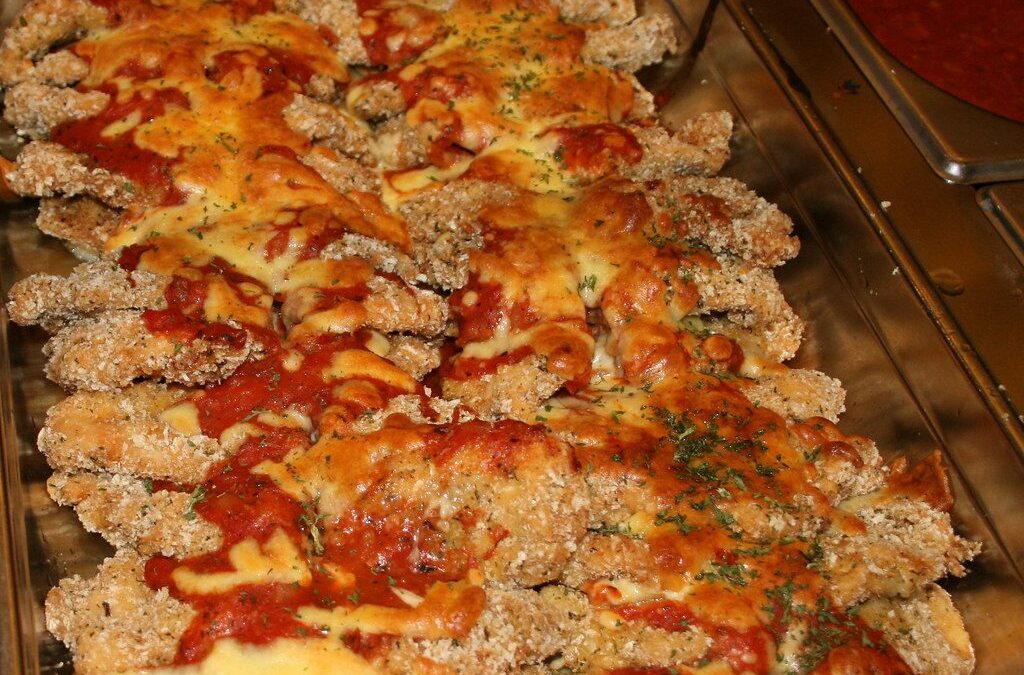
Baked chicken parmesan goes wrong in five predictable ways, and four of them happen before the dish ever sees the oven. Soggy breading, coating that slides off in sheets, chalky chicken, cheese that browns while the middle is still pink, sauce pooling on the plate. Every one has a cause you can point at, and every one has a fix that costs you nothing extra.
I stopped deep-frying cutlets years ago because the oil smell sat in my kitchen curtains for two days afterwards. The baked version took a while to get right. What follows is the order things actually went wrong for me, then the recipe that came out of fixing them.
Prep: 25 mins Cook: 25 mins Serves: 4
The crust goes soft the moment the sauce lands
Marinara is roughly 85% water. Spread it wall to wall over a crisp cutlet and you’ve built a steam room on top of your breadcrumbs. Ten minutes later the crust has the texture of wet bread, which is exactly what it is.
The fix has two halves. First, sauce only the middle third: one heaped tablespoon down the centre, with a clear 2 cm border of bare breading all the way round. You still taste sauce in every bite, because the cheese drags it sideways as you cut. The edges stay audible.
Second, the single biggest lever in the whole recipe: toast the panko dry before you bread anything. Raw panko in a 220°C oven has about 20 minutes to brown, and it’s fighting moisture off the chicken the entire time. Pre-toasted crumbs start the bake already golden and already dehydrated. Dry pan, medium heat, 4 to 5 minutes, stirring throughout, until it’s the colour of a digestive biscuit.
Toast it dry rather than in oil. Oil-toasted crumbs taste good but they clump, and clumped crumbs leave bald patches on the cutlet. I learned that the messy way. The same principle carries over to baked eggplant parmesan, where the vegetable itself gives off far more water than chicken does.
Half the coating peels off and stays on the rack
Three separate causes, and people usually have at least two of them running at once.
No flour layer. Egg doesn’t stick to wet protein, it slides on it. Flour is the grip layer: it absorbs the surface moisture and gives the egg something with texture to hold. Skip it and you’ve essentially painted egg onto a wet surface. Pat the cutlets properly dry with kitchen paper first, then flour, then shake off everything that isn’t clinging.
Wet hands. Use the same hand for the egg dish and the crumb dish and the crumbs glue themselves to your fingers instead of the chicken. By cutlet three you’re wearing a breadcrumb mitten. One hand dry, one hand wet.
No rest. Freshly breaded chicken going straight into a hot oven has a coating that’s still loose. Ten minutes uncovered in the fridge lets the flour hydrate and the egg set into a film that holds the crumbs mechanically. This was the step missing from how I used to do it, and it’s the reason my early attempts shed their crust onto the wire rack.
The chicken comes out dry and slightly stringy
Almost always a thickness problem, not a timing problem. A chicken breast halved horizontally still tapers from about 2.5 cm at the thick end to 8 mm at the tip. By the time the thick end is safe, the thin end has been overcooked for six or seven minutes.
Pound the cutlets to an even 1.5 cm. Not thinner. Under a centimetre and there isn’t enough meat to survive the second bake under the cheese. Put the cutlet in a freezer bag, use the flat side of a heavy pan or a rolling pin, and work from the thick end outward rather than hammering the middle.
Then pull the chicken at 74°C / 165°F at the thickest point, not by the clock. Ovens lie. Mine runs cool on the left side, which I only worked out after buying a cheap probe thermometer, and which explained a year of confusing results. It’s the same instrument that makes chicken cordon bleu reliable, where the filling hides the doneness completely.
Cheese browns dark while the chicken is still underdone
Mozzarella starts colouring at around the 6 minute mark at 220°C. Chicken cutlets need 15 to 18. Put the cheese on at the start and you get a brown lid over raw meat, then you’re stuck choosing between burnt dairy and undercooked chicken.
Cheese goes on for the last 8 to 10 minutes only. Bake the breaded cutlets naked first, pull the tray, add sauce and cheese, return it. The extra 30 seconds of handling is the whole trick.
Should you grill it at the end for colour? I don’t, usually: the grill browns the exposed breadcrumb edges faster than the cheese, and those edges taste burnt rather than toasted. If the cheese is stubbornly pale at 10 minutes, give it 90 seconds with the door cracked and stand there watching.
Sauce pools on the plate and the bottom goes limp
Two culprits. Thin jarred marinara is the common one: a lot of supermarket jars are closer to passata with herbs, and they’ll run the second they warm through. Tip your jar sideways. If it moves like tomato juice rather than sliding in one lump, simmer it in a small pan for 8 to 10 minutes until it holds a line when you drag a spoon through it. That reduction costs you nothing but pan space and it also makes the sauce taste of something.
The second culprit is fresh mozzarella, the sort sold in a ball of brine. Lovely cheese, and it sheds about a tablespoon of liquid per cutlet as it melts. Use low-moisture block mozzarella, grated yourself: pre-grated bags carry potato starch or cellulose as an anti-caking agent, which is why that cheese melts grainy rather than stretchy.
And bake on a wire rack set inside the tray. Straight on the metal, the underside sits in its own steam and turns pale and damp while the top looks perfect. Save the sauce-drenched approach for baked ziti, where soft is the point.
Ingredients
- 2 large boneless, skinless chicken breasts — halved horizontally, then pounded to 1.5 cm
- 1 cup panko breadcrumbs — coarse Japanese-style, not fine dried crumbs
- 1/2 cup grated parmesan — divided, half into the crumbs and half over the cheese
- 1/2 cup plain flour — the grip layer, don’t skip it
- 2 large eggs — beaten with 1 tablespoon water to loosen them
- 1 teaspoon garlic powder
- 1 teaspoon dried oregano
- 1 1/2 cups marinara — thick, or reduced for 8 to 10 minutes first
- 1 1/2 cups low-moisture mozzarella — grated from a block
- 2 tablespoons olive oil — for drizzling the breaded cutlets, not for the crumbs
- Salt and black pepper
- Fresh basil — torn, to finish
Instructions
- Toast the panko dry. Wide pan, no oil, medium heat, 4 to 5 minutes, stirring constantly until evenly light brown. Tip it into a shallow dish immediately or the residual pan heat will take it too far. Stir in half the parmesan, the oregano and a good pinch of salt. Let it cool.
- Even out the chicken. Halve each breast horizontally, then pound each piece to a uniform 1.5 cm inside a freezer bag. Pat both sides dry and season with salt, pepper and the garlic powder.
- Set up three dishes. Flour, then beaten egg, then the toasted crumbs. Keep one hand dry and one hand wet.
- Bread and rest. Flour each cutlet and shake off the excess, dip in egg and let the drips fall, then press firmly into the crumbs on both sides and the edges. Lay them on a wire rack set over a tray and refrigerate, uncovered, for 10 minutes. Heat the oven to 220°C / 425°F now.
- First bake, no cheese. Drizzle or spray the tops lightly with the olive oil. Bake on the rack for 15 minutes.
- Sauce the middle third. One heaped tablespoon of marinara down the centre of each cutlet, leaving a 2 cm bare border. Top with mozzarella and the remaining parmesan, keeping the cheese inside the sauce line.
- Second bake, 8 to 10 minutes, until the cheese is bubbling and the thickest part of the chicken reads 74°C / 165°F.
- Rest 5 minutes on the rack, not on a plate, so the underside doesn’t steam. Tear over the basil.
Worth knowing for tomorrow: leftovers come back to crisp at 190°C for 8 minutes on a rack, nowhere near as sad as the microwave version. Sliced cold into a roll with extra sauce, it makes a better sandwich than it has any right to. Add cheesy garlic bread and nobody asks what’s for pudding.