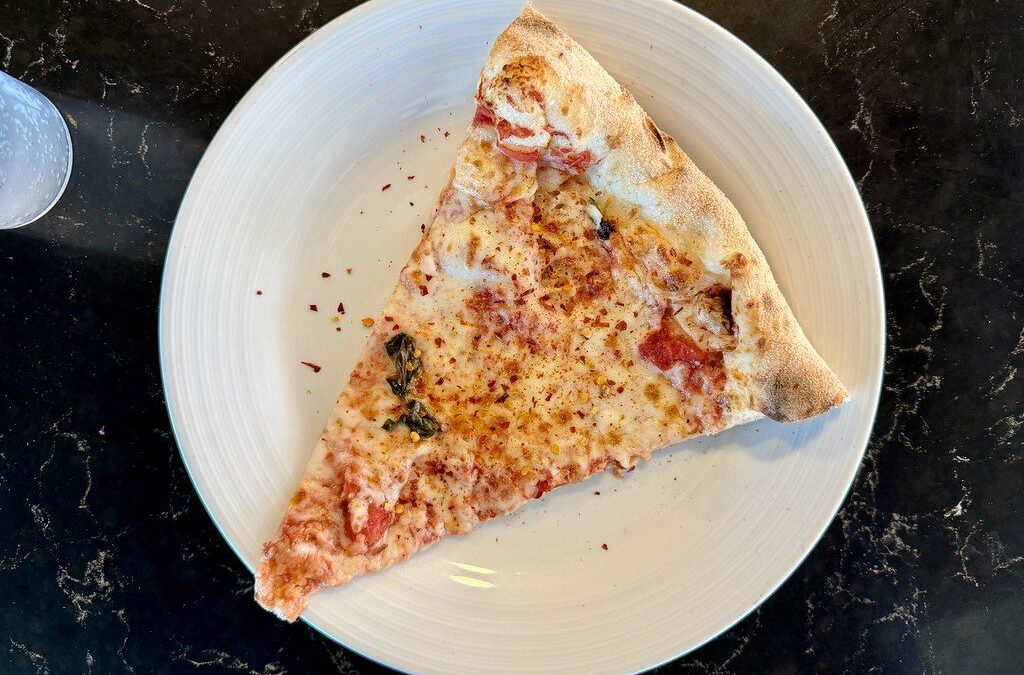
The gap between a home margherita and a pizzeria one isn’t the recipe. It’s about 450 degrees Fahrenheit. A Neapolitan oven runs somewhere around 900F and cooks a pizza in 60 to 90 seconds; your oven tops out at 450 to 550F and needs 8 to 12 minutes. Everything that goes wrong with homemade pizza traces back to that difference.
So before the recipe, here’s what actually goes wrong, in the order it went wrong for me.
Prep: 20 mins Cook: 12 mins Serves: 2
Five Ways Margherita Goes Wrong at Home
Pale, floppy base
Nearly always a cold surface. Slide dough onto a room-temperature sheet and the sheet spends the first four minutes climbing to temperature instead of blasting heat into the crust. By then the top is done and the base never sets.
Fix: put the stone, steel or an upturned heavy baking sheet into the oven before you turn it on, and give it 45 minutes at maximum. Not 15. An oven thermometer will say the air is at 500F long before a 6 mm steel is.
Soggy middle, crisp rim
Too much sauce, or sauce that’s too thin, or both. The centre of the pizza is where liquid ends up and it has 10 minutes to steam its way out through the dough. It won’t.
Fix: 3 to 4 tablespoons of sauce per 10-inch pizza, spread in a thin coat you can still see dough through in places. If your crushed tomatoes are watery, tip them into a sieve for 10 minutes first and use the pulp.
Dough that springs back and won’t stretch
Two causes, often mistaken for each other: cold dough, and gluten that hasn’t relaxed. A ball straight from the fridge has both, and it’ll fight you no matter how hard you push.
Fix: take the dough out 90 minutes before you bake. If it still snaps back, walk away for 15 minutes. It relaxes on its own; fighting it only tightens it.
Cheese pooling water
Fresh mozzarella is stored in brine. Tear a ball open and it’s visibly wet. In a 90-second oven that water flashes off; in a 10-minute oven it sits there and turns the surface into a milky puddle.
Fix: tear the mozzarella an hour ahead, spread it on paper towel, and leave it uncovered in the fridge. You’ll be surprised how much the towel takes up.
Burnt rim, raw centre
This one’s a rack position problem. Too close to the top element and the rim, which is the tallest part, chars while the centre is still setting.
Fix: bake on the upper-middle rack, not the very top, and turn the broiler on only for the last 60 to 90 seconds if you want colour on the cheese. Stand there and watch it.
Your Oven’s Ceiling Decides Everything Else
Find out what your oven actually does. Mine claims 250C on the dial and settles at about 235C with a thermometer inside, which is roughly 455F. That number changes the whole approach.
At 500F and above with a properly heated steel, you can bake a thin, wet-ish dough in 7 to 9 minutes and get char. At 450F you can’t, and pushing for char just dries the crust out. What works at the lower end is a slightly thicker base, a touch more olive oil in the dough for tenderness, and accepting golden rather than blackened spots.
Stone, Steel, or an Upturned Tray
Ranked by how much they help, in my kitchen: a 6 mm baking steel, then a thick stone, then a cast-iron pan preheated upside down, then an inverted heavy baking sheet. Steel conducts heat into the dough far faster than stone, which is why it partly compensates for a cooler oven. A thin flimsy tray does almost nothing.
Does the pizza have to go directly onto the hot surface? No. Parchment underneath costs a little crispness and saves you the launch disaster. For the first several attempts that trade is worth it, and I still use it when I’ve had a glass of wine.
Ingredients
- 2 1/2 cups bread flour (about 320g) — higher protein, chewier crust
- 3/4 cup plus 1 tablespoon warm water (about 205g), around 105F
- 1 teaspoon instant yeast — no proofing needed
- 1 teaspoon sugar — feeds the yeast, helps browning
- 1 teaspoon fine salt
- 2 tablespoons olive oil, plus more for drizzling
- 1 cup canned San Marzano tomatoes, crushed by hand
- 1 clove garlic, grated
- 8 oz fresh mozzarella, torn and dried on paper towel
- Fresh basil leaves, a generous handful
- Flaky salt to finish
- Semolina or cornmeal for dusting
Instructions
- Mix the dough. Whisk the flour, yeast, sugar and salt in a large bowl. Add the water and olive oil and stir to a shaggy mass. Knead on a lightly floured surface for 8 minutes until it’s smooth and springs back slowly when poked, or 5 minutes in a stand mixer with the dough hook.
- First rise. Oil a bowl, drop the dough in, cover, and leave 1 to 1 1/2 hours at room temperature until doubled. An overnight rise in the fridge tastes better; pull it out 90 minutes before shaping.
- Preheat properly. Set your stone or steel on the upper-middle rack, turn the oven to maximum, and leave it 45 minutes. Do this before you touch the dough again.
- Sauce. Crush the tomatoes by hand, stir in the grated garlic, a good pinch of salt and a drizzle of oil. No cooking. If it looks loose, sieve it for 10 minutes.
- Shape. Halve the dough. Press one piece from the centre outward with your fingertips, leaving the outer inch untouched for the rim, then lift it and let gravity stretch it over your knuckles. Aim for 10 to 12 inches. No rolling pin, which crushes the air out of the rim.
- Top lightly. Move the round onto a semolina-dusted peel or a sheet of parchment. Spread 3 to 4 tablespoons of sauce, leaving a 3/4-inch border, then dot with the dried mozzarella. Restraint here is the whole trick.
- Bake. Slide it onto the hot surface and bake 8 to 12 minutes, until the rim is puffed with dark blistered spots and the cheese is bubbling. Check the underside with a spatula at 8 minutes.
- Finish. Out of the oven, scatter the basil, drizzle olive oil, add flaky salt. Wait one minute before slicing so the cheese sets enough to stay put. Then eat it standing up, which is how the first slice always gets eaten in my house.
Where the Water Comes From
Three sources, and they add up: the tomatoes, the mozzarella, and the dough itself.
Tomato is the easiest to control and the one people ignore. Tinned San Marzanos sit in juice thinner than the fruit, so crush them by hand and leave most of that juice behind in the tin. You want pulp with structure, not passata.
Dough hydration matters more than it looks. I’ve settled this recipe at about 64 percent (205g water to 320g flour). An earlier version called for a full cup of water against the same flour, which pushes past 75 percent, and dough that wet needs a very hot oven to set fast; in a domestic oven it stays gummy in the middle and it’s genuinely hard to hand-stretch. Lower hydration is the forgiving choice at 450 to 500F.
And basil goes on after baking, never before. Ten minutes at 500F turns it black and bitter. I learned that on a pizza I’d otherwise got right.
A Single-Slice Test Before You Commit
Never used this oven for pizza and cooking for guests? Stretch a palm-sized piece of dough, smear it with oil, nothing else, and bake it on the hot surface. Two or three minutes tells you how fast your base colours. Still white at three minutes means your surface isn’t hot enough, and no amount of clever topping will save the real one.
Dough freezes well after the first rise: portion into balls, oil them, bag them for up to two months, thaw overnight in the fridge. That’s how pizza became a Thursday thing here rather than an event.
If tonight isn’t a dough night, the same tomato-mozzarella-basil trio does honest work on grilled bruschetta or a plate of caprese salad. For something pizza-shaped with no proving at all, two-ingredient yogurt flatbread bases take ten minutes, though you give up the chew. Once the base behaves, the sensible next build is pepperoni, which brings its own fat and needs even less cheese, and the preheat lessons carry straight over to rosemary focaccia.