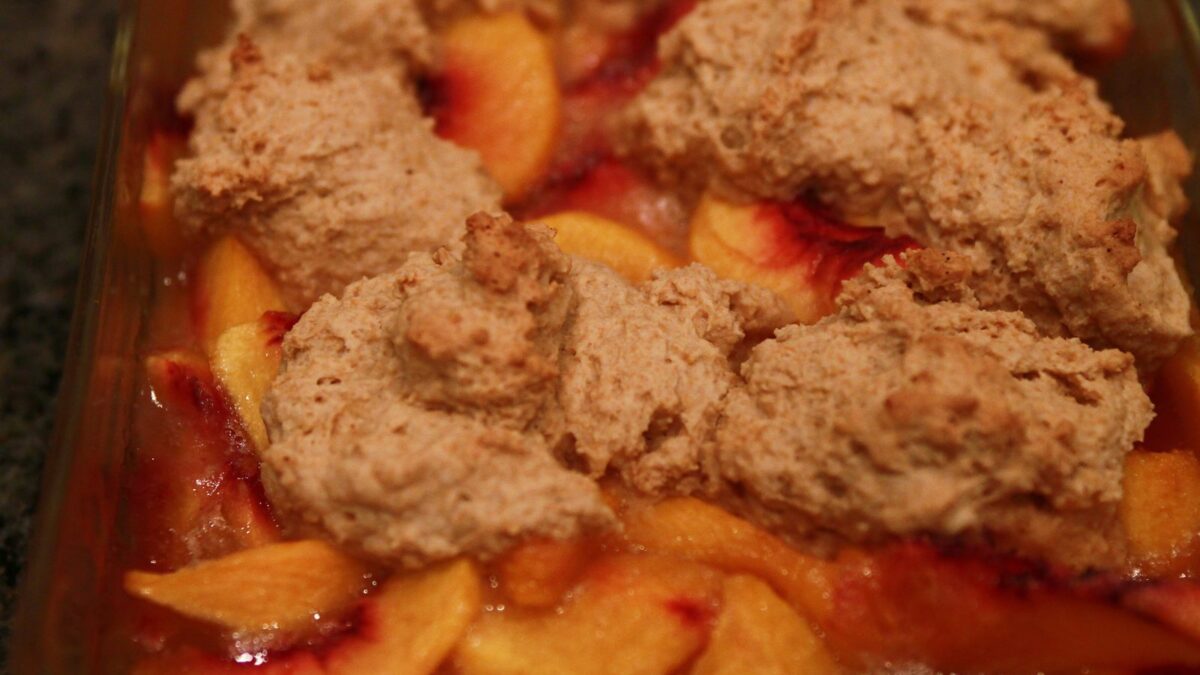
Peach cobbler fails in exactly two ways: watery underneath, or pale and doughy on top. Both are fixable before the dish goes in the oven, and both come down to decisions you make about the fruit and the topping rather than anything that happens during the 40 minutes of baking.
This is the long version — which peaches to buy in which month, how much thickener for how much juice, the real difference between a poured batter and a dropped biscuit, and what changes if your dish is 8 by 8 instead of 9 by 13. The recipe itself is a brown sugar batter cobbler baked at 375F, and it’s below in full.
Fresh, Tinned, or Frozen: Which Peaches to Buy When
Fresh is only better when fresh is actually ripe. A rock-hard supermarket peach in April makes a worse cobbler than a tin, and I say that as someone who spent years insisting otherwise.
Fresh peaches are worth it from roughly July through early September, and the test is smell, not colour. Hold one at the stem end near your nose. If it smells of peach across the room, it’ll cook down sweet. If it smells of nothing, it’ll taste of nothing after 45 minutes in the oven too — heat concentrates what’s there, it doesn’t invent flavour. Free-stone varieties come away from the pit cleanly and are worth asking for by name at a market stall; cling-stone fights you for every slice.
Tinned peaches in juice, not syrup, are a genuinely good cobbler. Drain them properly — two 29-ounce tins gives you close to the 6 cups this recipe wants — and cut the sugar in the fruit from 1/2 cup to about 1/3 cup, because tinned fruit arrives pre-sweetened. Skip the 10-minute macerating step entirely; they’ve already given up all the juice they have.
Frozen peaches are my winter default, and the trick is to never let them meet the batter in either extreme state. Thawed slices go limp and flood the dish; frozen-solid slices chill the batter and leave a raw seam. Tip them into the saucepan straight from the freezer for the cook-down in step 3, add an extra teaspoon of cornstarch, and bring them to a simmer first.
Peeling Peaches Without Losing Half the Fruit
A vegetable peeler on a ripe peach takes the skin, a good layer of flesh, and most of your patience.
Score a shallow X in the base of each peach, drop them into boiling water for 40 seconds, then straight into a bowl of iced water. The skins slip off in sheets. Eight medium peaches take about four minutes this way, most of which is waiting for the water to boil.
Should you peel at all? For a cobbler, yes. Peach skin doesn’t dissolve the way apple skin does in a crumble — it curls into little red-brown strips that catch on the spoon. In a pie or a crumble I’d let it go, but the loose, saucy texture of a cobbler makes the strips obvious.
Thickeners: How Much, and Which One
Six cups of peaches carry somewhere near a cup of liquid once heated. Thickener turns that into sauce instead of a puddle.
| Thickener | Amount for 6 cups fruit | What it gives you |
|---|---|---|
| Cornstarch | 1 tbsp (1.5 tbsp for frozen) | Glossy, clear, sets as it cools. My default. |
| All-purpose flour | 3 tbsp | Cloudy and slightly matte. Forgiving, hard to overdo. |
| Tapioca starch | 2 tbsp | Clearest of the three, stays soft even cold. Good for making ahead. |
| Nothing | — | A juicy, spoonable cobbler. Fine over ice cream, poor on a plate. |
The rule of thumb is roughly 1 tablespoon of cornstarch per 6 cups of fruit for a sauce that coats a spoon, and 1 and 1/2 if your peaches are very ripe and running. Doubling it doesn’t make a better cobbler — cornstarch past about 2 tablespoons here goes slick and faintly chalky on the tongue.
Cornstarch also has a ceiling. It thickens hard around 95C and then starts breaking down again if you hold it there, which is one reason the pre-cook in the saucepan is short — five minutes over medium heat, just until the liquid turns glossy, and off.
Batter Topping Against Biscuit Topping
These are two different desserts sharing a name, and choosing badly is why some cobblers disappoint people who were expecting the other kind.
A batter topping — what this recipe uses — is pourable, closer to a thick pancake batter, and bakes into a soft cake-like layer with crisp edges. It sinks slightly into the fruit at the boundary and gives a sweet, tender roof. It’s forgiving: no rubbing in butter, no risk of over-handling.
A biscuit topping is a scone dough dropped in rough spoonfuls — cold butter cut into flour, minimal liquid, craggy tops that go golden and crunchy while the underside steams soft in the fruit. Better contrast, more to go wrong. For that version, make the dough from my buttermilk biscuits at two-thirds quantity, drop it in eight mounds over the hot fruit, and bake at 400F for 30 to 35 minutes.
Then there’s the Southern poured-batter method: melted butter in the dish, batter over it, fruit spooned on last so it sinks. Spectacular crust, much sweeter result. Too sweet for me, but it’s the version plenty of people grew up with and I’d never argue someone out of it.
Dish Size Changes More Than You’d Think
Depth drives everything. A 9 by 13-inch dish spreads 6 cups of peaches about an inch and a half deep, and the 40 to 45 minute bake at 375F is written for that.
The same quantity in an 8 by 8 sits nearly three inches deep. The topping browns on schedule while the fruit underneath is still cool, and the batter directly over the fruit stays raw. If that’s the dish you own, either halve the recipe or add 15 minutes and tent with foil once the top is golden, around the 35-minute mark.
Deep cast iron works well and holds heat long after it leaves the oven — allow a few extra minutes of resting time, and expect the edges to caramelise more than in glass or ceramic. Fill any dish no more than two-thirds up the side. The fruit bubbles up hard around minute 30, and I have cleaned enough peach syrup off an oven floor to now put a baking sheet on the rack below every time.
Ingredients
- 6 cups sliced peaches, from about 8 medium fresh peaches, peeled
- 1/2 cup granulated sugar, for the fruit
- 1 tablespoon lemon juice
- 1 tablespoon cornstarch
- 1 teaspoon ground cinnamon, divided
- 1 1/2 cups all-purpose flour
- 3/4 cup granulated sugar, for the topping
- 1/2 cup light brown sugar, packed
- 2 teaspoons baking powder
- 1/2 teaspoon salt
- 3/4 cup whole milk
- 1/2 cup unsalted butter, melted, plus more for the dish
- 1 teaspoon vanilla extract
- Coarse sugar, for sprinkling (optional)
Instructions
- Heat the oven to 375F and butter a 9 by 13-inch dish generously, sides included. Set a baking sheet on the rack below.
- Toss the peaches with the 1/2 cup sugar, lemon juice, cornstarch, and half a teaspoon of the cinnamon. Leave 10 minutes so the fruit releases its juice.
- Tip the peaches and juices into a saucepan and warm over medium heat about 5 minutes, stirring gently, until the liquid turns glossy and coats the back of a spoon. Take it off the heat.
- Whisk the flour, both sugars, baking powder, salt, and the remaining half teaspoon of cinnamon. Pour in the milk, melted butter, and vanilla and stir just until combined into a thick, pourable batter. Stop while a few lumps remain.
- Spread the warm peaches evenly in the dish. Spoon the batter over in dollops, leaving gaps so the fruit can bubble through.
- Sprinkle coarse sugar over the top if you want a crackly finish.
- Bake 40 to 45 minutes, until the topping is deep golden and the juices bubble thickly at the edges rather than running thin.
- Rest at least 20 minutes before serving so the filling firms up.
Reading Doneness Without Guessing
Colour alone lies. The top of a cobbler goes golden well before the batter over the fruit has set, because it’s the only part in dry heat.
Three checks, in order. The bubbling: at 375F the juices should come up at the edges in slow, thick blurps, not thin fast ones — thin bubbles mean the starch hasn’t finished working. A skewer into the thickest part of the topping, not through to the fruit, should come out with crumbs and no wet batter. And a fingertip press in the middle: done batter springs back, underdone stays dented.
If the top is dark at 30 minutes and the middle still loose, lay foil over loosely and keep going. Pulling it early is the commoner mistake, and the one you can’t fix on the plate.
Making It Ahead, and What Survives the Fridge
Cobbler is at its best somewhere between 40 minutes and 3 hours out of the oven, which makes it awkward for dinner parties. Here’s what actually works.
Cook the fruit through step 3 up to two days ahead and keep it covered in the fridge. Warm it in the saucepan before it meets the batter — cold fruit adds around 10 minutes to the bake and skews the timings above. Mix the dry topping ingredients ahead too, but keep the milk and butter out until the moment you bake; baking powder starts working the instant it gets wet, and a batter that sat an hour rises noticeably less.
A baked cobbler keeps three days covered in the fridge. Reheat portions at 325F for 15 minutes, uncovered, which brings back some crispness. The microwave works but turns the topping soft and slightly gluey. Freezing baked cobbler is not worth it — the fruit weeps on thawing and the topping never recovers.
Where Peach Cobbler Usually Goes Wrong
Watery filling, nearly always, means the pre-cook was skipped or the peaches were tinned in syrup and went in undrained. Do step 3 even when you’re in a hurry; five minutes there saves the whole dish.
Tough, bready topping means the batter was over-stirred. Twelve or fifteen strokes with a spoon is enough. It should still look slightly lumpy going into the dish.
A raw seam where the batter meets the fruit is a temperature problem: cold fruit under cold batter, or a dish too deep for the recipe. Warm fruit fixes it.
And if the whole thing tastes flat despite being sweet, it’s the lemon juice you left out. A tablespoon in 6 cups of fruit isn’t there for tartness you can taste — it’s there so the peach flavour has an edge to stand against. Same reason a pinch of salt goes in the topping.
Questions I Get About Cobbler
Can I use a mix of fruit?
Yes, and peaches with blackberries or raspberries is the pairing I’d pick — swap out about 1 and 1/2 cups of the peaches for berries. Berries carry more water and less pectin, so nudge the cornstarch up to 1 and 1/2 tablespoons. Peaches with plums also works. Peaches with apples doesn’t; apples want twice the cooking time and stay crunchy while the peaches disintegrate around them. Apples belong in a crumble instead.
What’s the difference between cobbler, crumble, and crisp?
Cobbler has a batter or biscuit topping that bakes into a soft layer. Crumble has a rubbed mixture of flour, butter, and sugar that stays sandy. Crisp is a crumble with oats or nuts in it for crunch. Same fruit, three different roofs.
Can I halve the sugar?
In the fruit, yes — down to 1/4 cup with ripe August peaches and nothing bad happens. In the topping, no. The 3/4 cup granulated and 1/2 cup brown are doing structural work as well as sweetening, and cutting them gives a pale, dry topping. If you want it less sweet overall, cut the fruit sugar and skip the coarse sugar sprinkle.
Why is my cobbler sandy on the bottom?
Cornstarch that went in dry and clumped rather than dissolving. Toss it with the sugar first so the grains separate, then add it to the fruit.
What do I serve with it?
Vanilla ice cream, obviously, and cold cream is arguably better because it doesn’t melt into the juices. For a summer table where cobbler is one of two puddings, strawberry shortcake sits alongside it well. And leftover cobbler at breakfast, cold, with coffee and a blueberry scone on the same plate, is one of the better arguments for making the 9 by 13.