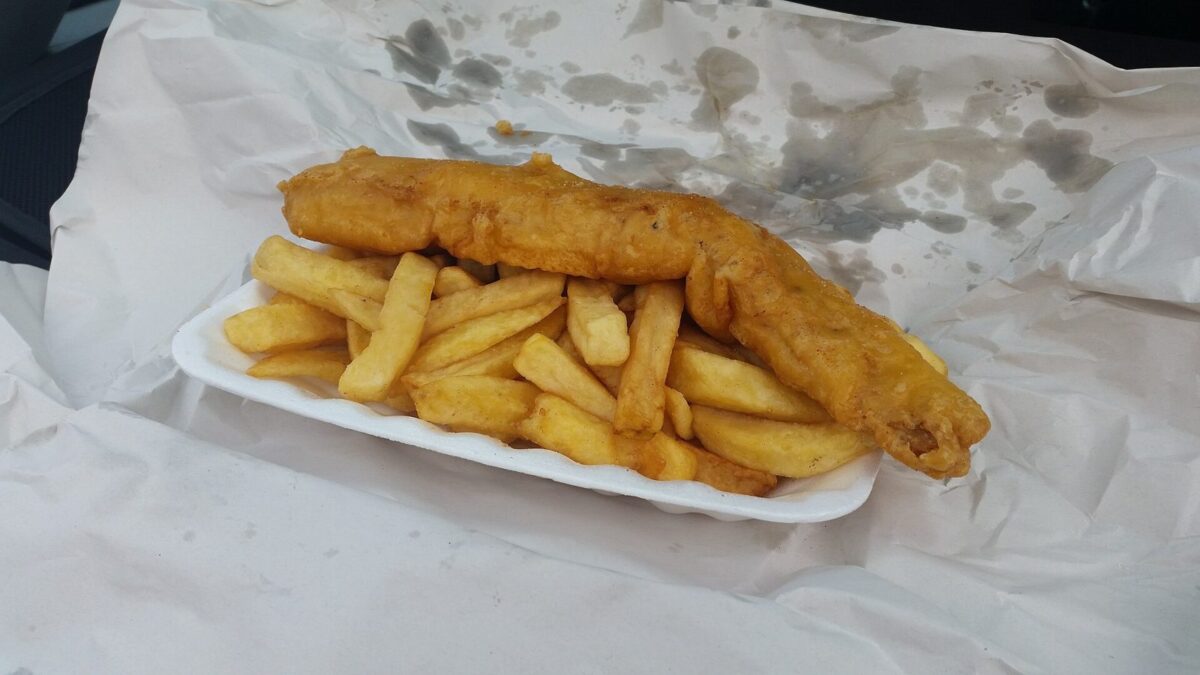
The batter is the whole thing. Get it right and everything else about fish and chips is straightforward; get it wrong and it doesn’t matter how good the cod was, because you’ve made a fillet in a soggy jacket.
So this starts with the batter and works outward. The short version: cold, fizzy, and about a third cornflour.
Cold liquid, and why the fizz matters
Two separate things are happening when you use fridge-cold beer or sparkling water rather than tap water.
The cold slows gluten development. Flour plus liquid plus time and warmth makes stretchy gluten, and stretchy is exactly what you don’t want in a coating — stretchy sets into something chewy and bready. A batter mixed at 4°C and used within five minutes barely gets started on gluten at all.
The bubbles do the second job. Dissolved CO₂ comes out of solution the instant the batter hits 185°C oil, and it does so from inside the coating, blowing it into a lace of tiny voids rather than a solid shell. That’s the structure that shatters when you bite it. Flat beer works far less well, and I have tested this on a bottle left open overnight — same recipe, noticeably denser and heavier crust.
Beer or sparkling water? Beer adds a faint malt flavour and browns a shade quicker because of the residual sugars. Sparkling water is cleaner-tasting and slightly crisper. I use a cheap lager most of the time and honestly can’t tell them apart once the malt vinegar is on.
The cornflour proportion
This is where most home batters fall down. Plain flour alone contains 9-11% protein, and protein means gluten, and gluten means chew. Cornflour has effectively none.
The ratio here is 125g plain flour to 60g cornflour — a shade under a third of the total by weight. Push it further, to half and half, and the crust turns brittle in a glassy way and starts sliding off the fish in sheets. Drop the cornflour entirely and you get a batter that tastes like a thin pancake.
The teaspoon of baking powder is doing a different job again: it’s insurance. If your beer has gone slightly flat or the batter sits for two minutes longer than planned, the baking powder still generates lift the moment it hits the heat.
Mixing it, and when
Whisk the dry ingredients together first, then pour in the cold liquid and stop whisking the second it comes together. Lumps the size of a peppercorn are fine and will disappear in the fryer. A perfectly smooth batter is an over-mixed batter.
Mix it after the oil is already at temperature, not before. Batter that stands for twenty minutes on the counter warms up and slackens, and you lose both advantages you built in.
Oil at 185°C, not hotter
Fish goes in at 185°C / 365°F. This is lower than most people run their fryer, and it’s deliberate.
A 170g cod fillet needs 5 to 7 minutes to reach a safe core temperature. At 200°C the batter is mahogany and starting to burn at four minutes, with the centre of the fillet still translucent. At 185°C the browning rate and the cooking rate finally line up — the crust arrives golden at roughly the same moment the fish is done.
Get a thermometer. A clip-on probe costs less than the fish does and it’s the single piece of kit that changed my frying most. Judging oil by dropping in a cube of bread tells you roughly nothing within a 30-degree band, and 30 degrees is the entire margin here.
Fry two fillets at a time in a pot with at least 8cm of oil and 8cm of clear space above it. Four fillets at once will drag a domestic hob’s oil down by 25-30°C, and cold oil is absorbed oil — that’s the greasy batter people blame on the recipe.
Which potato, and why it matters more than the cut
Floury, high-starch, low-moisture. Maris Piper in the UK, Russet in the US, King Edward if you can get them. Waxy potatoes — Charlotte, new potatoes, most red-skinned ones — hold their moisture and go leathery outside while staying dense in the middle.
Cut them about 1.5cm square, roughly the width of an index finger. Then rinse them in cold water until the water stops going cloudy, which takes two or three changes, and dry them properly. Surface starch is what makes chips glue together in the basket and go patchy-dark.
Drying is not optional. I spread them on a tea towel and leave them ten minutes while the oil heats. Wet potatoes hitting 130°C oil spit hard enough to be genuinely worth avoiding.
Two fries, two temperatures
The double-cook exists because a chip needs two different things done to it and they need two different temperatures.
First fry, 130°C / 265°F, 8 to 10 minutes. This is a poach in oil. You’re cooking the interior to fluffy and driving moisture out of the outer few millimetres, and 130°C is low enough that nothing browns. The chips come out pale, floppy and unappetising. That’s correct.
Second fry, 190°C / 375°F, 3 to 4 minutes. Now you’re only crisping a surface that’s already dehydrated, so it happens fast and evenly.
Skip the first fry and go straight in at 190°C and you get a chip that’s dark outside and raw at the core. Do both at 160°C and you get an even, mediocre chip with no contrast.
If you can, let the blanched chips cool completely — 30 minutes on a rack, or an hour in the fridge — before the second fry. The temperature gap between chip and oil is part of what makes the crust set sharply. This is also the only make-ahead step in the recipe worth doing.
Drying the fish
Pat the fillets dry, then dry them again. Then dust them with a thin film of plain flour and shake off everything that isn’t clinging.
Wet fish makes batter slide. What happens is that the moisture turns to steam under the coating and lifts it off in one piece, and you pull a naked fillet out of a floating shell of batter. The flour dusting gives the batter something to grip.
Frozen fillets need thawing overnight in the fridge and then a hard press between paper towels. They release a lot of water. Fresh cod is easier, but frozen-at-sea cod is often the better fish.
Ingredients
- 4 white fish fillets — cod or haddock, about 170g / 6 oz each, skinless and boneless.
- 700g / 1½ lb floury potatoes — Maris Piper or Russet.
- 125g / 1 cup plain flour — plus 2 tablespoons extra for dusting.
- 60g / ½ cup cornflour (cornstarch)
- 1 tsp baking powder
- 240ml / 1 cup cold lager or sparkling water — straight from the fridge, 4°C or colder.
- 1 tsp salt — plus flaky salt for finishing.
- Neutral oil for frying — sunflower, rapeseed or vegetable, enough for 8cm depth.
- Lemon wedges and malt vinegar — to serve.
Instructions
- Peel and cut the potatoes into 1.5cm chips. Rinse in cold water until it runs clear, then spread on a towel and dry thoroughly.
- Heat the oil to 130°C / 265°F. Blanch the chips in two batches for 8 to 10 minutes each, until a chip crushes easily against the side of the pot but hasn’t coloured. Lift onto a wire rack and cool for at least 30 minutes.
- Pat the fish very dry, dust lightly with flour, and shake off the excess. Leave it on a rack while the oil comes up.
- Raise the oil to 185°C / 365°F. Only now, whisk the flour, cornflour, baking powder and salt together and pour in the cold beer. Whisk just until combined — the consistency of double cream, small lumps and all.
- Dip one fillet, let the excess run off for two seconds, and lower it into the oil away from you, releasing it once the batter has set for a moment so it doesn’t stick to the base. Fry two at a time for 5 to 7 minutes, turning once, until deep gold.
- Check the thickest part with a probe: 63°C / 145°F, and the flesh should part into opaque flakes. Drain on a wire rack, never on paper alone, and hold in a 90°C oven with the door slightly ajar.
- Bring the oil up to 190°C / 375°F. Fry the cooled chips in two batches for 3 to 4 minutes until golden and rigid.
- Salt the chips the second they leave the oil, while the surface is still oily enough to hold it. Serve immediately with lemon and malt vinegar.
Reading the fish at 63°C
Cod and haddock are done at 63°C / 145°F in the thickest part. Past 70°C the muscle fibres contract hard enough to squeeze out moisture, and the flakes go from silky to cottony — the difference between good chip-shop cod and the sad kind. The same 63°C ceiling governs cod baked under a herb crust, where overshooting shows up as a crust that slides off wet fish.
Without a probe, push a knife tip into the thickest point and hold it there for three seconds, then touch it to your lip. Warm, not hot, means underdone. Uncomfortably hot means you’ve gone past. It’s cruder than a thermometer but it’s better than guessing from the outside.
The oil, afterwards
Let it cool completely, then strain it through a coffee filter or a double layer of muslin into a clean jar. Frying oil for fish is good for two or three more sessions of fish, and it does pick up flavour, so I keep that jar separate from the one I use for chips and doughnuts.
It’s finished when it foams on heating, smells fishy from cold, or has gone noticeably darker and more viscous. Then it goes out with the household waste solidified in a sealed container, not down the sink.
For the plate itself, a sharp creamy coleslaw cuts the fat better than a salad does, and mushy peas are the traditional partner if you want the full chip-shop set. If you liked the batter logic here, Southern fried catfish takes the opposite route with a cornmeal crust and is worth trying back-to-back. For a night when you don’t want to fry at all, baked salmon with lemon gets you fish on the table in 20 minutes. And the double-cook principle transfers directly to crispy hash browns, where par-cooking the potato first is the same fix for the same problem.